




Long-Life Trailer Specs
Everything has a life span, but some of the things we make die sooner than they used to. For trailers, shortened lives usually can be blamed on corrosio

Everything has a life span, but some of the things we make die sooner than they used to. For trailers, shortened lives usually can be blamed on corrosion
caused by aggressive anti-icing chemicals spread on road pavements. But abuse by those who work around them is also a factor.
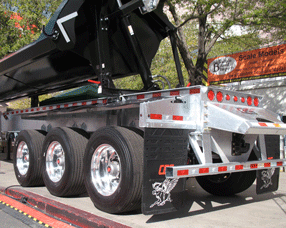
Trailer manufacturers occasionally tout long-life packages. Last March at the Mid-America Trucking Show, Dorsey talked about a 10-year warranty for its Lifeguard 5000 refrigerated van. Vanguard's vans use only galvanized steel in key areas, including landing gear, rear door frames and underride guards. At the ConExpo construction show, several builders showed trailers whose underside components were of galvanized steel. Manac offers a package of galvanized components on dump and flatbed trailers for about $800 - cheap insurance against corrosion.
Corrosion damage has become a major subject of discussion at meetings of the American Trucking Associations' Technology & Maintenance Council. Out of the resulting sessions come advice for coping with it. In short, vehicles can be built with special materials and treatments to resist corrosion, and to stand up to misuse by careless workers. But fleets can't afford to buy all of them.
However, there are reasonably priced options that add years of life to any trailer. Some items have to be fought for as part of the ordering process. Thoughtful analysis of the equipment problems that come from any hauling operation show what deteriorates and breaks, and the specifications for the next batch of vehicles can be created accordingly. We talked to two TMC regulars about what they're doing to their trailers to make them live longer.
"First, we use all LED lights and sealed wiring harnesses," said Roy Gambrell, current general chairman of TMC and director of maintenance for Truck It, a small fleet in Cottontown, Tenn. "And the harnesses are in sections. That way if one part gets damaged, you can replace it in sections rather than try to replace the whole harness.
"Once corrosion gets into the harness, I'll guarantee that in less than 90 days after you've repaired it you'll have it in [the shop] again. Electricity has a wicking effect on copper that draws corrosion in. If we used silver that wouldn't be a problem, but we can't afford that."
Truck It's steel flatbeds tend to haul heavy loads, such as large generator sets and locomotive diesels. He believes aluminum wouldn't hold up. Because steel corrodes easily, he specs specially treated parts where possible. For example, the upper coupler is dipped in an undercoating substance before assembly.
At Gambrell's direction, Fontaine, which built his last group of trailers, installed galvanized steel crossmembers instead of painted steel. Gladhands were zinc-coated during the casting process. Main rails and certain other steel parts got a zinc chromate coating before priming and painting.
"If they're damaged, you can sand into this and then repaint," he said of the zinc chromate. And though he believes in hot-dip galvanizing and would order the trailer's entire rear end in galvanized steel, Gambrell notes that sanding and welding can damage its zinc layer and render it open to rusting.
Some trailer builders are not set up to include certain anti-corrosion processes, or prefer to use methods that the buyer might not agree with. "You have to push for it," he said, "and as small as we are now (down to five trailers and three tractors since the recession), I'd probably have to attach our order onto someone else's to get what we want."
This tactic works well if a fleet manager is in touch with others in the trucking community, like Gambrell is through TMC. Sometimes the trailer manufacturer will tell the manager about another order that's similar to what he wants, and be willing to consolidate the two.
Service life and cost are of course related. "Before all these corrosion elements came in, we could run them 15 years," he said. "Now, they'll go only three years unless you do something. The difference is $1,800 per trailer versus a plain Jane trailer for $20,000 or $21,000, and you'll probably get four to five years extra life out of it, or 10 years total."
Dry freight carrier PAM Transport, Tontitown, Ark., had its van trailers on a 10-year trade cycle, but Carl Tapp, who recently retired as vice president, maintenance, has been pushing that to 15 years.
"We can't buy trailers all the time because we have a serviceable trailer that we spec'd right, and maintained well, and now, after 10 years, it should be worth more than $1,000 as a storage trailer," Tapp explained. "And trailers have gone from $14,000 10 years ago to $26,000 now. So when we order something, we need to be sure that it will hold up much longer."
Tapp shared some of the build specs for a group of 53-by-102.3 vans from Hyundai Translead, whose sales and engineering people are "very accommodating" and will build in things other manufacturers cannot or will not do, he said. The long-life items on the list combat abuse and normal wear as well as corrosion. He didn't have cost figures, but said careful spec'ing doesn't add a lot of money but does add life:
* Phillips nose box for the 7-way electrical connector, with 20-amp circuit breakers and threaded studs for ring terminals on the wiring harness to secure wiring connections. "When going down the road, the connections can vibrate loose, but won't if you use studs and nuts instead of push-on connectors."
* Oak hardwood, 1-3/8-inch dimensional (actual) instead of nominal, from Havco. "It's got the best warranty, and is pretty much a lifetime floor."
* Rear impact guard assembled with cadmium-plated bolts and built to the stronger Canadian spec. This is standard on all Hyundai trailers but has to be requested from other builders, Tapp said. An extra K-brace in the center strengthens the guard if it's not released by a dock lock and the trailer is moved forward.
* Roof panels of aluminum (instead of plastic, which tend to crack). "In monocoque construction, the roof is a big part of the trailer's strength."
* Side liners of full-height recycled plastic panels (rather than plywood). "They don't snag the freight, stay clean, and we're helping the environment using recycled material," Tapp said. "They're easy to replace, but we've rarely had to replace one, unless the trailer had been wrecked."
* Side scuff liner of laminated hardwood ("It lasts better than anything"), 12 inches high along the floor, to bear up against moving pallets.
* Forward scuff liner of 7-gauge steel, 12 inches high, welded to the upper coupler, to withstand forklift battering.
* SAF Holland landing gear with greaseless gearing, which has a 10-year warranty.
* Stemco Platinum Performance Plus wheel-end package for durability.
* Meritor Tire Inflation System by P.S.I. to extend the lives of tires.
* Truck-Lite LED lamps ("LEDs last a long time and don't draw much current") and Truck-Lite harness ("Get the lights and harness from the same manufacturer and there's extra warranty"). Lights have lock rings and stainless steel rivets to prevent theft. "Try to drill a stainless steel rivet out," Tapp chuckled.
* Meritor Q+ brakes. "They have a wider, longer-life shoe."
* License plate mounted inside a rear wing-plate bracket so it can't be hit, with a white LED license-plate light. The white LED is a recent addition to Truck-Lite's fixtures, and is a bright way to end the list.
Read more on trailers each week from Senior Editor Tom Berg in his Trailer Talk blog at www.truckinginfo.com/trailer-talk.
From the November 2011 issue of HDT.
More Maintenance

Color Match Smarter: Tools That Restore & Perform
For fleet managers and collision repair professionals keeping heavy-duty trucks on the road, getting the color right the first time isn't just about appearance — it's about efficiency, turnaround time, and bottom-line results. Discover how today's digital color tools are transforming the repair process from guesswork to precision.
Read More →
Wrong Repair Prompts Recall of Freightliner, Western Star 4x2 Trucks
DTNA is recalling more than 2,400 trucks that received an incompatible software fix instead of the hardware repair required to address brake valve corrosion.
Read More →
Truck Drivers Need More Than Another Alert
Fleets have more visibility into truck health, safety events, and driver activity than ever. The next challenge is turning all that information into useful guidance for the person who has to decide what to do next.
Read More →
The Maintenance Checks Trucking Fleets Should Prioritize Before Fall Freight Picks Up
Making it through August isn’t the same as being ready for the next several months of operation. Find out what systems may have suffered from summer heat and need to be checked out before fall.
Read More →
What Three Fleets Are Doing Differently When Buying Truck Parts in 2026
With freight improving but costs still climbing, fleet maintenance executives explain how they're balancing price, quality, and supplier relationships.
Read More →
Paccar Recalls 2027 Trucks Built This Summer for Possible Electrical Problem
The nearly 6,000 Kenworth and Peterbilt trucks in the recall could potentially lose engine power, among other things.
Read More →
Will API PC-12 Oil Change Trucking Fleet Maintenance?
The new API PC-12 heavy-duty engine oil category reflects the changing demands of modern diesel engines. But fleets like Foodliner are looking to getting their own data before making decisions on adopting the new oils and questions such as extending oil drain intervals.
Read More →
Brake Safety Week to Focus on Drums and Rotors
Commercial vehicle inspectors are focusing on truck brakes during CVSA's Brake Safety Week, August 23-29.
Read More →Possible Battery-Cable Fires Prompt Recall of 15,000+ International MV and HV Trucks
On the recalled vehicles, manufacturing variations can cause the battery interconnect cable to contact the auxiliary stud and hold down the bracket.
Read More →
Rush, MCT Team Up to Grow Refrigeration Service Network
The joint venture will operate MCT's network of Carrier Transicold dealerships and mobile service locations, with the companies promising greater service capacity and uptime for refrigerated fleets.
Read More →