




Keeping An Eye on 
Axles and Suspensions
Although the maintenance-free tractor-trailer is still a few years off, there are really only two big maintenance items left when it comes to axles and suspensions: the shock absorbers and the air springs. Some historically large maintenance items today are designed to almost outlive the trucks

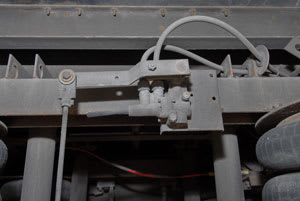
Shocks are a small components with big performance implications. Look for oil residue on the shock tube, and check for bushing wear.
Although the maintenance-free tractor-trailer is still a few years off, there are really only two big maintenance items left when it comes to axles and suspensions: the shock absorbers and the air springs. Some historically large maintenance items today are designed to almost outlive the trucks.
Parts such as main pivot bushings on a trailing arm suspension now come with 5- to 7-year warranties.
"The technology is now so good, you don't really have to concern yourself with those things on an annual basis," says Mike Edlund, a suspension application engineer at SAF-Holland. "Back in the old days, everything would wear and seat, and that meant steady work for the guys in the shop. It's not like that anymore - but that doesn't mean you can just ignore stuff below the frame rails."
Drive axles
While the axle housings themselves require little maintenance other than visual inspection for cracked or broken welds or loose mounting hardware, the seals and axle lubricant need a little attention periodically.
"At the engine oil change interval, it is customary to check the lubricant level in the axle to ensure it is still filled to the appropriate level," says Steve Slesinski, director of global product planning for commercial vehicle products at Dana Holding Corp. Other points that should be inspected, he says, are the carrier-to-housing connection, wheel seals, the pinion input or output shields (check for oil buildup or dirt), and the housing breather (check to see if it's missing or damaged).
A damaged breather could allow contaminants to enter the axle, compromising the lubricant. Conversely, if the breather is plugged, heat in the axle could cause pressure inside the housing to force lubricant out through the wheel or pinion seals, leading to an incorrect diagnosis of a seal failure.
The breather allows a little vapor to escape from the axle, and the area around the breather may appear wet or caked with dirt. According to Charlie Allen, general manager for rear drive axles at Meritor, a little wetness around the air vent on the axle is normal.
"Excessive wetness is not normal. Our new breather has a built-in oil separator to address oil getting out," he says. "Another source of oil around the breather is the fit of the breather in the axle housing. Using a thread sealant will put a stop to seepage."
It's also important to look after the axle lubricant. Many axle warranties now go out to 750,000 miles, but proper lubrication is required.
According to Bruce McGlone, senior chemist, materials engineering at Meritor, only correct and hardware-approved multi-viscosity oils should be used in axles and wheel ends.
"Approved oils will exhibit a longer in-use life and be more capable of addressing road concerns such as heat, contamination, loads/grades and driver dynamics," he says.
The other obvious maintenance implication for drive axles is alignment. Misaligned axles can wreak havoc with tires, especially steer tires, resulting in a misdiagnosis of the problem.
A quick-and-dirty method of ensuring the drive axles are reasonably well-aligned is to measure them in relation to the frame and each other. With the wheels chocked and the brake released, measure the distance between the axles. It should be the same on both sides. Also measure the distance from a fixed point on the axle, such as the brake spider, to the frame rail. Again, the measurements should be the same. If there is variance, consider a full-chassis alignment job.
Steer axles
Although drive axles only require visual inspection prior to their 500,000-mile initial service interval, steer axles demand a closer look about every 25,000 miles, depending on the application. Kingpins, tie rods and various ball joints are all in constant motion and in need of lubrication.
"When lubricating, it is critical to add lubrication until you see fresh grease start to purge from the product to ensure all contaminants have been flushed out of the system," Slesinksi says. "It is also critical to make every effort to keep contaminants out of the product whenever possible to extend steer axle life."
Some suspensions still require lube in the spring hangers and shackles, so don't overlook those. Remember to use the proper lubricant when greasing automatic brake adjusters.
Shock absorbers are a frequent maintenance item. They can wear out over time, and the mounting bushings can wear or crack. Both will affect the performance of the shock and, ultimately, the ride and handling and probably tire wear.
To tell if a shock is working properly, grasp the lower barrel of the shock just after it has come off the road. "It should be warm to the touch," Edlund says. "That tells you the internal mechanism is working." In this case, cold is bad. "The other telltale sign of a shock failure is when the lower tube has dust and dirt clinging to the body," he says. " That means oil has seeped out, and dust is clinging to the oil. If you can see that, the shock should be changed."
Suspensions
Beyond visual inspections and the occasional retorqeuing, steel spring suspensions are pretty much maintenance-free. Being made of metal, though, means corrosion and stress cracks will be factors.
"Inspect each frame hanger and replace any that have developed cracks or are badly rusted," Hendrickson recommends. "High-mileage springs with one or more leaves broken below the number two leaf should be replaced with a new spring assembly of the same part number. Replacing both springs will assure even spring deflection."
According to Reyco Granning, you can check leaves for cracks by examing the side of the spring packs. Rivulets of rust may appear on the side of the pack near a crack that can't be seen.
In air suspensions, the alignment of the air spring, the air spring itself and the pivot bushings all need periodic inspection.
According to Dave Vanette, manager of new business development at Firestone Industrial Products, most premature air spring failures are caused by other problems with the suspension system.
"Air lines may break loose and rub against air springs, causing abrasions or tears in the rubber bellows. Bushings may wear out and cause similar damage due to misalignment of the air spring," he says. "The most common problem found in non-warranty air spring product returns is overextension of the air spring, typically caused by a broken shock absorber. When a shock absorber breaks, it allows the air spring to travel too far and essentially tears the air spring apart."
Proper air spring inspection involves scanning the air spring for any signs of irregular wear or heat cracking. "The annual inspection should include checks for buildup of dirt, debris or corrosion on the piston (pedestal), which can create a surface similar to sandpaper and wear down the air spring," he notes. "If anything is found to be rubbing against the air springs, the driver should take the rig in for service."
The other essential component in an air suspension system, the leveling valve, should be checked for proper operation.
"It's essential for maintaining proper ride height as set by the vehicle manufacturer," says Randy Petresh, vice president of technical services at Haldex. "Ride height isn't a user-selected parameter based on preference. It's there to maintain proper driveline angles and maintain the correct height of the trailer."
Because they are pneumatically operated mechanical leveling valves, they are subject to air contamination, corrosion and possible physical damage. Cycle the valve through its extremes and make sure the moving parts are not binding.
Check th
More Maintenance

Color Match Smarter: Tools That Restore & Perform
For fleet managers and collision repair professionals keeping heavy-duty trucks on the road, getting the color right the first time isn't just about appearance — it's about efficiency, turnaround time, and bottom-line results. Discover how today's digital color tools are transforming the repair process from guesswork to precision.
Read More →
Wrong Repair Prompts Recall of Freightliner, Western Star 4x2 Trucks
DTNA is recalling more than 2,400 trucks that received an incompatible software fix instead of the hardware repair required to address brake valve corrosion.
Read More →
Truck Drivers Need More Than Another Alert
Fleets have more visibility into truck health, safety events, and driver activity than ever. The next challenge is turning all that information into useful guidance for the person who has to decide what to do next.
Read More →
The Maintenance Checks Trucking Fleets Should Prioritize Before Fall Freight Picks Up
Making it through August isn’t the same as being ready for the next several months of operation. Find out what systems may have suffered from summer heat and need to be checked out before fall.
Read More →
What Three Fleets Are Doing Differently When Buying Truck Parts in 2026
With freight improving but costs still climbing, fleet maintenance executives explain how they're balancing price, quality, and supplier relationships.
Read More →
Paccar Recalls 2027 Trucks Built This Summer for Possible Electrical Problem
The nearly 6,000 Kenworth and Peterbilt trucks in the recall could potentially lose engine power, among other things.
Read More →
Will API PC-12 Oil Change Trucking Fleet Maintenance?
The new API PC-12 heavy-duty engine oil category reflects the changing demands of modern diesel engines. But fleets like Foodliner are looking to getting their own data before making decisions on adopting the new oils and questions such as extending oil drain intervals.
Read More →
Brake Safety Week to Focus on Drums and Rotors
Commercial vehicle inspectors are focusing on truck brakes during CVSA's Brake Safety Week, August 23-29.
Read More →
Possible Battery-Cable Fires Prompt Recall of 15,000+ International MV and HV Trucks
On the recalled vehicles, manufacturing variations can cause the battery interconnect cable to contact the auxiliary stud and hold down the bracket.
Read More →
Rush, MCT Team Up to Grow Refrigeration Service Network
The joint venture will operate MCT's network of Carrier Transicold dealerships and mobile service locations, with the companies promising greater service capacity and uptime for refrigerated fleets.
Read More →