


Part 3 in a Series: Inside Best Fleets
Part 1: Do You Have What it Takes to be a 'Best Fleet to Drive For'?
Part 2: Inside the Best Fleets to Drive For Competition
 MENU
 SEARCH
An intensive interview process is a key part of the process as the Truckload Carriers Association and CarriersEdge winnow down the best trucking fleets for drivers to work for to be honored as Best Fleets to Drive For.

Flatdeck carrier Chief Carriers has special trailers assigned to load securement training.
Photo: James Menzies
What does it take for a motor carrier to be honored as a Best Fleet to Drive For?
After filling out a 110-question questionnaire covering all aspects of a fleet’s operations, further scrutiny awaits. In November and December, Best Fleets to Drive For administrators conduct exhaustive interviews of all the fleets that have made it through the nomination and questionnaire stages.
The Best Fleets to Drive For program, run by CarriersEdge in partnership with the Truckload Carriers Association, has grown so much, administrators have had to bring in more support staff to assist with the vetting process. New to the interviewing process this year are Courtney Muir and Christine Brooks-Wilson; both are CarriersEdge staffers. They joined CarriersEdge founders Jane Jazrawy and Mark Murrell, who have until this year managed the interview process on their own.
Truck News (which which HDT has an editorial sharing arrangement) is embedded into this year’s selection process, and sat in on two interviews in November and December. The in-depth questionnaires cover business information; compensation; benefits; human resources strategy; operational strategy; performance and recognition; and work-life balance.
The follow-up interview gives administrators an opportunity to ask further questions, or to dive deeper into certain responses. While some respondents have mastered the interview process, others struggle to explain their programs.
Lisa Mason was charged with handling the interview for Melton Truck Lines. She came into the interview clearly well prepared and able to answer all the questions posed by Mark Murrell, a founder of online training firm CarriersEdge, which launched the program in partnership with TCA.
Melton, a flatdeck company based in Tulsa, Oklahoma, runs 1,390 power units and employs 1,337 company drivers. During the interview, Murrell looks for unique programs for drivers and ways the company stands out. One way Melton stands out is through its per-diem payment plan for drivers, amounting to 10 to 14 cents per mile. Per-diems are an emerging trend some fleets are adopting.
Mason explained the company hired a third-party company to administer the per-diem. Another emerging trend among Best Fleets nominees is the move towards some form of guaranteed pay. However, Melton scrapped such a program after finding it wasn’t working out for the fleet.
“We found that in some situations, not all, it didn’t give us much of a return – and it created, in some scenarios, bad habits,” Mason admitted. “For us, we felt it wasn’t a road we wanted to continue on.”
Melton has a range of programs that have benefited both the company and its drivers, including profit sharing. It has a progressive benefits plan that last year was modified to recognize same-sex marriages. The company also focuses on driver health, and has invested in InBody measurement machines, which gives insight into a driver’s health. An on-site wellness manager is available to help drivers achieve their fitness goals.
The interview is comprehensive. It even covers pet policies (Melton allows cats and dogs up to 80 pounds), and clothing bonuses (Melton reimburses $25 towards safety shoes). Melton recognizes long-term drivers, and allows those with a million miles under their belts to spec their own trucks. The company goes to great lengths to make its drivers' lives more convenient, including having a dentist and hairdresser available at the terminal.
The company developed a Life Over the Road class for new hires, which looks to prepare them for the realities of the job.
“A lot of drivers coming into the industry don’t have a clue what they’re getting into,” Mason said. “This is a class we put together to give an honest look at what it’s going to be like.”
Murrell was impressed. “I’ve never heard of anyone doing that before,” he said of the program, after the interview.
Drivers seem to appreciate the initiatives, and have nominated the fleet for the program for six years.
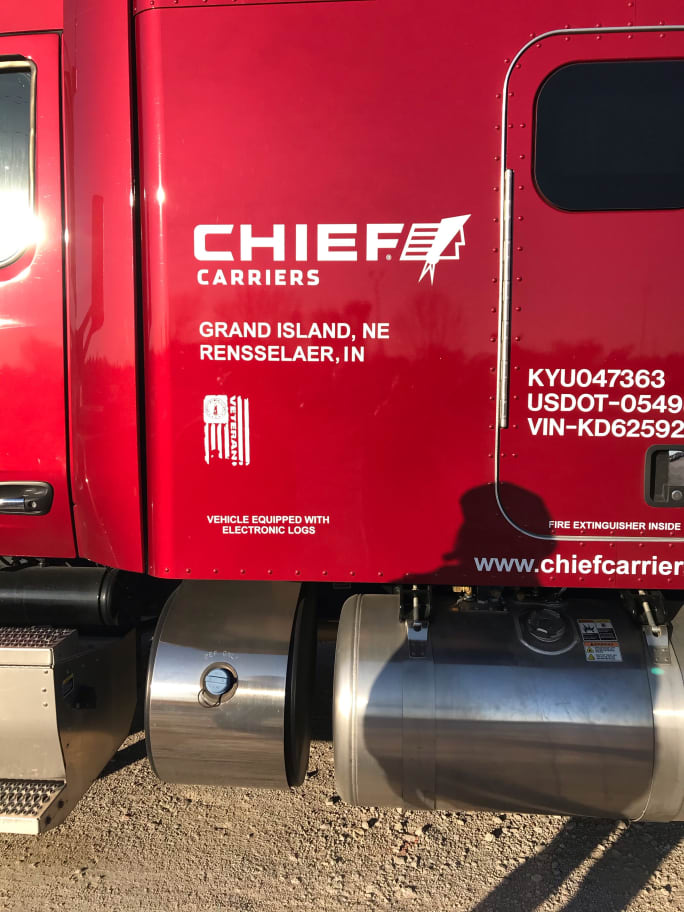
Chief Carriers recognizes military veterans with a special decal.
Photo: James Menzies
Chief Carriers out of Grand Island, Nebraska, was nominated for the first time this year. But General Manager Andy Winkler is no stranger to the Best Fleets program, having steered Grand Island Express into the Top 20 for eight consecutive years.
It was evident during the interview that Chief is taking an aggressive approach to improving its workplace for drivers. It, too, offers a per-diem, of 7 cents per mile. It also pays drivers $100 for a clean safety inspection, and offers fuel and referral bonuses. Drivers begin earning home time as soon as they’re hired, and qualify for paid vacation time after 90 days.
The company employs 63 drivers, and had 35 exits over the past year. It embarked on a goal of reducing driver turnover from 65% to 30%, but Winkler admitted it fell short. While the company improved its working environment, it was also struggling to keep up with demand in 2018 and went on a hiring spree.
“You end up hiring your turnovers,” Winkler admitted.
The company has since implemented a pre-hire risk evaluation, which considers the number of jobs drivers have had before considering Chief. “We are looking for more red flags in the applicants themselves,” Winkler explained. “We have quit trying to fool ourselves into thinking we are going to be able to keep this guy longer than he was in his last three jobs. We have slowed down the hiring process and look for more quality people.”
Chief reimburses drivers a portion of their costs for shirts, hats, boots and paid parking. It has also developed an app for drivers and integrated the apps of various truck stops. Drivers’ administrative jobs have been streamlined through the app. Many Chief drivers are out for 14 days at a time, but the company has taken steps to reduce this for drivers serving the surrounding states.
During the holidays, Chief recognizes about 35% of its drivers with rewards. It also offers a formal wellness program.
“Andy has clearly been working on improving the programs since he took over,” Murrell said following the interview.
After the interview, fleets must have a percentage of their drivers complete a survey on the company’s practices. As of Dec. 5, nine fleets had completed all the stages of the program, including driver surveys. Fleets that have come this far have until midnight Dec. 31 to get the driver surveys completed. In early January, program administrators will gather to score the fleets and come up with the Top 20 list. We will cover that process in Part 4 of this series.

Four additions to PS Fleet help fleets monitor loads, manage driver coaching, share truck locations and adjust video system settings.
Read More →
English language proficiency rules for commercial drivers aren’t new, but renewed out-of-service enforcement has raised the stakes. Here’s what carriers need to know before a driver reaches a roadside inspection.
Read More →
Agent Studio lets fleets create AI tools for hours-of-service monitoring, reporting and driver support, including agents that communicate by phone.
Read More →
Trucker Path has added close to 6,000 more truck parking spaces to its Trucker Path Reserved Parking Network with the addition of Safe Truck Parking.
Read More →
The agency says Trancasa USA rejected applicants over 65 and applied tougher driving-record standards to those over 60.
Read More →
This year has seen a swath of major truck driver pay increases as freight capacity has tightened.
Read More →
After three decades in trucking, Harold Perry shares what he's learned about driver safety, mentorship, and helping the next generation build confidence behind the wheel.
Read More →
Fleets have more visibility into truck health, safety events, and driver activity than ever. The next challenge is turning all that information into useful guidance for the person who has to decide what to do next.
Read More →
Federal regulators also are targeting more than 160 additional training providers and launching a nationwide audit of third-party CDL skills testers as part of a broader crackdown on trucking fraud.
Read More →
Two pilot programs could eventually reshape hours-of-service rules, giving truck drivers options to pause their 14-hour clock or use longer split sleeper rest periods.
Read More →