




HTUF's 10th Meeting a Big Draw
Hybrid Truck Users Forum's 10th annual meeting in late September in Dearborn, Mich., was its largest ever, with close to 700 attendees.

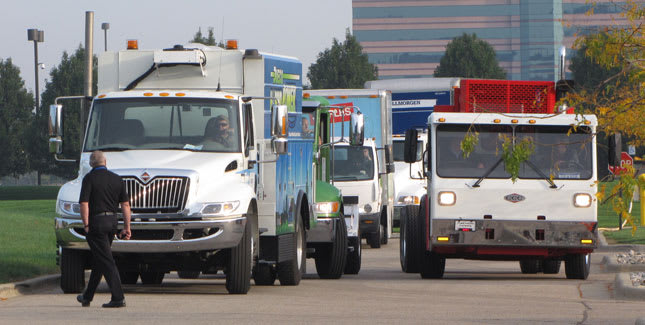
A parade of about 40 hybrid- and electric-drive trucks enters a parking lot at the Hyatt Regency Dearborn to start a ride-and-drive function at the Hybrid Truck Users Forum. (Photo by Tom Berg)
Hybrid Truck Users Forum's 10th annual meeting in late September in Dearborn, Mich., was its largest ever, with close to 700 attendees.
Managed by CalStart-WestStart in Pasadena, Calif., the group formed in 2000 and held its first meeting in 2001. For about the first five years, engineers and users talked about the basics and developments of equipment; then they began reporting production and field testing of actual hybrid-drive trucks. Today, medium-duty diesel-and gasoline-electrics are available from about a half a dozen major truck builders and several other lesser-known makers.
As at previous gatherings, people journeyed to Dearborn to learn about the latest hybrids and other alternatives to straight internal combustion drivetrains. HTUF has grown to include electric, natural gas- and propane-powered trucks and buses, and continues to include suppliers, users and officials from federal, state and local agencies.
For a few minutes, money was in the air. Congress and the Obama Administration gave the Department of Energy 50 percent more money in the past two years to spend on hybrids and other alternative propulsion systems, said a DOE representative. DOE has allotted $1.5 billion to development, manufacturing and deployment of advanced batteries, plus $900 million on electric drive system projects.
Hardware was everywhere, and everybody nosed around to see what everyone else has come up with to advance the cause. The cause is saving fuel and reducing emissions, and there's increasing interest in those goals. Saving fuel reduces dependence on imported oil. It also saves money - though not enough at the moment to pay for the hybrid and alternative-fuel systems to accomplish it, at least without government help.
Transit buses were the first platforms for hybrid development, and they continue to sell well because a lot of federal money helps buy local buses.
With commercial trucks, business rules are in force, and that's where the slowdown is. Suppliers have continued development of hybrid systems and more are ready for production, presenters said.
"We're beyond science projects," one noted. "We need customers, and it's time for the fleets to step up" and buy, like they did a few years ago. And suppliers are working to lower the cost of hybrids. "Every 10 to 15 percent we can take off the price is five to six months off the payback time," said another presenter.
Fuel prices responsible
Four- and five-dollar-a-gallon diesel fuel in 2008 made a good business case for hybrids, which can reduce fuel use by 30 to 50 percent or more. But fuel at today's $3 to $3.50 lengthens the payback time to unacceptable periods. That and expiration of federal tax incentives at the end of 2009, and no progress by Congress to restore them (not to mention the Great Recession), continue to seriously slow hybrid sales.
Thus all of HTUF's efforts and enthusiasm over 10 years have resulted in only about 2,000 hybrid trucks getting onto public roads. Yet efforts continue, because everybody knows that as the U.S. economy recovers, there'll be more demand for oil and fuel prices will go up again. Indeed, at this writing, gasoline and diesel had climbed by 25 to 50 cents a gallon over a couple of weeks. And there's talk of state legislatures and the U.S. Congress hiking fuel taxes to raise money for road and bridge building.
Higher fuel prices lower the time for return on the investment of buying a hybrid. An Eaton electric hybrid in a medium-duty Freightliner, International, Kenworth or Peterbilt costs $30,000 to $40,000 (minus any government-sponsored offsets) over a basic diesel-powered truck. If the hybrid returns 30 to 50 percent better fuel economy, the ROI is a simple function of taking the amount spent for fuel in a given period and reducing it by that percentage, then applying the savings toward the premium paid for the hybrid system. At 2008-level prices and depending on annual mileage, the ROI might come in just a couple of years.
Military's interest
One segment that could really use some fuel savings is the U.S. military, which runs huge fleets of trucks, not to mention fighting vehicles and aircraft. So the U.S. Army's National Automotive Center in Warren, Mich., has backed HTUF from the start. Early on it believed that hybrids should be developed for commercial use, where they could be proven, then the military could step off with them. It has funded the building of demonstration hybrids by various suppliers, with more coming in 2011.
One executive at the Army's Tank-Automotive Research, Development and Engineering Command (TARDEC), NAC's parent, has figured that if the military could reduce its fuel usage in Iraq and Afghanistan by just 1 percent, it could run 6,224 fewer convoys. That would cut operational costs, put fewer troops and vehicles at risk, and reduce the chance for enemy attacks on fuel tankers, which occurred recently at the Pakistan-Afghanistan border.
But NAC and TARDEC don't buy trucks for regular duty. Other arms of the Pentagon and the U.S. government do, and they are bound by complex procurement regulations that discourage acquiring anything not officially approved. An exception was the emergency purchasing in 2008-'09 of Mine-Resistant, Armor Protected trucks, more commonly known as MRAPs, to shield troops from roadside bombs.
Saving fuel is not an emergency requirement, but reliability remains a constant. So the military's latest buys of "tactical wheeled vehicles," like 2.5- and 5-ton military-spec cargo trucks for the Army, are essentially the same type it acquired in the mid 1990s, the executive said. They are tried and true, even if they use more fuel than they would if they were hybrids.
Meanwhile, people at TARDEC and other branches continue to ponder exactly what kind of hybrids the military should embrace. Should they be electric, so they can also produce power to run weapons systems and communications gear (and eliminate separate engine-driven generators)? Should they be hydraulics to just push the truck? Or should it buy some of both? Any decisions will have wide- and long reaching effects.
Yet TARDEC and NAC persevere. They have sponsored the formation of a special HTUF study group on military vehicles, which met for the first time at the start of the Dearborn meeting. Various agencies of the Department of Defense will explore hybrid systems and getting them into use, supporting them with spare parts and tools, and training troops to operate and maintain the vehicles.
Ride and drive
The HTUF meeting's ride and drive began with a parade of about 40 demonstration trucks and buses through area streets and into a parking lot set aside for the event. They were made available for examination by attendees, and many could be driven or at least ridden in. Some, like electric-drive heavy road tractors, were intriguing, but not close to manufacture. Others, like Eaton Corp.'s diesel-electric hybrid system, have been in production by various truck builders for three to five years. And there were several trucks that included new and refined hybrid products.
Read about our impressions of several of these vehicles in "We Try Out Latest Electric, Hybrid Models and Hybrid Truck Users Forum," 12/7/2010.
From the December 2010 issue of Heavy Duty Trucking magazine.
More Fuel Smarts

Record Diesel Prices Squeeze Trucking Fleets
Average U.S. diesel prices have climbed to nearly $6 a gallon, surpassing the 2022 record as tight refinery capacity and Middle East disruptions keep fuel costs elevated.
Read More →
How Fuel Delivery Shapes Engine Performance
Fuel delivery depends on more than what happens at the injector. For fleet, maintenance and technical professionals, looking at the full path from pump to injector can provide useful context for understanding engine performance.
Read More →
East Coast Port Launches $45M Electric Truck Push
The Port Authority of New York and New Jersey announced millions in incentives for zero-emission drayage trucks, yard tractors, and new charging hubs near the port.
Read More →

California Bill Could Shed Light on Electric Truck Prices
Why do battery-electric Class 8 trucks remain so expensive? A California bill headed to Gov. Gavin Newsom would give fleets and state agencies more visibility into what manufacturers charge.
Read More →
Detroit Opens Orders for EPA 2027 Engines
Detroit isn’t starting from scratch to meet EPA 2027 diesel emissions standards. Its Gen 6 DD13 and DD15 engines keep much of today’s platform while updating the fuel and aftertreatment systems.
Read More →
Zero-Emission Truck Corridor Planned for West Coast
California, Oregon, Washington, British Columbia and Baja California are coordinating plans for truck charging and hydrogen fueling from Canada to Mexico.
Read More →
A Closer Look at Kenworth’s Electric T880E Vocational Truck [Video]
Learn more about Kenworth's T880E battery-electric vocational truck at the Paccar Technical Center, including its range, applications, upfitting considerations, and PTO options, in this HDT Spotlight video.
Read More →
Kenworth T880E Brings EV Power to Vocational Trucks
A closer look at the Kenworth T880E’s range, charging, powertrain and upfit options — and where fleets are showing the most interest.
Read More →
Jennie Abarca Is Proving Electric Trucks Can Do the Job
HDT Truck Fleet Innovator Jennie Abarca is building confidence in fleet electrification one load at a time while openly sharing the challenges she encounters along the way as a small-fleet owner.
Read More →
Cummins Adjusts 2027 Engine Rollout After EPA Proposal
The engine maker will gradually introduce its new Model Year 2027 diesel engines while continuing to offer current models during the transition, citing the EPA's proposed emissions rule changes.
Read More →