





Related: Connection is Key to Truck Service Event Management
How to Speed Up the Shop
Can you improve your shop’s efficiency without compromising quality?
February 10, 2020
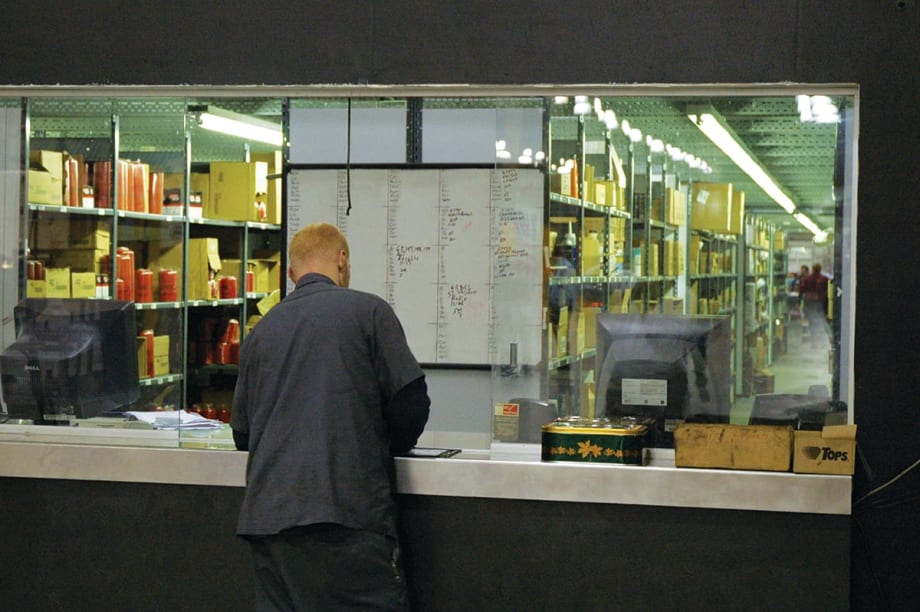
Waiting for parts wastes technicians’ time. Get the parts to the workstation before the job begins or considering using a parts runner to deliver parts to the bay.
Photo: Jim Park
7 min to read
Is your shop as efficient as it can be? Chances are there are loads of time- and space-wasting practices that could be improved upon; you just need to identify them. That may sound easy, but fleets struggling to stay ahead of day-to-day challenges often do not step back to see what’s really going on or try to get beyond the obvious.
The solution may be as simple as mapping out all the steps a technician takes around the shop cleaning tools, picking up parts, or disposing of packaging. It could be cleaning out a bay that’s filled with junk and turning it into a useful workspace. Sometimes all it takes is a little imagination.
Randy Obermeyer, the terminal manager for Batesville Logistics in Batesville, Indiana, recounted a story of how he managed to trim 30 minutes from the time it takes to complete a preventive maintenance (PM) service.
Speaking on a panel discussing ways of improving the efficiency and effectiveness of fleet maintenance practices at the 2019 annual meeting of the American Trucking Associations’ Technology & Maintenance Council, Obermeyer explained that he felt 2.5 hours per PM was a little long, so he set out to see what could be done to shorten the process. The first step was to make what he calls a spaghetti diagram, mapping all the movements a technician makes during the inspection. That yielded some surprising results.
“We found that technicians were leaving the inspection area several times during the process,” he said. “We tracked one tech making a couple of trips to the supervisor’s office, a trip to the water fountain to fill a water bottle, a separate trip to the oil filter crusher, a few trips to the parts room, etc., and he made multiple trips around the vehicle he was working on.”
The solution was to bring all the needed parts to the PM service bay prior to starting the work and reordering the inspection process into a specific sequence to cut down on the number of trips around the truck. They even went so far as to move a trash can into the service bay so the tech wouldn’t have to walk quite as far to dispose of the parts packaging.
In addition, Obermeyer went over the list of 135 inspection items and pared it down by 25, deciding not to inspect things like the controls on the driver’s seat, interior lighting and other things that drivers would be sure to point out if they failed.
“We went back over previous inspections and looked for things that we had never had to repair, and we identified inspection points drivers would let us know about,” he said. “The bottom line was, we knocked 30 minutes off a PM with absolutely no negative consequences to date.”
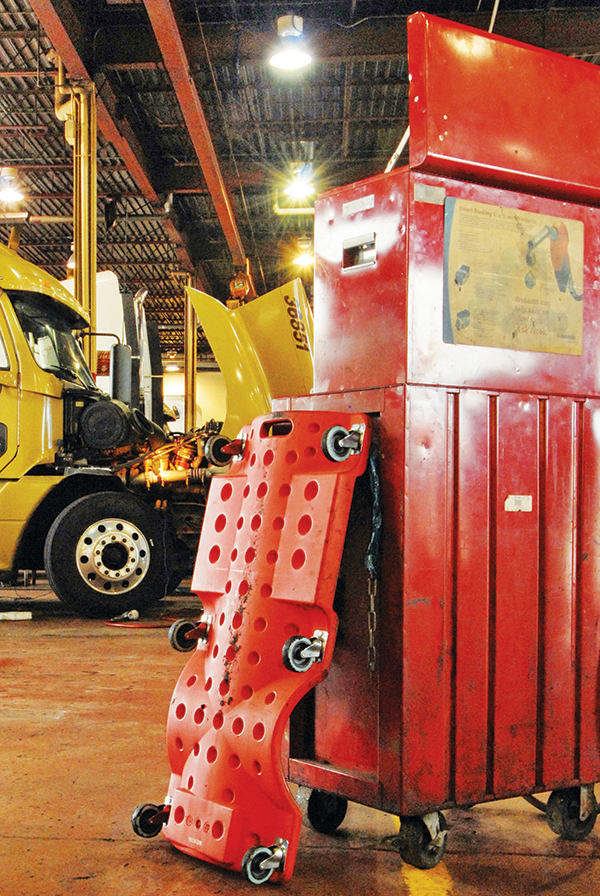
Everything at the ready: Keeping the tools you need in the work area cuts technician shop-transit time.
Photo: Jim Park
That exercise was all about rethinking a process that had gone more or less unchanged for years. Similar thinking helped Obermeyer discover that some of his technicians were not following procedures for tightening battery cables onto battery terminal posts, and that was killing batteries.
Obermeyer had noticed a technician replacing the batteries on a truck that was less than a year old and stopped to ask why. The technician told him the batteries would not hold a charge. Testing revealed the batteries had been discharged too deeply too many times and would no longer hold a charge.
While testing the batteries and replacing the bad ones is what you’d expect a diligent technician to do, Obermeyer wanted to know what had killed that set of batteries in the first place. Was the problem a failing alternator or a short circuit somewhere? He kept drilling down to get to the root cause. It turned out to be a technician who had previously serviced the truck had not followed recommended practices for tightening battery cables to the terminal posts, resulting in bad connections and batteries that were not charging properly.
“That’s a good example of how fleets can approach a problem with the objective of not just fixing the problem at hand, but getting to the root cause of the problem,” he said. “It was a simple problem to fix, but the cause took a bit of work to identify and prevent from happening again.”
Take Advantage of Technology
Telematics has opened the door to a whole new level of diagnostic clarity and streamlined maintenance. Trucks today practically tell you what’s wrong with them – which begs the question: Should we continue with traditional PMs or just wait for the alerts?
It’s much easier today to query a database to discover what might be the top 25 fault codes and focus on resolving those.
“That will save the tech-savvy fleet a lot of time and money previously spent chasing down problems,” said panelist Cindy Hunter, technology sales director for Rush Enterprises. “For fleets just getting familiar with telematics and diagnostics, there’s so much data there it can be overwhelming. If that happens, the data just becomes something else that takes time out of their day. Those fleets need a crawl, walk, run approach so they can stay focused on their pain points and not get distracted by the volume of data coming off the truck.”
Greg Johnsen, a regional service manager with Maverick Transportation, told the panel that telematics has helped his fleet take major service intervals out to 70,000 miles with a dry service in between. He noted that not long ago, trucks were hauled in for service every 20,000 miles.
“Telematics gives us a very close and current look at the truck,” he said. “It doesn’t need any more service, but telematics can alert us to a pending issue that we previously would not have seen coming. We don’t want to over-service the truck any more than we want excessive downtime. We have historically used pretty conservative service intervals, not knowing really what condition the truck was in. Now that we can literally see inside the thing, we can safely push those intervals out much further, which helps reduce overall maintenance costs and downtime, too.”
Use Your Imagination
How many times have you said to yourself, if we only had more room, or if only we had more technicians, we could be so much more effective? Have you ever asked yourself if you could make better use of your existing assets?
Kerry Stritt, the vice president of fleet services for less-than-truckload carrier Southeastern Freight Lines, was also on the TMC panel. He spoke about the advantages of looking for savings that are hiding in plain sight and those hidden in the deepest, darkest corner of the shop.
“Step one is to de-clutter,” Stritt said. “Ideally, you want to know exactly what you have out on the yard, and if you’re anything like us, you probably have a couple of bays full of junk. You may not even know what’s in there. The pile just keeps growing and you keep ignoring it. Any time you have a bay that’s underutilized or not properly utilized, you have an opportunity.”
SEFL reclaimed a previously underused service bay and turned it into a triage facility. The company appointed two of its best technicians as triage specialists, whose primary duty is to run a series of diagnostic tests on all incoming trucks to see what sort of work they need.
“They are trained on all the software, and they are the first one to touch the truck when it comes in,” he said. “We know that if we can diagnose a problem, we can fix it, too. He’ll run diagnostics on all the systems on that truck, do the updates and figure out what’s wrong with it. Sometimes they will fix the problem right there, but if not, he designates which bay the truck goes to for repairs.”
As for straight-up savings on maintenance costs — requiring very little imagination — Southeastern sticks very closely to the OEM service interval recommendations.
“We were changing oil on our highway fleet every 20,000 miles, but our OE said 50,000 miles is acceptable if we meet the criteria, and we do,” he said. “So now we’re dropping oil at 50,000 miles, or about once a quarter with oil sampling. Our trucks are spending less time in the shop.”
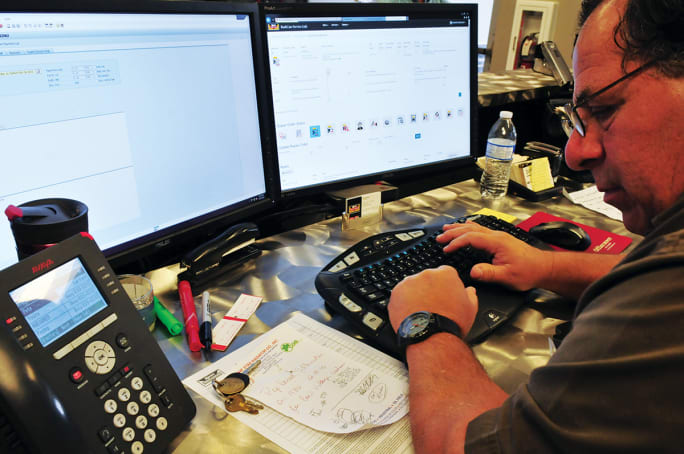
VMRS database queries can identify problem areas that need special attention during PMs.
Photo: Jim Park
Stritt said these processes drastically reduced parts-carrying costs and shop dwell time and helped get the repair work right the first time. But he acknowledged that changing from the way they had always done things to these newer measures wasn’t always smooth.
“Change is a fear of the unknown,” he noted. “The problem in many cases isn’t with the technicians, but with leadership. If you have shop managers running a shop for 30 years and then one day somebody comes in and says you’re doing it all wrong, that guy is bound to be a bit resistant to change. Once you communicate it correctly, they come onside.
“I encourage everyone to give this some thought,” added Stritt. “It costs nothing, yet the results can be profound. Sure, these ideas saved us some money, but some of our technicians even get to go home early occasionally rather than staying late to finish a job.”
Subscribe to Our Newsletter
More Maintenance

Sponsored•September 16, 2026
Color Match Smarter: Tools That Restore & Perform
For fleet managers and collision repair professionals keeping heavy-duty trucks on the road, getting the color right the first time isn't just about appearance — it's about efficiency, turnaround time, and bottom-line results. Discover how today's digital color tools are transforming the repair process from guesswork to precision.
Read More →
Wrong Repair Prompts Recall of Freightliner, Western Star 4x2 Trucks
DTNA is recalling more than 2,400 trucks that received an incompatible software fix instead of the hardware repair required to address brake valve corrosion.
Read More →
Truck Drivers Need More Than Another Alert
Fleets have more visibility into truck health, safety events, and driver activity than ever. The next challenge is turning all that information into useful guidance for the person who has to decide what to do next.
Read More →

The Maintenance Checks Trucking Fleets Should Prioritize Before Fall Freight Picks Up
Making it through August isn’t the same as being ready for the next several months of operation. Find out what systems may have suffered from summer heat and need to be checked out before fall.
Read More →
What Three Fleets Are Doing Differently When Buying Truck Parts in 2026
With freight improving but costs still climbing, fleet maintenance executives explain how they're balancing price, quality, and supplier relationships.
Read More →
Paccar Recalls 2027 Trucks Built This Summer for Possible Electrical Problem
The nearly 6,000 Kenworth and Peterbilt trucks in the recall could potentially lose engine power, among other things.
Read More →
Will API PC-12 Oil Change Trucking Fleet Maintenance?
The new API PC-12 heavy-duty engine oil category reflects the changing demands of modern diesel engines. But fleets like Foodliner are looking to getting their own data before making decisions on adopting the new oils and questions such as extending oil drain intervals.
Read More →
Brake Safety Week to Focus on Drums and Rotors
Commercial vehicle inspectors are focusing on truck brakes during CVSA's Brake Safety Week, August 23-29.
Read More →Possible Battery-Cable Fires Prompt Recall of 15,000+ International MV and HV Trucks
On the recalled vehicles, manufacturing variations can cause the battery interconnect cable to contact the auxiliary stud and hold down the bracket.
Read More →
Rush, MCT Team Up to Grow Refrigeration Service Network
The joint venture will operate MCT's network of Carrier Transicold dealerships and mobile service locations, with the companies promising greater service capacity and uptime for refrigerated fleets.
Read More →