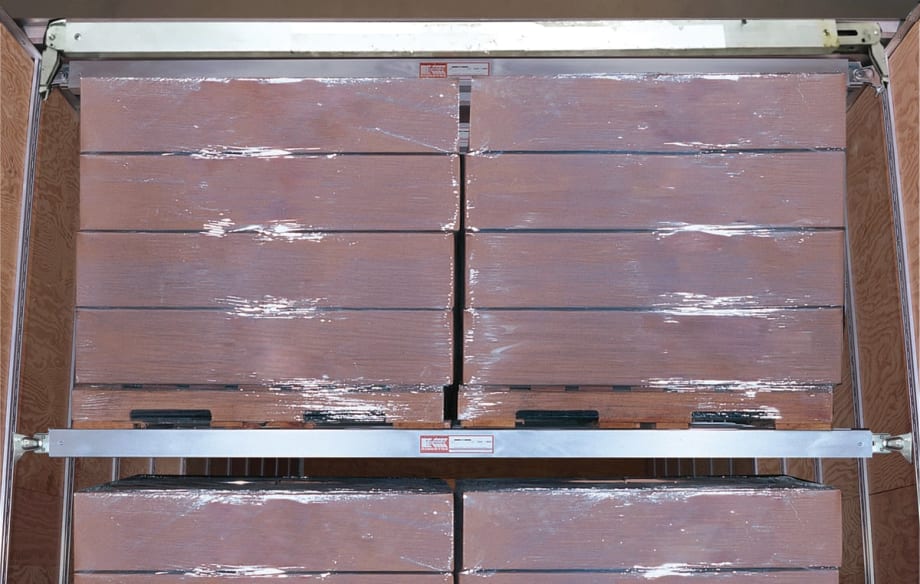
Fleets can solve capacity challenges by doubling the deck space with a decking system such as Kinedyne’s K2 Kaptive Beam. Bars stow at ceiling height to stay clear of forklift masts.
Photo: Kinedyne
6 min to read
Each time a passenger jet backs away from the jet bridge with empty seats, it’s lost revenue for the airline. For airlines and for trucking, space is a perishable commodity. It has value up until you close the doors and leave the dock. At that point, empty space becomes a missed opportunity. Why drag around a trailer full of air when you could fill it with profitable top freight?
Ad Loading...
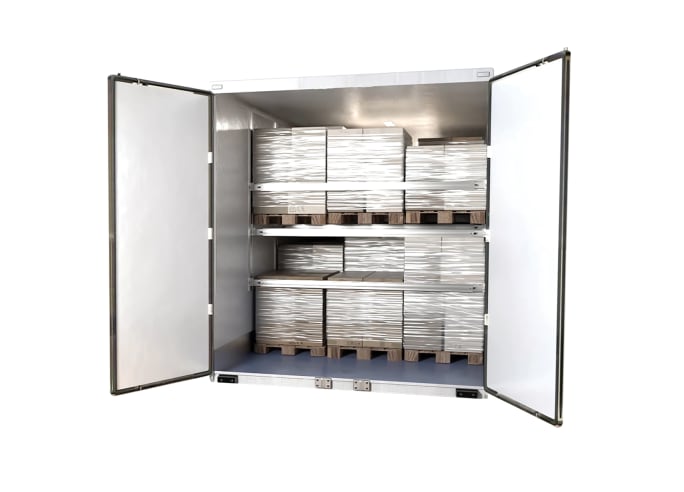
Some fleets try to make the best of their floor space by double-stacking pallets or other types of cargo. But that means more potential for damage if the top skid falls over or the bottom pallet is crushed by the one on top. An alternative is equipping trailers with a decking system, which can almost double your floor space.
“If you’re a fleet that really wants to maximize efficiency and improve driver productivity, double-decking can move 60 to 80% more freight using the same equipment and same driver,” says Bob Dissinger, Kinedyne’s director of U.S. sales. “The payback on some of these systems when used correctly can be just a matter of months.”
Ad Loading...
A double-decking strategy can be used to deck a few pallets here and there when an opportunity arises, or fleets can go all-in on consolidating loads from a distribution center with some advance planning.
The typical run-’n-gun truckload fleet might not be positioned in the market to take two or three hours to load a truck or make a couple of stops en route, but smaller fleets that watch load boards for top freight can pick up extra revenue with the aid of a dozen or so decking bars and load it above an already profitable load.
Decking systems range from a few bars up to full systems with electric activation. Installation can be original or aftermarket, and it’s easy to add logistics tracking or E-tracking to original trailer wall supports.
Individual decking bars, support tracking and shoring equipment are available from Ancra Cargo, Doleco USA, Kinedyne, U.S. Cargo Control, and other suppliers. Standard ratings run from 2,000 to 4,000 pounds in lengths from 86 to 102 inches. Decking bar weights run from 20 to 40 pounds, depending on the rating and the construction material (usually aluminum or steel.) A dozen bars would add 250 to 500 pounds to the trailer, but chances are if you’re in a position to think about decking cargo, a few hundred pounds won’t be a deal-breaker.
Full decking systems
Full decking systems such as Kinedyne’s Kaptive Beam system or Ancra’s Lift-A-Deck systems offer an enormous amount of flexibility. These are usually installed by the trailer manufacturer, but they can be retrofit as well. If a trailer wasn’t ordered with logistic tracking, the tracks can be retrofit too, without modification to the trailer. The walls in a sheet-and-post trailer (and most other trailers for that matter) are engineered to support the structure of the trailer.
Ad Loading...
“There are very few trailers, with the exception of refrigerated trailers, in which you cannot install the tracking,” says Dissinger. “It’s not because the walls [of a refrigerated trailer] aren’t strong enough, but by drilling holes in the interior lining, you risk degrading the insulation coefficient.”
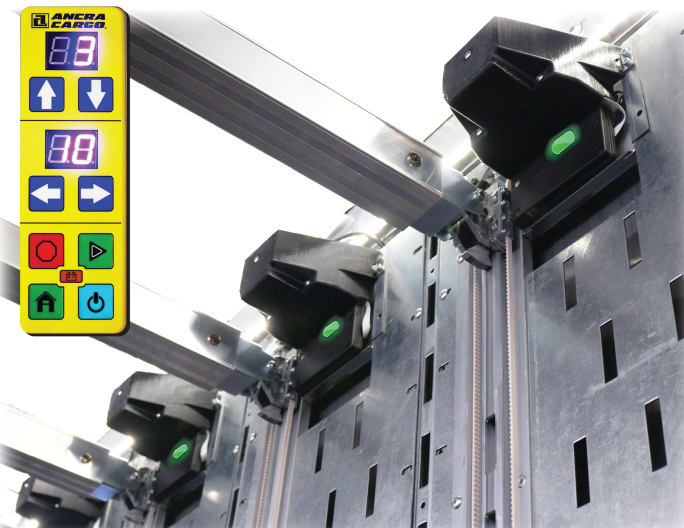
The AutoDeck decking-bar adjustment system from Ancra Cargo can be operated from the driver’s seat of a forklift, reducing loading time and labor costs while providing a safer work environment.
Photo: Ancra
Developing a business case to support the investment would require some analysis of the fleet’s traffic patterns and customer requirements. Certain applications would cost out better than others. Hauling kitchen cabinets, for example. The product is lightweight and high cube, and damage claims can really put a kink in customer relations — especially when a homeowner has to put up with a partial kitchen due to a damaged shipment. Since you can’t stack cargo like that, a decking system easily almost double the loading space.
Carriers regularly hauling high-cube, lightweight freight that can’t be stacked can almost always prove the ROI on a decking system costing between $4,000 and $8,000.
Going up one step further from a full decking system, Ancra Cargo’s AutoDeck system uses 12-volt electric motors to adjust the height of the decking bars. Jim Pearson, national sales executive at Ancra Cargo says, “the forklift operator can load the trailer without leaving the forklift or climbing over freight to adjust the beams. That can cut loading time by about 20%, and it can often be done by a single operator.”
There’s a push-button control panel located at the back of the trailer, where the forklift operator can lower a given set of bars into position and select the height. The operator then sets the pallets on the beams, brings in the next two pallets to set on the floor, and sets the height for the next row of beams.
Ad Loading...
Ancra says the electric lift mechanism reduces the possibility of injury to the loader from a falling beam or a pinched finger.
The system is powered by a 12-volt group 31 deep cycle battery connected to the trailer’s electrical system. It will operate 50 cycles on a full battery charge, and there’s a solar charging option available too, Pearson says. “The beams can also be lifted and lowered manually as well, so you won’t have to stop loading if the battery runs out.”
Elevators for LTL
Many less-than-truckload operators already use decking systems because of the irregular nature of mixed cargo. Decks make it easier to fill the space when stacking isn’t an option. Now LTL operators can load outside the box, literally, taking advantage of the void between the deck and the road.
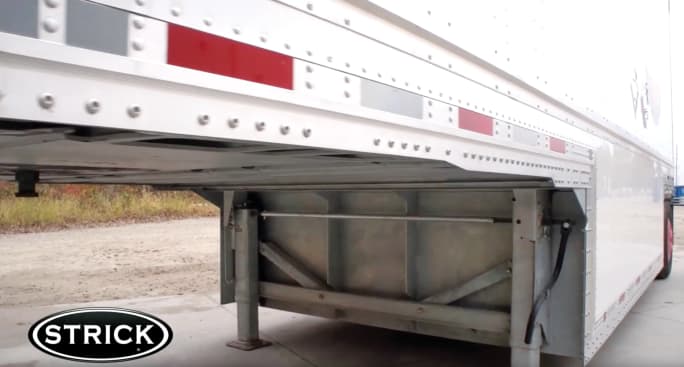
Strick Trailers, responding to a design request from a customer trying to maximize freight efficiency and driver utilization, has designed a belly-drop trailer with an elevator system that provides space for six additional pallets.
The Strick Elevator trailer is equipped with a motorized system that lowers palletized freight 34 inches into the drop-belly of the trailer. Inside, floor sections on hinges swing up to open access to the lower section. When closed, locked and fully stowed, the floor rating is 17,000 pounds – more than enough for a forklift. The floor panels can be left open in transit for tall cargos or closed when the space below is filled with shorter pallets. They also have red (open or unlocked), green (safe), and yellow (in motion) warning lights advising the operator if the floor is safe to drive on.
Ad Loading...
Strick trailers increased the cargo capacity of a 28-foot LTL trailer by 25% by dropping the floor 34 inches and adding three electric elevator section that can each accommodate two pallets weighing up to 5,000 pounds.
Photo: Strick
The trailer has a customized electrical system developed by Purkeys to support the lifting or lowering of up to 5,000 pounds with two actuators per section. The system is presently powered by the trailer’s electrical system, but plans are in the works for a plug-in power supply when backed into a dock.
“The unused space beneath the floor of the trailer is good for six pallets, or about 25% more cargo-carrying capacity,” says Jon Karel, vice president of national accounts at Strick Trailers. “In other words, it can carry the equivalent of 10 trailer loads with just eight trailers, or four trucks instead of five. There are fuel savings and emissions reductions as well as greater driver productivity.”
The system weighs about 4,000 pounds now, but it’s still new, Karel says. “We’re going to find efficiencies in manufacturing as the product evolves.”
A new kid on the block
Research for this story led us to a new player in the decking market. Doleco USA, which sells a line of cargo securement and lifting products including straps, logistics track, shoring bars and more, will unveil a decking system later this year. The company is in the final stages of field and stress testing with a major trailer OEM. (UPDATE: The new system was announced in September: Doleco Brings New Double-Decking Option to Market.)
A new cargo decking system from Doleco USA is currently in field testing with a major American trailer builder.
Photo: Doleco
“It will double the cargo capacity of a Class 8 trailer, while reducing cargo damage,” says Ralph Abato, president and managing director of Doleco USA. “Competition is a good thing, and the Doleco solution will give fleets and trailer manufacturers more options when it comes to payload-maximizing solutions.”
Ad Loading...
This article originally appeared in the May 2021 issue of Heavy Duty Trucking.
“Anything that takes the burden off the driver, that makes the equipment safer to operate, that meets the application, and provides a cost and maintenance savings to give a better return on investment over the life of a trailer” are options trailer buyers should consider.
Volvo’s updated D13 promises lower emissions without sacrificing performance or fuel economy. Take a closer look at what changed inside the engine in this HDT Spotlight video.
The Michelin X Multi Energy D2 is a regional haul drive tire engineered to help fleets improve fuel efficiency, durability and traction in demanding stop-and-go operations.
ZF is expanding its North American commercial-vehicle presence with new transmission applications, electrification, trailer technology and autonomous-driving systems.
Could Tesla’s camera-only autonomous driving technology work on an 80,000-pound Semi? In this commentary, HDT's Deborah Lockridge takes a look at Tesla, Cybercab, and how autonomous trucks see the road.
The U.S. Department of Transportation issued a new automated-vehicle strategy that outlines plans for driverless-truck regulations, cross-state freight corridors, and federal safety standards.
The Port Authority of New York and New Jersey announced millions in incentives for zero-emission drayage trucks, yard tractors, and new charging hubs near the port.
The National Highway Traffic Safety Administration says it lacks authority to regulate medium- and heavy-duty truck engines separately from complete vehicles, but the existing standards have not yet been eliminated.
Detroit isn’t starting from scratch to meet EPA 2027 diesel emissions standards. Its Gen 6 DD13 and DD15 engines keep much of today’s platform while updating the fuel and aftertreatment systems.