




How to Choose and Install an Inverter
Improperly installed inverters are known to have caused truck fires. There’s no reason to avoid using an inverter — just make sure it’s installed by someone who knows what they are doing.

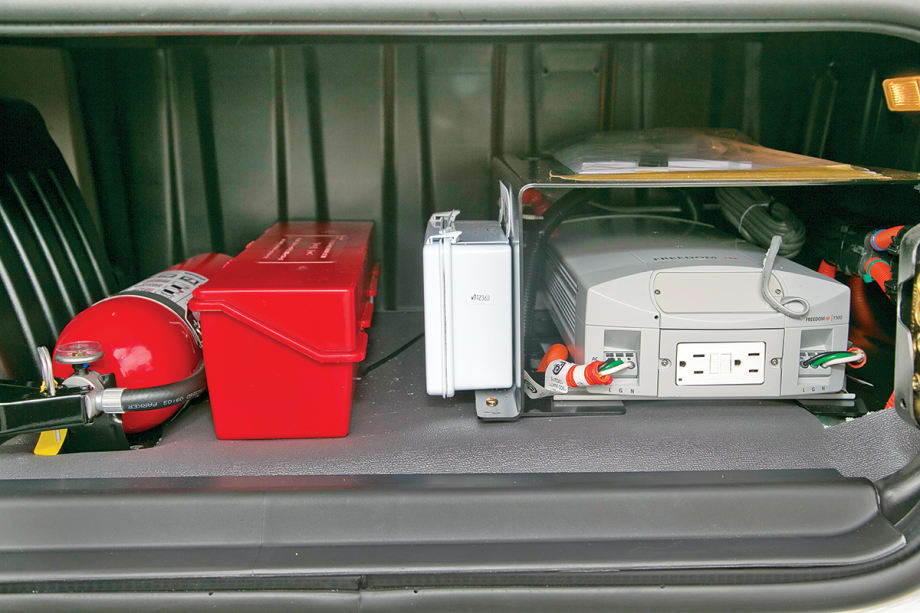
Inverters are usually installed under the bed or in a storage compartment. Care needs to be taken to protect the device from other objects in the compartment.
Photo: Xantrex
Truck drivers have been using AC/DC inverters for a couple of decades now. They are very versatile devices and must-haves in any sleeper cab. You’d think after all that time, drivers and technicians would have figured out how to install and use them properly. Yet every year we hear of several truck fires related to improper inverter installation or use. Some vehicles are completely consumed in those fires.
To put it into perspective, a fully loaded, 1,800-watt inverter can draw between 150 and 200 DC amps from the truck’s batteries/alternator (1,800 watts is about the same as a single 20-amp circuit found in homes). Those are usually peak loads, and the high current draw may not last more than a few minutes, but that can be enough to do some damage.
That much juice flowing through wiring that’s too thin or not securely connected can cause it to become extremely hot because of the additional resistance — hot enough to melt the insulation from wires or cause any adjacent flammable material to combust.
Not long ago, many fleets prohibited drivers from installing inverters in their trucks because of the risk of draining the batteries (resulting in no-starts in the morning) and the risk of fire. Drivers were known to jury-rig their inverters, often using alligator clips to connect directly to the batteries, but with too small a wire gauge. That sometimes resulted in damaged batteries, damaged appliances, and even fires.
Many fleets soon realized it was in their best interest to install their own inverters or order trucks with inverters right from the factory rather than trying to prohibit drivers from doing so.
“If you buy direct from an OEM, you’ll have the benefit of UL certification,” says Don “D.J.” Hasler, Xantrex strategic account manager. “That’s the first box the factory checks. And of course, engineering gets involved to make sure the correct sized cabling is used on the AC and the DC side, along with the proper-sized breakers and circuit protection. In other words, it’s installed properly.”
The downside to an OE-installed inverter is usually the price tag. Hasler says OEMs usually offer top-of-the-line models with features like DC charging and shore power plug-ins. When plugged into shore power, not only can you run your hotel loads, it also charges the batteries.
“Every fleet would want that,” he says. “It makes your batteries last so much longer and it keeps the truck from auto-starting to charge the batteries. The problem is, shore power still isn’t there yet in 2020,” as shore power stations are not widely available. “Since 90% of fleets can’t reap the benefits of shore power, they don’t want to pay for a Cadillac inverter with a bunch of features they can’t use.”
Follow the Instructions
Many fleets now install their own inverters. They can pick the product they feel is right for the application and have skilled and trained technicians install the devices. But there’s still some risk of the techs taking shortcuts, such as not routing the cable correctly or using the wrong gauge of wire.
“Make sure proper polarity is observed between the battery and inverter DC input,” cautions Keith Randolph, field application engineer with Eaton’s eMobility Controls and Power Conversion division. “Wiring connections must be snug, as loose connections may overheat due to high resistance and even lead to risk of fire if not properly circuit-protected.”
Cable length and routing is also a concern. Longer cable runs increase the voltage drop and add resistance to the circuit. Try to place the inverter as close to the batteries as is safe and practical, and check technical data on cable length, gauge, and voltage drop.
“Improper wire, undersize or improper circuit protection, can lead to equipment failure and even possible circuit fire,” Randolph says. “Wiring must be routed securely and clear of any sharp edges or extreme heat, such as when routing through the cab floor and under the cab when near the heat of the engine or exhaust systems.”
Hasler explains that while the batteries and the inverter may not be that far apart physically, by the time you route the cabling through the floor, around the various corners and keep it protected from heat and corrosion, the cable run can get pretty long. “That’s where the correct cable sizing becomes important,” he says. “It’s probably going to be longer than you’d first expect.”
Right from the Start
You can minimize problems by starting with the correct product for the task. Make sure the inverter you select meets or exceeds SAE J1455, UL 458 standards for electrical integrity and vibration.
“A truck application is a harsh environment compared to a stationary environment that many inverters are designed for,” cautions Randolph. “Non-approved inverters may initially cost less, but they can increase maintenance costs and can create safety hazards, including potential fires.”
To prevent overloading and to optimize performance, determine how the inverter will be used, what devices it will power, and what the duty cycles will be. It is important to size the inverter for the power output that the intended AC loads require on a continuous basis and for any necessary start-up surge requirement.
Inverters produce different types of AC waveforms. The two most common types of waveforms are true sine wave and modified sine wave. True sine wave inverters produce an AC waveform that is almost identical to the waveform found in your home.
In certain applications, true sine wave inverters are required due to the compatibility requirements of the AC device to be powered, such as radios, amplifiers, CPAP machines, some televisions, some microwaves and variable speed motors, such as drills. As well, some ground fault circuit interrupt (GFCI) devices may not operate properly off of a modified sine wave inverter.
Inverters that operate at higher efficiencies will draw less current from the batteries and will run cooler compared with lower efficiency-rated inverters. Inverter efficiency ratings typically range from 75-90%.
All those factors will determine how well the product will work in its intended environment, and it’s all starts with selecting the proper device and installing it carefully and correctly.
Hasler says Xantrex has manuals and installation videos online to help with the installation and even has teams that will install fleet orders. “There’s some cost involved whether you have your own techs do it, or have an expert do it for you,” says Hasler. “In the end, there’s some value in the peace of mind that comes from having it done right the first time.”
To the uninformed consumer, an inverter may just be a fancy colored box with a few wires and a couple of plugs on it. But the uninformed consumer may not realize that the $79 1,000-watt inverter from Amazon can’t deliver everything they want and could even cause some serious problems.
“The bottom line is that electrical systems are complicated,” says Eaton’s Randolph. “Careful product selection and professional/trained installation is always recommended to ensure safety.”
More Maintenance

Color Match Smarter: Tools That Restore & Perform
For fleet managers and collision repair professionals keeping heavy-duty trucks on the road, getting the color right the first time isn't just about appearance — it's about efficiency, turnaround time, and bottom-line results. Discover how today's digital color tools are transforming the repair process from guesswork to precision.
Read More →
Wrong Repair Prompts Recall of Freightliner, Western Star 4x2 Trucks
DTNA is recalling more than 2,400 trucks that received an incompatible software fix instead of the hardware repair required to address brake valve corrosion.
Read More →
Truck Drivers Need More Than Another Alert
Fleets have more visibility into truck health, safety events, and driver activity than ever. The next challenge is turning all that information into useful guidance for the person who has to decide what to do next.
Read More →

The Maintenance Checks Trucking Fleets Should Prioritize Before Fall Freight Picks Up
Making it through August isn’t the same as being ready for the next several months of operation. Find out what systems may have suffered from summer heat and need to be checked out before fall.
Read More →
What Three Fleets Are Doing Differently When Buying Truck Parts in 2026
With freight improving but costs still climbing, fleet maintenance executives explain how they're balancing price, quality, and supplier relationships.
Read More →
Paccar Recalls 2027 Trucks Built This Summer for Possible Electrical Problem
The nearly 6,000 Kenworth and Peterbilt trucks in the recall could potentially lose engine power, among other things.
Read More →
Will API PC-12 Oil Change Trucking Fleet Maintenance?
The new API PC-12 heavy-duty engine oil category reflects the changing demands of modern diesel engines. But fleets like Foodliner are looking to getting their own data before making decisions on adopting the new oils and questions such as extending oil drain intervals.
Read More →
Brake Safety Week to Focus on Drums and Rotors
Commercial vehicle inspectors are focusing on truck brakes during CVSA's Brake Safety Week, August 23-29.
Read More →Possible Battery-Cable Fires Prompt Recall of 15,000+ International MV and HV Trucks
On the recalled vehicles, manufacturing variations can cause the battery interconnect cable to contact the auxiliary stud and hold down the bracket.
Read More →
Rush, MCT Team Up to Grow Refrigeration Service Network
The joint venture will operate MCT's network of Carrier Transicold dealerships and mobile service locations, with the companies promising greater service capacity and uptime for refrigerated fleets.
Read More →