




How Mack Sees the Next Era of Fleet Intelligence
Telematics has evolved from simple vehicle tracking into a connected service platform that can help fleets boost uptime, improve specifications, and move toward predictive maintenance. Mack executives say AI is now giving fleets a way to turn all that vehicle data into faster, smarter decisions.


Mack experts say connectivity is no longer just about seeing the truck. It is about understanding the truck, anticipating what comes next, and making better decisions before downtime ever happens.
Mack Trucks/Canva
For years, telematics in trucking was often framed as a visibility tool: where is the truck, how fast is it moving, how much fuel is it using, and what fault codes is it throwing?
That is still part of the picture. But for fleets trying to improve uptime and control total cost of ownership, telematics is becoming something much bigger.
The technology is now turning into an operating layer that connects trucks, components, dealers, service teams, and fleet managers in ways that can make maintenance more proactive and vehicle performance more precise.
That was a key takeaway from a conversation at TMC with Marty Foulks, product manager for Mack’s GuardDog Connect platform, and Ashish Sadhu, services director for Mack Trucks.
Their message was straightforward: fleets are finally moving beyond the idea of connected vehicles as a nice-to-have feature and starting to treat them as a core part of running the business.
And increasingly, AI is what makes that data useful.
From Data Collection to Decision Support
Foulks described connected vehicle services as resting on three pillars: awareness, intelligence, and uptime.
The awareness piece is the most familiar. Fleets need to know what is happening with their vehicles. They need visibility into faults, performance trends, and operating conditions. But raw awareness alone is not enough.
“The next step is intelligence,” Foulks said. “It is one thing to know a truck has a problem. It is another to know what that problem means, how urgent it is, what action should be taken, and whether the issue is likely to affect uptime.”
That is where the connected vehicle model starts to mature, he explained. Instead of simply surfacing codes and alerts, the system begins to interpret them.
It can share information not only with the fleet, but also with dealers, service personnel, and support teams so the right response can happen faster.
For fleets, that matters because downtime is rarely caused by a lack of data. More often, it comes from a lack of clarity about what the data is saying.
Why Fleets Want Fewer Portals and More Integration
One of the enduring frustrations in fleet technology is fragmentation. A fleet may have trucks, engines, transmissions, bodies, mixers, cameras, and other systems from multiple suppliers, each with its own sensors, dashboards, and login credentials.
That creates complexity fast.
Foulks said Mack has been trying to consolidate more of that information into a single experience for customers, pulling diagnostics and operational insights into one platform instead of asking fleets to bounce between multiple portals.
He also pointed to Mack’s API-based data interface as a way for larger fleets to pull information into their own systems. Especially when they are managing mixed-OME operations.
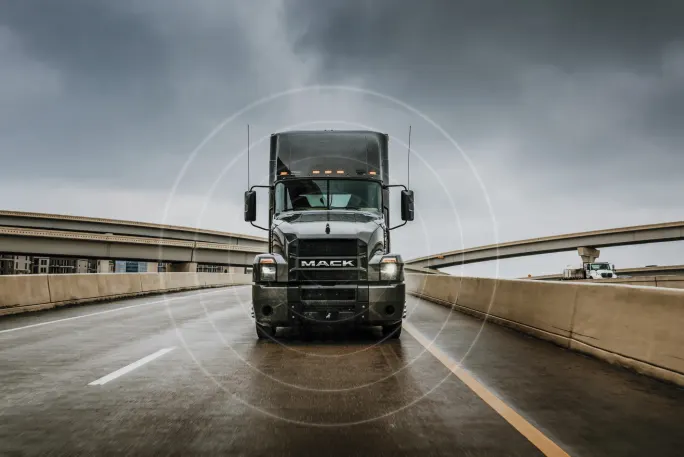
Data coming off of trucks today not only helps fleets. It also helps manufacturers understand whether a component is underperforming or if a supplier issue exists.
Mack Trucks
That issue is becoming more important, not less. Fleets do not need more disconnected streams of information. They need a way to combine vehicle health data, operational data, and service intelligence into something they can actually use.
In practical terms, the value of telematics rises when it becomes easier to act on.
What AI Actually Does for Fleets
Both executives were careful not to treat AI like magic. Foulks acknowledged the term is overused, which is true across nearly every industry right now. But he also gave a clear definition of what it can do inside a connected truck environment.
At its core, AI looks for patterns.
It learns how a truck, a component, or an operation is supposed to behave under normal conditions. Then it detects when temperatures, pressures, loads, or other behaviors start moving outside those norms. Over time, it can connect those changes to degradation, likely failures, or lower-than-expected performance.
That matters because no human being can manually process that amount of information at scale.
A single truck generates a large amount of operating data. A fleet of 20 trucks generates far more. A fleet of 1,000 trucks creates data volumes that can overwhelm even sophisticated internal teams. AI gives fleets a way to recognize patterns inside that complexity.
And those patterns can be analyzed at multiple levels.
A fleet might look at one component, like a turbocharger, and track how its performance changes under certain workloads and temperatures. It might look at one vehicle to see whether it is operating outside expected parameters. It might compare a group of trucks working in one application against another group in a different duty cycle. Or it might use broad fleet-level data to spot trends that affect an entire operation.
That is where AI starts to “super-power” telematics: not by replacing human judgment, but by narrowing the search, identifying anomalies, and speeding up the path to action.
Predictive Maintenance Moves Closer to Reality
The most compelling use case may be predictive maintenance.
Instead of waiting for a part to fail or relying purely on fixed maintenance intervals, fleets can begin to understand how components degrade in the real world. If the system recognizes that a part tends to fail after certain trends appear, it can warn the fleet before that failure occurs.
Sadhu used the example of a component such as a turbocharger. If a connected system can see how inputs and outputs shift over time, and it knows when the part was repaired or replaced, it can start building a degradation curve. With enough data, AI can estimate when that component is likely to need service again.
That same logic can go much deeper. Say, for example, a supplier delivers a bad series of components to an OEM – say a coolant reservoir tank or hoses that are failing sooner than normal due to an isolated manufacturing issue.
AI can pick up on this anomaly, determine the serial numbers of affected products, and incorporate that knowledge into its decision-making processes, Sadhu said.
That is important not only for fleets, but for OEM engineering teams as well. The data can feed back upstream, helping manufacturers understand whether a component is underperforming, whether a supplier issue exists, and what changes might be needed.
In other words, Sadhu said, connected vehicle data is no longer just a maintenance tool. It is also becoming a product-improvement tool.
Better Data Can Also Improve Spec Decisions
Telematics is often discussed in a maintenance context, but Sadhu made clear it also has implications for vehicle specification.
A fleet operating in Reno may have very different performance demands than one running in Atlanta, he noted. Terrain, climate, loads, stop-and-go duty cycles, and service patterns all affect what powertrain or component package makes the most sense.

AI can "super-Power" fleet telematics, Ashish Sadhu says, not by replacing human judgment, but by narrowing the search, identifying anomalies, and speeding up the path to action.
Mack Trucks
Sadhu said Mack already has tools that help dealers and customers compare truck performance by operation, geography, and use case. That creates the possibility of more evidence-based spec’ing.
“Instead of relying only on habit or anecdotal experience, a fleet can compare how certain combinations perform in one environment versus another,” he explained. “The same connected vehicle infrastructure that supports uptime can also help answer questions such as which axle, maintenance interval, or powertrain configuration best fits a given application.”
For fleets chasing lower TCO, that is a significant shift.
Fleets Have to Catch Up, Too
Technology adoption is only part of the story. The management structure around it also has to evolve.
One common frustration is that many fleets are still organized around older business processes that do not fully match what connected vehicles can now deliver. If telematics data flows to one person who lacks the tools, time, or authority to act on it, the value gets trapped.
Sadhu said Mack is already seeing some fleets build more capability around this, bringing new competencies into their organizations and treating connected vehicle intelligence as a shared operational resource rather than a narrow IT function.
He also said pressure is flowing back onto OEMs and dealers, which now have to make sure their sales, service, and application teams can have more sophisticated data-driven conversations with customers.
That may be one of the clearest signs the market is changing: telematics is no longer just a feature set. It is becoming an organizational capability.
The Next Step Is Edge Computing and Autonomy
It is important to remember that as cutting-edge as AI-maintenance technology already is – it is still evolving. And fleets need to have some understanding of where it is headed next.
Sadhu said the commercial vehicle industry is already moving toward more software-defined vehicles and edge computing.
Edge computing is when analysis of a problem or condition actually happens on the truck itself, rather than sending raw data back to the office where it is analyzed.
In the edge computing telematics model, the component or vehicle can process information locally, interpret what it means, and transmit a more useful result upstream.
That matters even more in future autonomous operations.
If trucks are going to run with increasing levels of automation, the connected vehicle stack becomes even more important, Sadhu said. Fleets and depots will need to know when the vehicle is arriving, what service it needs, whether sensors are aligned, what components are trending toward failure, and what work should be done during a narrow service window.
That is still an emerging model in trucking, but the building blocks are already visible: telematics, AI, predictive maintenance, and increasingly intelligent vehicles that can diagnose more of their own condition before they ever reach the shop.
For fleets, Sadhu and Foulkes said connectivity is no longer just about seeing the truck. It is about understanding the truck, anticipating what comes next, and making better decisions before downtime ever happens.
More Maintenance

Color Match Smarter: Tools That Restore & Perform
For fleet managers and collision repair professionals keeping heavy-duty trucks on the road, getting the color right the first time isn't just about appearance — it's about efficiency, turnaround time, and bottom-line results. Discover how today's digital color tools are transforming the repair process from guesswork to precision.
Read More →
Wrong Repair Prompts Recall of Freightliner, Western Star 4x2 Trucks
DTNA is recalling more than 2,400 trucks that received an incompatible software fix instead of the hardware repair required to address brake valve corrosion.
Read More →
Truck Drivers Need More Than Another Alert
Fleets have more visibility into truck health, safety events, and driver activity than ever. The next challenge is turning all that information into useful guidance for the person who has to decide what to do next.
Read More →
The Maintenance Checks Trucking Fleets Should Prioritize Before Fall Freight Picks Up
Making it through August isn’t the same as being ready for the next several months of operation. Find out what systems may have suffered from summer heat and need to be checked out before fall.
Read More →
What Three Fleets Are Doing Differently When Buying Truck Parts in 2026
With freight improving but costs still climbing, fleet maintenance executives explain how they're balancing price, quality, and supplier relationships.
Read More →
Paccar Recalls 2027 Trucks Built This Summer for Possible Electrical Problem
The nearly 6,000 Kenworth and Peterbilt trucks in the recall could potentially lose engine power, among other things.
Read More →
Will API PC-12 Oil Change Trucking Fleet Maintenance?
The new API PC-12 heavy-duty engine oil category reflects the changing demands of modern diesel engines. But fleets like Foodliner are looking to getting their own data before making decisions on adopting the new oils and questions such as extending oil drain intervals.
Read More →
Brake Safety Week to Focus on Drums and Rotors
Commercial vehicle inspectors are focusing on truck brakes during CVSA's Brake Safety Week, August 23-29.
Read More →
Possible Battery-Cable Fires Prompt Recall of 15,000+ International MV and HV Trucks
On the recalled vehicles, manufacturing variations can cause the battery interconnect cable to contact the auxiliary stud and hold down the bracket.
Read More →
Rush, MCT Team Up to Grow Refrigeration Service Network
The joint venture will operate MCT's network of Carrier Transicold dealerships and mobile service locations, with the companies promising greater service capacity and uptime for refrigerated fleets.
Read More →