



More in this series:
Part 1: Understanding AI in Trucking
Part 2: The Ultimate 'Plug and Play' Technology for Trucking?
Part 3: Risks and Roadblocks Facing AI in Trucking
Part 4: What Can Artificial Intelligence Do For Trucking Fleets?
 MENU
MENU SEARCH
The first in a series of stories detailing the rise of artificial intelligence in the trucking industry looks at the basics: What is AI? How does it work? What does it do?
AI is the ability to train computers to observe the world around them, gather information from it, draw conclusions from that data, and then take some kind of action based on those actions.
Image: HDT Graphic/Getty Images/Stockphoto
And suddenly, just like that, you had to add artificial intelligence to the list of new technologies you need to learn about and implement.
If you feel that way, it’s understandable. In the past year or so, artificial intelligence, or AI for short, has jumped off the movie screen and onto pretty much every industry news story you read, or email you get.
If all those killer-cyborg movies we saw growing up are any indication, then AI sounds like pretty serious stuff. Or at least something that’s going to be complicated to learn and difficult to use… assuming you know what it can be used for in the first place.
Both assumptions are partly correct. AI does represent a next-generation leap forward in terms of power, functionality and efficiency for computers and software programs. While autonomous trucks are probably the flashiest example of where AI is being implemented, it has potential applications for every part of a trucking business.
In simple terms, AI is the ability to train computers — or currently, to program software systems, to be more specific — to observe the world around them, gather information from it, draw conclusions from that data, and then take some kind of action based on those actions.
In the movies, this generally means computers take a look around, decide that humans are evil, and then set about trying to kill all of us.
To be fair, there are some very smart people who are worried that something along those lines might happen one day, if we as a society are not careful about how we regulate and constrain AI in its early stages.
In reality, most AI systems today are limited in terms of the scope and scale in which they can view the world. They are fine-tuned to specialize in certain disciplines or activities. In trucking, that could be predictive maintenance, distracted driving detection, analyzing contracts, or autonomous driving.
In these and other applications, AI can be very useful in helping humans perform mundane or repetitive tasks quickly and efficiently. AI can also analyze massive of data and not only draw conclusions on it, but also make recommendations or informed decisions using that data, and put it to use in ways that complement your management goals.
But how, exactly, does AI work? How does it do those things? Is it difficult to install, learn and use? How powerful a tool is it?
Artificial intelligence refers to the simulation of human intelligence in machines that are programmed to think and learn like humans, according to Hans Galland, CEO, BeyondTrucks, a developer of smart automation work systems for fleets.
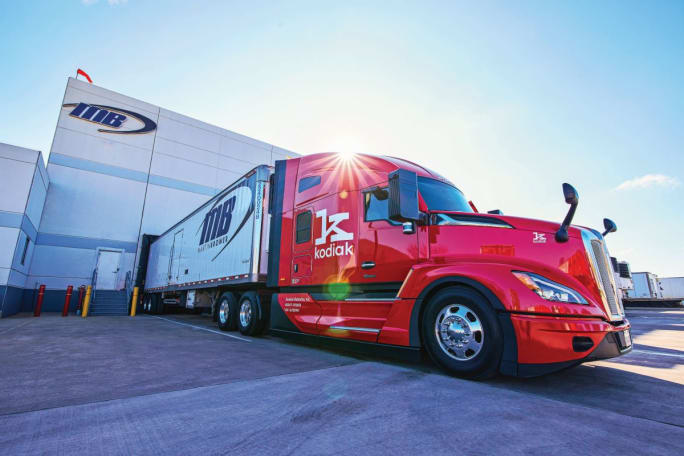
Autonomous truck developers like Kodiak Robotics are using AI to help the vehicle control systems "learn" how to drive and avoid having to write code for every possible traffic scenario that could possibly arise.
Photo: Kodiak Robotics
Galland says AI differs from traditional computer programs, which are designed to follow predefined instructions and execute specific tasks based on programmed algorithms.
AI systems, instead, can learn from data, adapt to changing inputs, and make decisions or predictions without explicit programming for every possible scenario.
Today, Galland says, some of the most advanced artificial intelligence applications include optimization where the performance of a computer can exceed that of a human. This is because computers can evaluate the various outcomes of a series of decisions faster and pick the best decision sequence, incorporate probabilities, and avoid behavioral biases that humans are subject to.
Image: HDT Graphic/Getty Images/Stockphoto
AI isn’t just one thing, says Alan McMillan, president, Intangles, a developer of software platforms to optimize fleet performance. It’s a whole new type of computing system that can be applied in almost limitless ways to boost human productivity.
“There are many different branches of AI, from search to pattern recognition to genetic programming,” McMillan says. “And because AI is still developing, there are many concepts or topics that haven't even been developed yet, including applications that will be transformative for the trucking industry.”
Before AI, computer systems were used primarily to run programs that were based on an “if-then” method of engagement, explains Anar Mammadov, technical co-founder, last mile, supply chain and logistics, Senpex, which develops same-day and on-demand delivery solutions for e-commerce and wholesale businesses.
“As a result, the extent of their usefulness was limited to their programming, but AI can go well beyond mere programming.
When built properly, McMillan adds, an AI-based solution should enhance an operation and improve efficiencies while complementing the existing work that is being done by an operator.
“AI in its first phase is only providing insights, faster and more comprehensive than a human,” he says. “However, the real power comes when these insights are turned into action items to empower a fleet operator to get things done.”
AI could be used to improve efficiency and transparency in areas such as:
Advanced safety systems
Autonomous vehicle technology
Pricing and bidding
Routing optimization
Automating back-office functions
Taken as a whole, AI is poised to become one of the most transformative management systems for fleets, ever, McMillan says.
“We expect AI will totally change the nature of work at trucking companies. The proportion of time people spend on repetitive work like data entry will decline.”
At the same time, McMillan predicts that the percentage of challenging work people do at fleets will increase.
Most importantly, he says, tasks that require advanced manual skills (such as diesel technicians); a high level of judgment (safety supervision or management), emotional skills (customer service or people management), or highly technical skills (data science) will be in high demand and take up most of employees’ time.
Editor and Associate Publisher Deborah Lockridge contributed to this article

For fleet managers and collision repair professionals keeping heavy-duty trucks on the road, getting the color right the first time isn't just about appearance — it's about efficiency, turnaround time, and bottom-line results. Discover how today's digital color tools are transforming the repair process from guesswork to precision.
Read More →
Carriers whose updates were due on or after June 1 have more time, while FMCSA works to stabilize its new registration system and warns of phishing sites impersonating its new carrier registration system, Motus.
Read More →
Cargo theft is no longer just the cost of doing business. It's a multi-billion-dollar criminal enterprise exploiting vulnerabilities across your fleet, drivers, and supply chain.
Read More →
Explore how telematics help refrigerated fleets improve visibility, uptime, efficiency, compliance, and cargo protection across connected cold chain operations.
Read More →
Escalating U.S.-Canada tariffs could disrupt cross-border freight, reduce truck volumes, raise costs, and create new uncertainty for carriers on both sides of the border.
Read More →
The American Transportation Research Institute wants to know what's worrying trucking fleet managers, drivers, and other stakeholders in its annual Industry Issues survey.
Read More →
ATA President and CEO Chris Spear abruptly left his job at the association on August 21, at a pivotal time for the trucking industry.
Read More →
Public Wi-Fi can expose truck drivers and fleets to credential theft, malware, and other cyber threats. Here’s how to reduce the risk on the road.
Read More →
HDT Truck Fleet Innovator Nicky Cupp turns everyday pain points at Fraley & Schilling into opportunities for better technology and smarter processes.
Read More →
HDT Truck Fleet Innovator Adam Buttgenbach helped PepsiCo build one of North America’s largest EV fleets by focusing on where electric trucks make operational sense.
Read More →
