




In-Cab Coaching Apps Can Coax Better Fuel Economy
Encouraging drivers to drive more efficiently through coaching tools and reviews will get fleets further than limiting or taking away performance features.

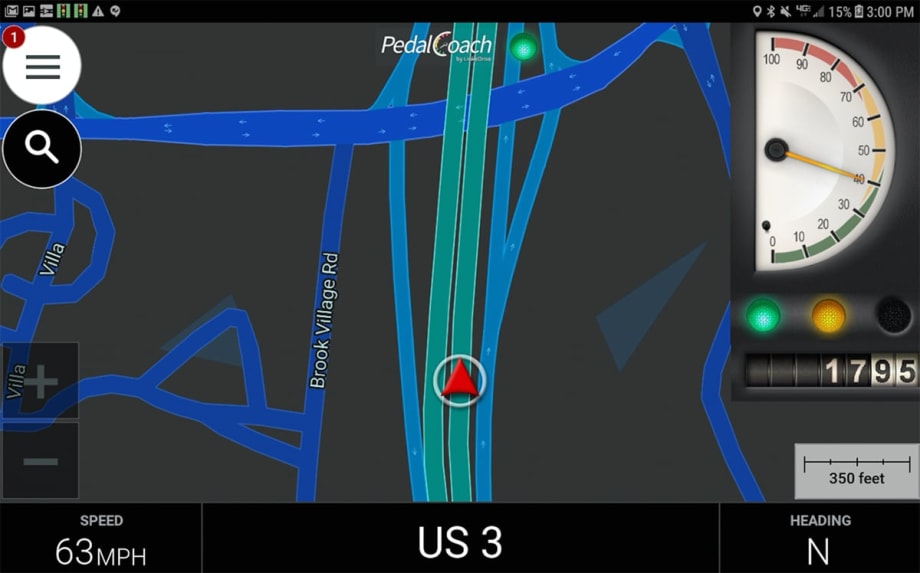
PedalCoach's gauge display is a visual representation of fuel consumed at any given moment. The more time the driver spends in the green zone, the better his or her fuel economy will be.
Courtesy of PedalCoach
How do you coax drivers to operate more fuel efficiently? Paying fuel bonuses may seem like a good idea, but it's almost impossible to manage a fuel incentive program based solely on fuel consumed, because it’s not seen as fair.
Drivers will argue, rightly, that there are too many variables at play to compare mpg performance, even on two identical trucks on identical routes. Factors such as traffic density, weather, schedules, and even tire tread depth come into play.
But what if drivers were rewarded for driving the truck properly, for coaxing every last mile out of a gallon of fuel, rather than using an mpg-based system or punishing drivers for poor performance? That’s the premise of in-cab coaching apps such as Isaac Coach, True Fuel, and Pedal Coach.
“What's 7 mpg anyway?” asks Jeff Baer, founder and CEO of LinkeDrive, developer of the PedalCoach in-cab coaching app. "Without some context, the mpg gauge doesn't know if 7 mpg is good or bad. Would you bonus a driver that gets 7 mpg with a load of ping-pong balls? How about a load of brick?"
PedalCoach gives drivers visual cues to help them drive more efficiently by constantly calculating the optimal fuel rate at any moment. It gives drivers a moving consumption target that doesn’t penalize them for heavy loads, old trucks, headwinds, traffic density, etc. It simply encourages proper operation of the truck.
Isaac Instruments takes a similar approach with its Isaac Coach application, bundled into its fleet management devices. It uses visual indicators to coach drivers on proper throttle management and gear selection while providing a performance-based scorecard for realistic comparison of drivers' eco-driving skills.

Isaac Coach uses colored dots to represent throttle pedal position and fuel input, along with words such as “coast” or “accel” to encourage certain driver behavior.
Courtesy of Issac Coach
“Isaac Coach takes the actual fuel mileage out of the equation, and instead monitors how efficiently the driver operates the truck,” says Jean-Sebastien Bouchard, Isaac Instrument's vice president of marketing. “You could score any two drivers in the world accurately and fairly using Isaac Coach."
The True Fuel application from Vnomics takes a similar approach, but uses an audible alert to warn drivers when they are going outside the envelope. Using algorithms developed in-house, True Fuel calculates the maximum potential fuel economy at any moment in time and compares precisely to actual fuel consumed. If the driver is operating correctly, nothing happens. If drivers accelerate too hard, take engine revs too high, or exceed a set speed limit, they hear a beep alerting them to outside-the-envelope performance.
“We feel that feedback in the cab should be exception-based and audible rather than visual for safety reasons,” explains Lloyd Palum, Vnomics' chief technology officer. “True Fuel is an easy-to-understand tool that gives drivers the ability to master fuel-efficient driving for themselves.”
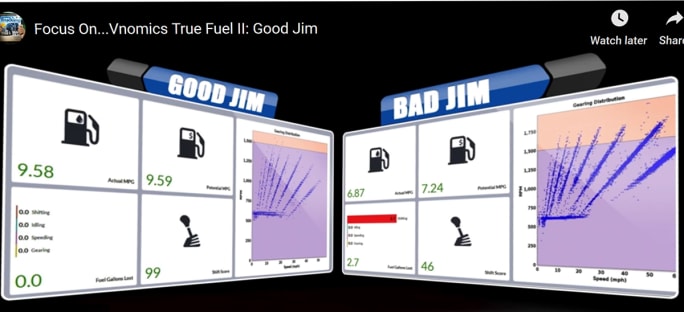
Vnomics uses an audible signal in the cab to indicate when certain thresholds have been exceeded. Reports can be produced showing driver fuel and shifting scores as well as fuel burned and fuel wasted.
Courtesy of Vnomics
While these apps might deliver their message in slightly different ways, they have several things in common:
They tap into the truck's data port and draw fuel consumption numbers and vehicle parameters directly from the ECM;
They provide drivers with indications of how well they are driving to encourage better performance; and
They provide feedback and score drivers based on technique, independent of actual fuel consumption (though that may be included as well).
“PedalCoach is as much a driver engagement tool as it is a fuel-saving device,” Baer explains. “We don't make assumptions on the amount of fuel used, just that the driver is using the minimum amount of fuel possible to maintain speed. For every mile drivers keeps the gauge in the green, they get a point. When the trip is over, the number of points over miles is the PedalCoach score. It really just indicates how hard the driver is trying to conserve fuel, regardless of what they have to work with."
What the Driver Sees
Vnomics’ True Fuel, on the surface, has the least intrusive interface. The black box connected to the data port can be hidden away anywhere. The driver sees nothing, but hears an alert tone when he or she is exceeding some parameter. At the end of each leg of the trip, when the key is turned off, the system announces the driver's score. A score of 100 would be perfect. This near-immediate feedback for the driver is a much better coaching tool than sitting down with a supervisor a week or two after the fact to review reports, Palum says. By that time, the driver will have forgotten the incident, and it will be of no value as a teaching tool.
“There are two prongs to what we do for a teaching experience,” Palum says. “The first is the audible feedback at the moment in time you’re doing something inefficient. The other is a ‘game-film’ approach where the driver can review a previous run and get detailed information about the truck he or she was driving, where the waste was sneaking in and under what conditions.”
A visually appealing report shows actual mpg for a trip, potential fuel economy (an estimated number based on sticking with best operating practices), as well as “gallons lost” field showing how much fuel was wasted. In addition to an overall 0-100 driver score, there's a gear-shift distribution showing truck and engine speed, as well as gear selection and time at certain rpm in certain gears. This is a very clear reminder of whether drivers are using progressive shifting.
The Isaac Coach interface is visual. On a tablet screen, the driver will see three green or yellow circles. Data on the truck’s weight, speed, terrain come from the ECM, and the algorithm calculates potential fuel savings compared to actual fuel used based on inputs such as which gear the truck is in and the percentage of the throttle pedal input.
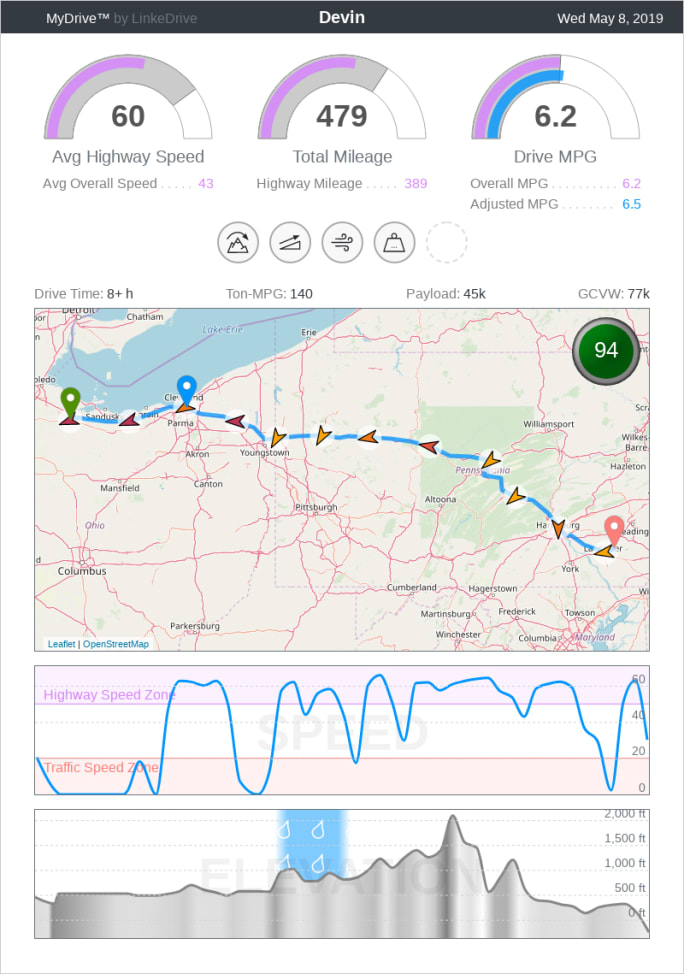
The MyDrive report from PedalCoach is emailed to drivers at the end of the driving shift so they can review the day's performance while it’s still fresh in their minds.
Courtesy of PedalCoach
Three green circles indicate more throttle can be safely applied; three yellow circles means the driver is close to the throttle input limit. If the word "accel" appears on the screen, the driver has exceeded the throttle input and should back off a little. If the driver removes his or her foot from the pedal and coasts, the word “coast” appears, and this earns extra points. The word “shift” appears when the driver exceeds a certain rpm in a certain gear, or when traveling faster than 90 km/h when not in top gear (that’s about 56 mph; Isaac Coach is based in Canada.)
“Even if all the fleet’s trucks are doing different operations – city, highway, heavy or lightly loaded – they are all scored the same way with Isaac Coach,” Bouchard says. “It’s not the actual fuel consumption that matters; it’s how well the driver operated the trucks by following the prompts on the tablet. The fuel economy follows when the driver is driving properly.”
With PedalCoach, the driver interface is more visually oriented, displaying what looks like a speedometer with numbers from 0 to 100. Here lower is better, like golf. The gauge is shaded green (0-45), yellow (25-75) and red (65-100). Essentially, the gauge displays the relationship between the fuel going into the engine and the vehicle speed, and the rate of change of those two signals.
“We're also looking at pedal position and what they are doing with the brakes and everything else,” Baer says. “It’s very simple for the driver. All they have to do is keep it in the green and they are operating in the most economical range of the engine under a certain set of conditions – uphill, into a headwind or on flat ground."
If the driver encounters a hill or a sudden change in wind direction, trying to maintain the same speed will require more fuel, so as he or she steps on the pedal, the gauge creeps upward into the yellow or even the red. Staying in the green might require giving up a few miles per hour to maintain efficiency.
At the end of each day the driver is emailed a daily summary report called MyDrive. It shows details from the trip, including miles driven, at highway speed and in the city, weather conditions with wind direction and speed at various points along the route, and a few other useful summaries.
Using These Tools in Your Fleet
“Use of these tools lines up with how the fleet is already doing in terms of a culture of performance and cooperation with its drivers,” Palum says. “If the fleet feels that it doesn't have a constructive relationship with its driver pool, then introducing something like this, where there's already a lack of trust, can be counterproductive. The fleets that do the best are those that have a culture of trust.”
Palum went on to describe such a fleet, where the drivers are saying “Hey, please give us another decimal point in the score so we can break a tie.”
“They have moved beyond the bickering and mistrust and they are really trying to master driving for efficiency,” Palum says. “We work with the customers to help build that sort of culture. It’s the carrot versus the stick approach. Coaxing and coaching versus coercion.”
More Fuel Smarts

How Volvo Updated Its D13 for EPA 2027 [Watch]
Volvo’s updated D13 promises lower emissions without sacrificing performance or fuel economy. Take a closer look at what changed inside the engine in this HDT Spotlight video.
Read More →
Diesel Price Spike Shortens Payback for Natural Gas Trucks, Report Says
Energy Vision estimates fleets could recover the higher purchase price of an RNG-fueled Class 8 tractor in 1.3 to 2.8 years under current fuel-price scenarios.
Read More →
Calstart Becomes Catalyst Mobility, Reflecting Broader Focus
Calstart is now Catalyst Mobility, reflecting the nonprofit’s growing national role in clean transportation, including zero-emission trucks, infrastructure and incentive programs.
Read More →

Record Diesel Prices Squeeze Trucking Fleets
Average U.S. diesel prices have climbed to nearly $6 a gallon, surpassing the 2022 record as tight refinery capacity and Middle East disruptions keep fuel costs elevated.
Read More →
How Fuel Delivery Shapes Engine Performance
Fuel delivery depends on more than what happens at the injector. For fleet, maintenance and technical professionals, looking at the full path from pump to injector can provide useful context for understanding engine performance.
Read More →
East Coast Port Launches $45M Electric Truck Push
The Port Authority of New York and New Jersey announced millions in incentives for zero-emission drayage trucks, yard tractors, and new charging hubs near the port.
Read More →
California Bill Could Shed Light on Electric Truck Prices
Why do battery-electric Class 8 trucks remain so expensive? A California bill headed to Gov. Gavin Newsom would give fleets and state agencies more visibility into what manufacturers charge.
Read More →
Detroit Opens Orders for EPA 2027 Engines
Detroit isn’t starting from scratch to meet EPA 2027 diesel emissions standards. Its Gen 6 DD13 and DD15 engines keep much of today’s platform while updating the fuel and aftertreatment systems.
Read More →
Zero-Emission Truck Corridor Planned for West Coast
California, Oregon, Washington, British Columbia and Baja California are coordinating plans for truck charging and hydrogen fueling from Canada to Mexico.
Read More →
A Closer Look at Kenworth’s Electric T880E Vocational Truck [Video]
Learn more about Kenworth's T880E battery-electric vocational truck at the Paccar Technical Center, including its range, applications, upfitting considerations, and PTO options, in this HDT Spotlight video.
Read More →