HDT’s editors reflect on what trend, event, person, or company was in our headlines the most and had the greatest impact on the trucking industry.
Before the novel coronavirus upended supply and demand and logistics across the globe last year, most people had probably never even heard the term “supply chain” or given it much thought. COVID-19 changed all that, and what was thought to be a temporary supply-chain problem in 2020 has shown itself in 2021 to be a much more complex and ongoing issue.
Store shelves were understandably empty in the early days of the pandemic, as suddenly demand for things such as hand sanitizer and Clorox wipes outstripped supply, as well as products such as toilet paper and meat because of panic-buying in the face of unknown lockdowns.
If you were an editor at HDT, what would you vote as the biggest news of 2021?
— Heavy Duty Trucking (@HDTrucking) December 8, 2021
But here we are going on two years later, and empty store shelves persist, motor carriers can’t get the new trucks they ordered because they’re sitting in a parking lot assembled except for a few microchips, while container ships back up waiting to get into ports and intermodal trains wait outside Chicagoland depots.
More, More, More
Why are the nation’s and the world’s supply chains so scrambled? It’s a complex issue, but at the core of it is the fact that during pandemic shutdowns, people started buying more stuff (or in economists’ terms, goods), as spend-ing on services such as restaurants and vacations was curtailed. E-commerce soared. But that spending has not really slowed, even though most people aren’t stuck at home anymore.
As American Trucking Associations’ Chief Economist Bob Costello pointed out during the American Trucking Asso-ciations’ management conference in Nashville in late October, even with the supply chain problems, U.S. manufac-turing output was up more than 7% so far this year. Two other drivers of truck freight, retail sales and single-family housing starts, were both up by around 20%.
And all those goods need to be manufactured and shipped and eventually end up in customers’ hands.
That unprecedented demand, along with factors such as a nationwide labor shortage that means it’s harder to find truck drivers and warehouse workers, means cracks in the chain that have long been a problem have opened wide and, in some cases, appear broken. And fixing one broken link won’t fix the whole chain.
In a vicious cycle, the supply-chain crisis also has crimped the ability of the trucking industry to respond. Motor carriers have had a difficult time expanding their fleets (even if they can find the drivers), because truck makers can’t get the microchips and other components they need to build as many trucks as customers demand.
Before the year was half over, we were reporting that new Class 8 truck orders from April essentially filled the backlog for the remainder of 2021 in North America.
Trailer makers, too, have not been able to meet the demand from fleets desperate for new dry vans to compen-sate for the shortage of new trucks and drivers in the tight capacity environment.
And those same parts shortages mean carriers haven’t been able to keep their current fleets operating at peak efficiency. Chip shortages meant malfunctioning diesel exhaust fluid sensors couldn’t be replaced, shutting down trucks. Fleets have had to cannibalize some trucks for parts in order to keep others running.
At the Ports
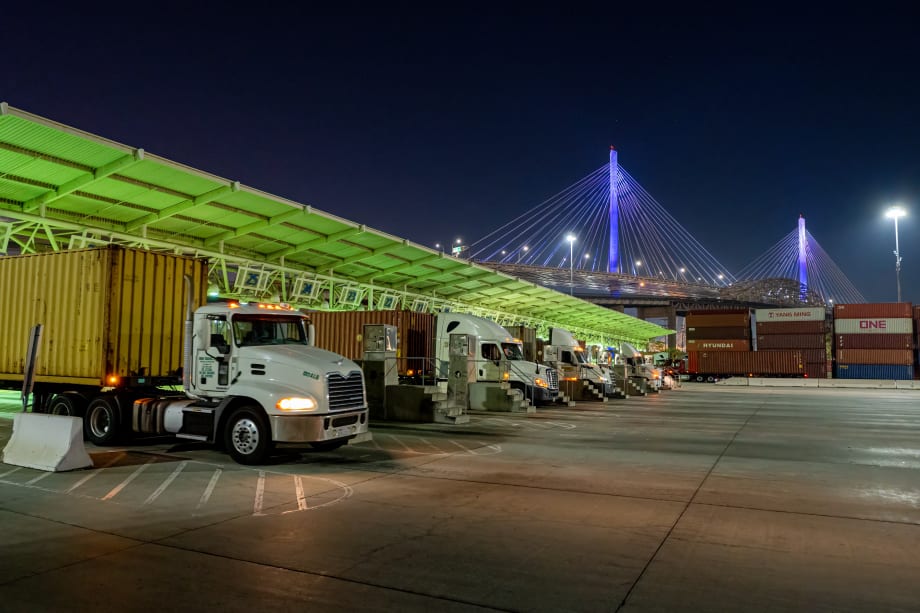
Much of the recent attention on the supply-chain crisis has focused on the nation’s ports, especially those in southern California, where containers of imports have hit bottlenecks.
In April, we were reporting that the ports of Los Angeles and Long Beach saw their busiest March on record. Gene Seroka, executive director of the Port of Los Angeles, called it a “once in a decade” situation in an interview with WSJ, but the ports, as well as some on the East Coast, continued to set records, both of imported containers and of ships waiting to unload.
The Biden administration in October tried to address it by getting the Ports of Los Angeles and Long Beach to agree to 24/7 operations, but so far, the uptake on those off-peak appointments has been slow.
California Gov. Gavin Newsom has also been trying to address the problem, including finding places to temporarily store containers and looking at lifting weight limits on priority freight routes.
But the problem is complex. Trucking companies and drivers have long complained about inefficiencies at the ports, and they are only making the supply-chain crisis worse. For instance, truckers complain that it’s nearly impos-sible to coordinate appointments where they can take an empty chassis or container into the port and pick up a full one at the same time.
Long-Term Problem
Most supply chain executives expect the situation will drag on for at least a year, according to a survey by Accen-ture.
And that’s not surprising if you consider that the pandemic-fueled supply chain problems simply broke wide open existing cracks in the system. For decades, industry has prided itself on its lean, efficient, “just-in-time” processes. Demand for cheap goods has led to raw materials, parts, and finished products that come from across the ocean, then must be transferred to train and truck to get to where they’re going.
Shortly after taking office, President Joe Biden signed an executive order directing “a whole-of-government ap-proach to assessing vulnerabilities in, and strengthening the resilience of, critical supply chains.”
In announcing its 100-day review report on the issue in June, the White House noted, “structural weaknesses in both domestic and international supply chains threaten America’s economic and national security. While amplified by the public health and economic crisis, decades of underinvestment and public policy choices led to fragile supply chains across a range of sectors and products. Unfair trade practices by competitor nations and private sector and public policy prioritization of low-cost labor, just-in-time production, consolidation, and private sector focus on short-term returns over long-term investment have hollowed out the U.S. industrial base, siphoned innovation from the United States, and stifled wage and productivity growth.”
Most of the actions being taken by the Biden administration have focused more on the manufacturing side of the supply-chain crisis. In November, a coalition of associations — including the American Trucking Associations, Truck-load Carriers Association, National Tank Truck Carriers, NATSO and the Next Generation in Trucking Association, among other trucking organizations — called for the administration to take the following steps to address the sup-ply-chain crisis:
Support a pilot program to enable employers to create an apprenticeship program to allow qualified drivers between the ages of 18 and 20 to operate in interstate commerce.
Promote careers in transportation and the supply chain.
Give flexibility on the COVID-19 vaccine mandate.
Provide relief and greater flexibility to the hours of service regulations.
Investigate the causes of inefficiencies at ports and work collaboratively to minimize bottlenecks.
Even before the pandemic, the rapid growth of e-commerce was already making it evident that supply-chain sys-tems need to change for the future. This will require greater adoption of technology and better collaboration be-tween shippers, carriers, intermediaries, port and intermodal rail facilities, and all the other parts of the supply chain.
This article first appeared in the December 2021 issue of Heavy Duty Trucking.