




HDT Fact Book 2023: Logistics Experiences "Great Reset"
Disruptions to the supply chain in recent years have forced shippers to adapt, try new things, build new partnerships, and moving forward many will be more resilient by having new options on the table. The e-commerce boom is anticipated to flatten, and both shippers and carriers now plan to better prepare for any unforeseen disruptions.

The logistics industry, both shippers and carriers, have faced many challenges.
Source: Canva/HDT Illustration
U.S. supply chains responded to the global volatility of the past two years by transforming networks to improve resilience against future disruption, according to the 2023 State of Logistics Report, produced for the Council of Supply Chain Management Professionals by global consulting firm Kearney and presented by Penske Logistics. Learn about that, e-commerce trends, and the growth of 3PLs as detailed in the HDT Fact Book 2023, HDT's annual snapshot of where the trucking industry is, where it's been and what its current long-term trends are.

Fact Book 2023: HDT's annual snapshot of where the industry is, where it's been, and long-term trends.
In 2022, the market swung back sharply in shippers’ favor, a trend that largely continued during the first half of 2023. Shipper demand and carrier capacity have rebalanced. Inventories are ample, and the COVID-driven demand spikes have leveled off.
HDT Series: How Freight Movement is Changing
Many shippers still feel stung by the supply disruptions of 2020 and 2021 are now in the driver’s seat and often looking to take advantage. They are in many cases rethinking their former trust in long-term carrier agreements, and more aggressively seeking options for capacity assurance. Mini-bids and more frequent touch points are becoming the norm rather than the traditional yearly bid process.
But looking at the shift in the role of logistics itself since the pandemic, say the report’s authors, “It’s becoming increasingly clear that shippers and carriers need to think more seriously and proactively about building strategic capability, the agility to respond to whatever disruption erupts.”
Not easy for carriers that are focused on making it through the downturn. “At such a moment, thinking expansively and strategically can feel like a luxury — but in truth, it may be a necessity, and the surest path back to prosperity.”
The report’s authors say both shippers and carriers need to look at this time as a reset — "resetting their thinking, resetting their strategies, perhaps even resetting their trust in one another.”
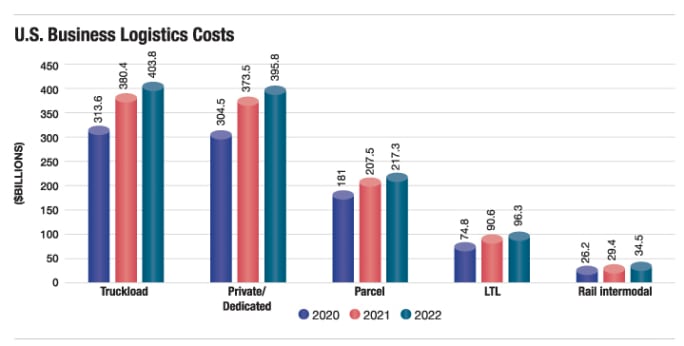
U.S. business logistics costs now stand at a record $2.3 trillion (up from $1.85 trillion last year), representing 9.1% of national GDP — the highest percentage of GDP ever.
Source: 2023 State of Logistics Report
“Although the market has swung back in shippers’ favor — to the detriment of carriers — we cannot emphasize enough the importance for all industry participants to begin planning for geopolitical tensions, cybersecurity threats, climate change and related natural disasters, slowing e-commerce growth, and global recessionary factors,” said Balika Sonthalia, senior partner at Kearney and co-author of the report.
— From the 2023 State of Logistics Report
State of Logistics: E-Commerce Trends
The U.S. e-commerce market is now a $1.03 trillion behemoth, representing 14.5% of the entire U.S. retail market. However, e-commerce’s share of all sales has started to flatten.
It is expected that the steep e-commerce growth curve experienced during the pandemic will flatten by late 2023 or early 2024 due to inflation, a potential recession, and the continued return to in-store shopping. This cooling in the e-commerce sector will continue to have a significant impact on parcel and last-mile provider operations.
— From the 2023 State of Logistics Report
Armstrong: 3PL Market Growth Normalizing Post-Pandemic
Revenue in the U.S. third-party logistics market is expected to be down 18% in 2023, led by the Domestic Transportation Management/Freight Brokerage and International Transportation Management/Freight Forwarding 3PL market segments, due to declining shipping rates, demand, and continued normalization post-COVID.
In 2022, the non-asset-based Domestic Transportation Management segment led all other 3PL segments with net revenue growth of 33.8% to $26.4 billion.
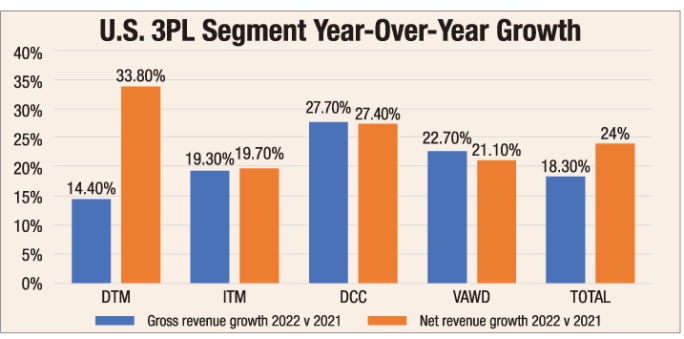
In 2022, the non-asset-based Domestic Transportation Management segment led all other 3PL segments with net revenue growth of 33.8% to $26.4 billion while overall gross revenue increased a healthy 14.4% to $159 billion.
Source: Armstrong & Associates
The asset-heavy Dedicated Contract Carriage 3PL Market segment delivered the second largest year-over-year net revenue growth of 27.4% to $29.2 billion in 2022.
Growth in the dedicated sector benefited from shippers wanting to lock in capacity after a turbulent 2021, an increased ability to attract drivers through wage increases and better recruiting, and having ample capital to invest in equipment. In addition, 3PLs with freight brokerages that could handle “overflow” business from DCC operations as dedicated or spot truckload capacity tended to do well.
The Value-Added Warehousing and Distribution segment did extremely well in 2022. Most 3PLs in this segment had full warehouses last year and were scrambling to find more.
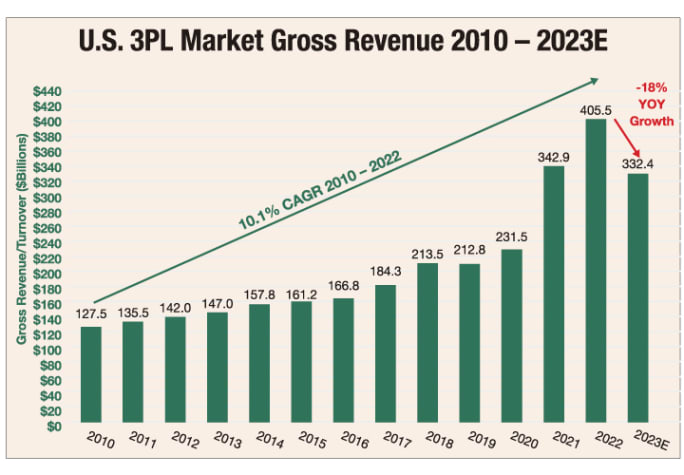
While year-over-year growth in 2022 was significantly less than the 48.1% gross revenue growth registered the previous year, it was still the fourth-best growth year on record since Armstrong began developing 3PL market estimates in 1995.
Source: Armstrong & Associates
The International Transportation Management segment’s 2022 growth may seem underwhelming, but that’s compared to an unheard-of 75% gross revenue gain In 2021, thanks to COVID-driven demand from shippers wanting to replenish inventories to meet strong consumer demand.
The ITM environment has dramatically changed since mid-2022, with ocean freight rates from Asia to the U.S. trending down to pre-pandemic levels as consumer demand moderated and supply chain operations stabilized.
— Contributed by Armstrong & Associates
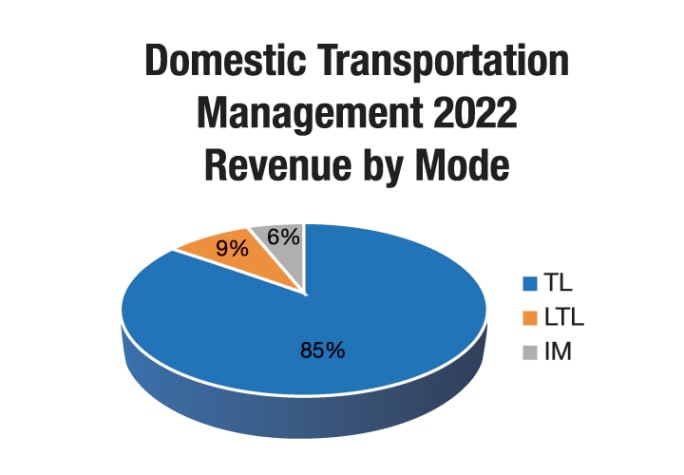
The Domestic Transportation Management 3PL Market Segment is dominated by truckload shipments.
Source: Armstrong & Associates
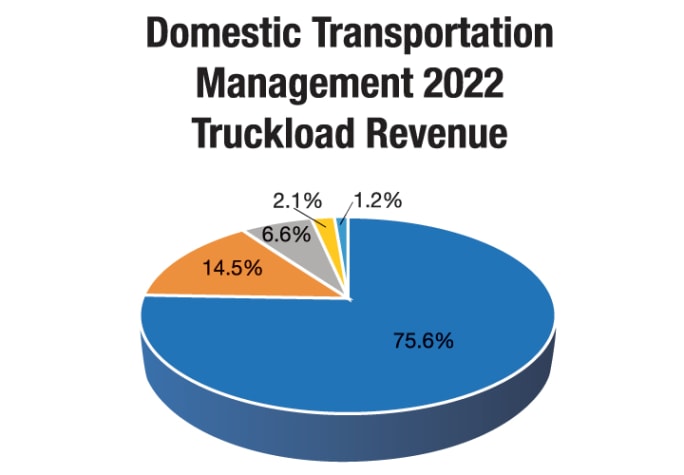
Dry van freight accounted for more than three-quarters of truckload revenue for domestic transportation management providers in 2022.
Source: Armstrong & Associates
More Fleet Management

Color Match Smarter: Tools That Restore & Perform
For fleet managers and collision repair professionals keeping heavy-duty trucks on the road, getting the color right the first time isn't just about appearance — it's about efficiency, turnaround time, and bottom-line results. Discover how today's digital color tools are transforming the repair process from guesswork to precision.
Read More →
FMCSA Pauses Biennial-Update Enforcement Amid Motus Transition
Carriers whose updates were due on or after June 1 have more time, while FMCSA works to stabilize its new registration system and warns of phishing sites impersonating its new carrier registration system, Motus.
Read More →
2026 Blueprint for Countering Smarter Supply Chain Theft
Cargo theft is no longer just the cost of doing business. It's a multi-billion-dollar criminal enterprise exploiting vulnerabilities across your fleet, drivers, and supply chain.
Read More →


How Telematics Improves Visibility, Control, and Performance in Refrigerated Fleets
Explore how telematics help refrigerated fleets improve visibility, uptime, efficiency, compliance, and cargo protection across connected cold chain operations.
Read More →
What the U.S.-Canada Trade War Means for Trucking
Escalating U.S.-Canada tariffs could disrupt cross-border freight, reduce truck volumes, raise costs, and create new uncertainty for carriers on both sides of the border.
Read More →
What Are Trucking’s Top Concerns for 2026?
The American Transportation Research Institute wants to know what's worrying trucking fleet managers, drivers, and other stakeholders in its annual Industry Issues survey.
Read More →
American Trucking Associations Looks for a New Leader
ATA President and CEO Chris Spear abruptly left his job at the association on August 21, at a pivotal time for the trucking industry.
Read More →
Public Wi-Fi Cybersecurity Risks: How Truck Drivers and Fleets Can Protect Their Data
Public Wi-Fi can expose truck drivers and fleets to credential theft, malware, and other cyber threats. Here’s how to reduce the risk on the road.
Read More →
For Nicky Cupp, Fleet Innovation Starts With Frustration
HDT Truck Fleet Innovator Nicky Cupp turns everyday pain points at Fraley & Schilling into opportunities for better technology and smarter processes.
Read More →
Adam Buttgenbach’s Approach to Electric Trucks: Start With Where They Fit
HDT Truck Fleet Innovator Adam Buttgenbach helped PepsiCo build one of North America’s largest EV fleets by focusing on where electric trucks make operational sense.
Read More →