




Great American Trucks: The International Transtar Cabover
Tough, reliable and stylish, the International Transtar became one of the most recognizable Class 8 American cabover trucks ever.

The International Transtar was a common sight on North American highways during trucking's "golden age" in the 1960s and 1970s.
Photo: Jim Park
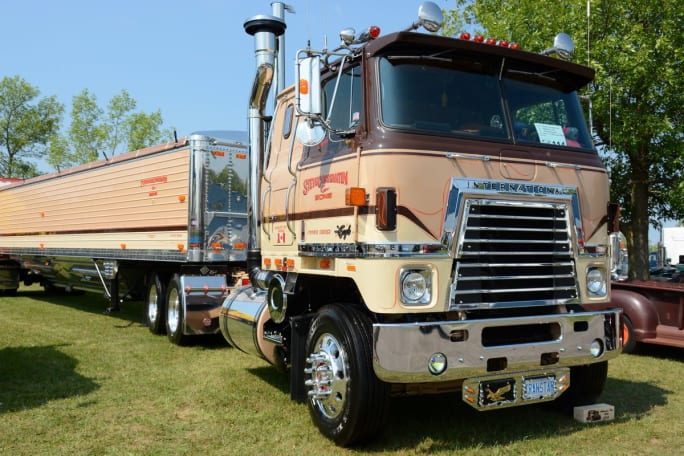
Its tall, accented, trapazodal grille gave the International Transtar a stylish, distinctive look that resonates with vintage truck collectors today.
Photo: Jim Park
As the 1960s dawned, International Harvester was sitting high atop the pyramid of American heavy truck builders.
One of the oldest and best-known American companies in existence, Harvester's roots went back to the 1840s, when Cyrus McCormick, inventor of the horse-drawn reaper — one of the first mechanical harvesting machines — revolutionized American farming.
In 1902, McCormick’s company joined forces with two other farm machinery manufacturers to form the International Harvester company. The new conglomerate, one of the first large corporations in the U.S., began moving away from steam-powered tractors and farming machinery toward the then-new internal combustion engine and emerging automotive technology.
Farm tractors were naturally the company’s initial focus for automotive machines. But it quickly became obvious that once the crops were in, farmers needed some sort of heavy-duty automobile to help them carry them to market.
As a result, the very first International truck, the Auto Wagon, appeared in 1907. The right-hand steer Auto Wagon was simple and tough, with high ground clearance that performed well on the poor – or even nonexistent – roads of the time.
Eventually, International Harvester would become a massive global company. Its name would grace light-duty pickups, SUVs, lawn and garden equipment, construction machinery and even home appliances and electronic goods.
But heavy trucks increasingly became a core competency for International. In fact, Navistar Trucks is today the last surviving business division of the once-massive International Harvester Corporation.
Transtar Rising
As the company headed into the 1960s, its heavy truck division was at the top of its game. Its “Emeryville” series of 1940s and 1950s cabover models had earned a reputation for reliability and toughness. And the trucks’ striking “bullnose” front ends remain an enduring style point for trucks of the era and collectors’ favorites today.
But the long-haul Class 8 cabover market was changing. As new sections of the Interstate highway were completed, truckers were able to take on longer routes. And the need for spacious, comfortable interiors, combined with powertrains and chassis able to tackle these tough, new long-haul applications, was apparent.
In the early ‘60s, the International DCOF-405 Emeryville cabover had been the top-selling American heavy truck for four years running. In 1965, International capitalized on that design with the introduction of the CO-4000 cabover tractor.
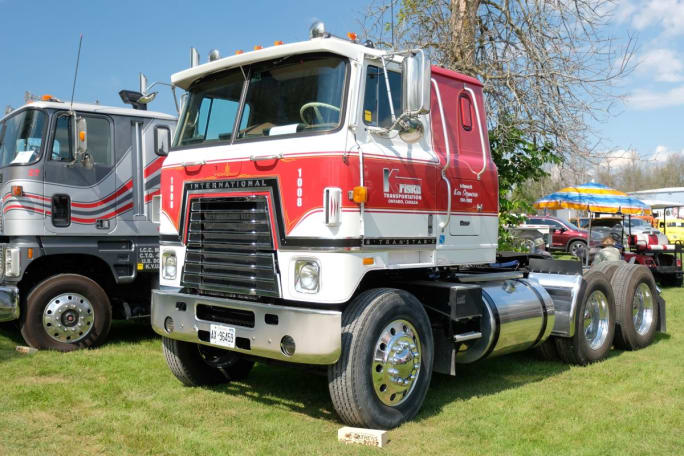
The Transtar line lasted until 1981, when it was replaced by International's "Newport Cab" series of cabovers.
Photo: Jim Park
The new tractor featured a larger and wider cab. It was taller than its predecessor, with more rounded edges. A large, trapezoidal grille with angular accent lines emphasizing its outline dominated the front end of the truck – an iconic styling point that would remain a feature of International cabovers well into the 1990s.
The Transtar name was first affixed to the CO-4000 in 1968. That year, the standard engine was the IHC DVT573 turbocharged diesel. Cummins and Detroit Diesel engines were offered as optional specs.
The ride could be a little rough, as the trucks came with rubber block suspensions (air ride was not available yet). And, like with all cabovers, the cab tended to be chilly in the winter. Engine noise could be intense, especially at higher rpm.
On the other hand, the truck got high marks for its looks, turning radius and interior amenities.
New Transtar Models and Features
The Transtar was a hit. In 1970, International decided to capitalize on its popularity with two new models, including a “Super Transtar” and a short-lived “Unistar” all-wheel-drive variant. The Super Transtar featured a 12V72, V-12 Detroit Diesel engine capable of pulling loads up to 144,000 lbs.
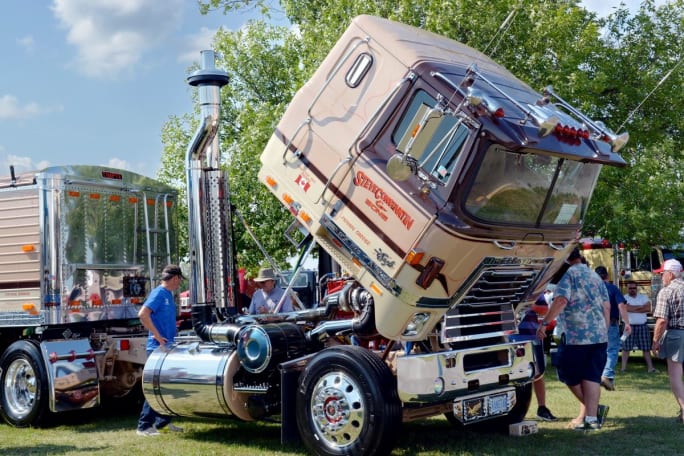
International engines were standard for the Transtar, of course. But a variety of Cat, Cummins and Detroit Diesel options were available as well.
Photo: Jim Park
Another major upgrade came in 1974, when the Transtar II was launched. Most of the enhancements were under the hood. Visually the trucks looked nearly identical. New, more powerful diesel engines were becoming popular, and the Transtar II took advantage of this trend with a larger, redesigned engine compartment.
You could spec the truck with a standard IHC V800 turbocharged V-8. The Detroit Diesel engine offering was upgraded from the 12V71 to the 8V92 V-8. You could also spec a Caterpillar 3406, six-cylinder diesel, as well as several Cummins options, including the massive KT-450 with a whopping 1,150 cubic-inch displacement. It remains one of the largest diesel engines ever fitted to a serial production commercial vehicle.
Beginning of the End for COE Trucks
Changes to tractor-trailer length laws in 1976 heralded the beginning of the end of the Class 8 cabover in North America. Class 8 conventionals, which offered drivers much more room and a smoother ride, saw an immediate spike in sales.
The International Transtar II ceased production in 1981, replaced by International’s new Newport Series cabovers, which featured a completely flat cab floor in order to maximize interior space and compete with conventional model trucks.
All International cabover production finally ceased in 1991.
One Driver's Memories of the International Transtar
“I loved that truck,” says HDT contributing editor Jim Park. He drove one in the late 1970s during his tenure as a professional driver. “It had a smooth ride – although that was dependent on the wheelbase. The longer-wheelbase Transtar was really smooth. But any short wheelbase cabover will beat the snot out of you. But it was a really nimble truck. And it had a lot of power for its time, too.”
The smaller cab wasn’t a problem, either, Park says. “I liked a smaller cab,” he says. “The Transtar doghouse was low. So it was really easy to get in, and out of the seat and into the bunk. Some of the other trucks at the time had really high doghouses – which were a pain to deal with. They were just really good trucks for that time.”
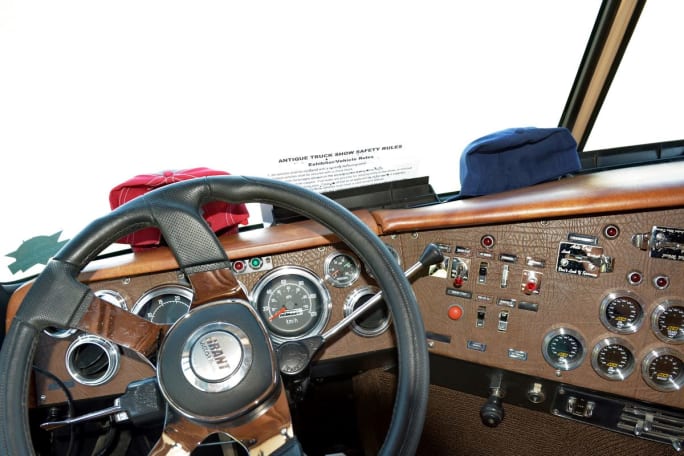
The Transtar's dashboard was typical for the time period -- with lots of plastic faux woodgrain finishes.
Photo: Jim Park
Hear from an International Transtar Truck Collector
“They’re rough riding,” says Transtar collector Mike Britton. He’s owned a 1976 model that he bought in 2015 and did an extensive restoration on.
“You don’t feel a bump in the road once in a Transtar,” he quips. “You feel it three times! And they’re a little bit louder than a conventional truck. But not too bad.”
Britton exhibits his Transtars at antique truck shows in and around his native Missouri. And he says the reactions he gets at the shows are remarkable.
“Every show,” he says. “It’s unreal how many guys come up to me and say, ‘My dad had one of these!’ or ‘I started out in a Transtar just like this one!’ That’s why when I decided to name the truck, I called it ‘Remember When,’ because of all the good memories it brings to people.”
The International Transtar and Transtar II were excellent trucks that made the most of the regulations and technology of the time. Fleets and drivers alike loved them. And, over time, they became mainstays on North American highways. Today, they are instantly recognizable to trucking enthusiasts who remember those days, and nearly extinct cabover trucks, fondly.
More Equipment

How Volvo Updated Its D13 for EPA 2027 [Watch]
Volvo’s updated D13 promises lower emissions without sacrificing performance or fuel economy. Take a closer look at what changed inside the engine in this HDT Spotlight video.
Read More →
Michelin Tire Improves Efficiency and Durability for Regional Fleets
The Michelin X Multi Energy D2 is a regional haul drive tire engineered to help fleets improve fuel efficiency, durability and traction in demanding stop-and-go operations.
Read More →
ZF Expands Commercial Vehicle Push in North America
ZF is expanding its North American commercial-vehicle presence with new transmission applications, electrification, trailer technology and autonomous-driving systems.
Read More →
Tesla Wants a Self-Driving Semi. Are Cameras Enough?
Could Tesla’s camera-only autonomous driving technology work on an 80,000-pound Semi? In this commentary, HDT's Deborah Lockridge takes a look at Tesla, Cybercab, and how autonomous trucks see the road.
Read More →
Kodiak: Driverless Long-Haul Truck Launch on Track for 2026
Kodiak AI says its driverless long-haul safety case is 93% complete and it remains on track to begin commercial operations by year-end 2026.
Read More →
What DOT’s Automated Vehicle Strategy Means for Trucking
The U.S. Department of Transportation issued a new automated-vehicle strategy that outlines plans for driverless-truck regulations, cross-state freight corridors, and federal safety standards.
Read More →
East Coast Port Launches $45M Electric Truck Push
The Port Authority of New York and New Jersey announced millions in incentives for zero-emission drayage trucks, yard tractors, and new charging hubs near the port.
Read More →
PlusAI Going Public to Fund Autonomous Truck Launch
A SPAC deal could provide PlusAI with up to $300 million as it works toward a 2027 commercial launch of factory-built autonomous trucks.
Read More →
NHTSA Moves to Rewrite Truck Fuel-Economy Rules
The National Highway Traffic Safety Administration says it lacks authority to regulate medium- and heavy-duty truck engines separately from complete vehicles, but the existing standards have not yet been eliminated.
Read More →
Detroit Opens Orders for EPA 2027 Engines
Detroit isn’t starting from scratch to meet EPA 2027 diesel emissions standards. Its Gen 6 DD13 and DD15 engines keep much of today’s platform while updating the fuel and aftertreatment systems.
Read More →