




Going Electric
For many years we've been accustomed to seeing electric carts scoot around golf courses and airports, and strong, silent forklifts do heavy lifting in factories and warehouses. Now street-legal trucks are ready to haul cargo in American cities

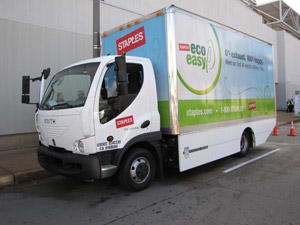
Except for its electric propulsion, Smith's Newton looks and maneuvers like the low cabover it is. (Photo by Tom Berg)
For many years we've been accustomed to seeing electric carts scoot around golf courses and airports, and strong, silent forklifts do heavy lifting in factories and warehouses. Now street-legal trucks are ready to haul cargo in American cities.
Their appeal? No emissions, no fuel to buy, and very little maintenance. And unlike many alternative fuels, the supporting infrastructure for electric vehicles - the power grid - is already in place.
Will they really go over in the commercial world? Yes, say those in the commercial electric vehicle business, especially in North America, with its large, teeming cities where thousands of delivery trucks are busy. Why now and not years ago? Because battery technology has advanced greatly, making realistic ranges possible. At the same time, the cost per kilowatt-hour - the accepted measure in the expanding electric vehicle industry - has come down and will continue to fall.
Mike Elwood, vice president of marketing for Azure Dynamics, which has developed an electric propulsion system for Ford's Transit Connect compact van, recently came away from an international conference on how motor vehicles can help reduce use of petroleum and cut greenhouse gases. One conclusion of the conference in Brazil, he says, is that "the internal combustion engine is not going away, but in order for the world to reduce dependency on oil, we must improve the efficiency of the internal combustion engine and go to electric and other vehicles."
Political support
Clean electric cars and trucks have inspired political support, resulting in government funding of their development and acquisition, Elwood says. In the U.S., the federal government is spending hundreds of millions of dollars on battery development, and will kick in $7,500 toward the purchase of an electric vehicle. California is contributing $15,000 to $20,000 per vehicle from a special fund of $20 million that's now down to about $1.5 million, due to enthusiastic "green" thinking fleets there. Other states and municipalities also have set up pools of money to help interested buyers.
Financial help is needed to buy an electric commercial vehicle, because it currently costs about three times what a comparable engine-powered truck or bus does. But cost for electricity to recharge an ECV's batteries is only one-quarter to one-fifth the dollars needed to buy gasoline or diesel fuel for a regular van, various sources say. And an electric truck requires very little maintenance because there's no engine, transmission, normal cooling system, etc. Batteries are now projected to last for years, and in some cases for the life of a vehicle. These savings, plus falling prices for batteries, will eventually make a decent business case for electric commercial vehicles and remove the need for government subsidies.
One objection from some environmentalists is that power plants produce immense amounts of carbon dioxide and other pollutants. But the U.S. Environmental Protection Agency counters that smokestacks in those plants are heavily regulated and will get cleaner. They also burn domestic coal, oil and gas, so they reduce dependence on imported oil.
For local use only
Electric commercial vehicles aren't for everybody. They'll work on known urban routes where speeds are low. Stop-and-go operation is best, because regenerative braking helps recharge batteries. Electric vehicles must return home every night so they can be plugged in and fully recharged, which builders say will usually take six to eight hours. Most will need a 220-volt circuit, which is not too costly to wire inside or outside a terminal or shop building. ECVs won't work on extended routes involving freeway or highway travel. Their range of about 100 miles would see them peter out before their runs are done, and highway speeds draw down batteries too quickly.
Several electric trucks are now available on the market. Others are coming. Some were available for short drives during the National Truck Equipment Association's annual meeting in St. Louis earlier this year. I drove two: Smith Electric's Newton, now being produced, and Freightliner Custom Chassis Corp.'s All-Electric MT-45 van, which is due for production early next year.
In May I drove Navistar International's new eStar, which like the Newton is low-cab-forward in layout. The two look alike, with bulbous noses and smooth-sided van bodies. Both were designed in England and come here in kits. Navistar's Monaco RV subsidiary assembles the eStar in Wakarusa, Ind. (see June HDT), while Smith-USA bolts together the Newton in Kansas City, Mo.
Quick kick
The St. Louis route for the Newton and the electric MT-45 was about eight city blocks, the distance around the city's downtown convention center complex - not very long, but enough to form some favorable impressions. In short, they - and all electric trucks I've operated thus far - are a kick to drive. They're quick (at least while they're empty) and silent. There's no gear shifting because there are no transmissions, and pickup is quick, because electric motors develop maximum torque right from a start.
Each electric truck differs in how it carries its driver and cargo. The Class 4-6 Newton is a cabover, with separate cab and body. It drives and maneuvers somewhat like a bus, and with the windshield almost as far forward as the bumper, forward visibility is excellent. The Newton has normal, hinged side doors whose windows roll down partway - a good thing, because the huge windshield can do a greenhouse number on people in the cab.
The Class 3-4 electric MT-45 is a walk-in van with integral cab and body. There's a short nose housing electrical components. The superstructure is tall and boxy, for stand-up ease and immediate access to the cargo compartment. The eMT-45 (as I'll call it) feels big and tall, but it scoots just the same. Its sliding doors (with partial sliding windows) are a little balky until you get used to their operation. In summer, the doors slide back and lock, allowing gales of air to blow through.
Of course a walk-in van's cab is part of the cargo body, allowing direct access to the goods in back. The entire body is stand-up tall so the driver can walk in via a short flight of stairs, move around without stooping, and exit quickly.
FCCC worked with Enova Systems and Tesla Motors in engineering an electric drive into the MT-45 chassis (which is also available with diesel, gasoline, natural gas and hybrid powertrains). Enova provides the controls, as it does for certain diesel-electric hybrid vehicles. Tesla (famous for its hot, 120-mph electric sports car) supplies the lithium-ion batteries and motor. The latter are under the body's floor, which should lower the center of gravity for stability.
More important, of course, are zero tailpipe emissions and low cost of operation. FCCC says the owner of an electric MT-45 will save about $15,000 a year in fuel. Smith claims even higher savings for the Newton, and Navistar forecasts low operating costs for its eStar. That, plus the offsetting government grants, make the e-trucks entirely workable, even with list prices just this side of $150,000. If a close look at the numbers doesn't convince prospective buyers to place orders, a fun-filled spin around the block might close a deal.
From the July 2010 issue of Heavy Duty Trucking.
More Fuel Smarts

How Volvo Updated Its D13 for EPA 2027 [Watch]
Volvo’s updated D13 promises lower emissions without sacrificing performance or fuel economy. Take a closer look at what changed inside the engine in this HDT Spotlight video.
Read More →
Diesel Price Spike Shortens Payback for Natural Gas Trucks, Report Says
Energy Vision estimates fleets could recover the higher purchase price of an RNG-fueled Class 8 tractor in 1.3 to 2.8 years under current fuel-price scenarios.
Read More →
Calstart Becomes Catalyst Mobility, Reflecting Broader Focus
Calstart is now Catalyst Mobility, reflecting the nonprofit’s growing national role in clean transportation, including zero-emission trucks, infrastructure and incentive programs.
Read More →

Record Diesel Prices Squeeze Trucking Fleets
Average U.S. diesel prices have climbed to nearly $6 a gallon, surpassing the 2022 record as tight refinery capacity and Middle East disruptions keep fuel costs elevated.
Read More →
How Fuel Delivery Shapes Engine Performance
Fuel delivery depends on more than what happens at the injector. For fleet, maintenance and technical professionals, looking at the full path from pump to injector can provide useful context for understanding engine performance.
Read More →
East Coast Port Launches $45M Electric Truck Push
The Port Authority of New York and New Jersey announced millions in incentives for zero-emission drayage trucks, yard tractors, and new charging hubs near the port.
Read More →
California Bill Could Shed Light on Electric Truck Prices
Why do battery-electric Class 8 trucks remain so expensive? A California bill headed to Gov. Gavin Newsom would give fleets and state agencies more visibility into what manufacturers charge.
Read More →
Detroit Opens Orders for EPA 2027 Engines
Detroit isn’t starting from scratch to meet EPA 2027 diesel emissions standards. Its Gen 6 DD13 and DD15 engines keep much of today’s platform while updating the fuel and aftertreatment systems.
Read More →
Zero-Emission Truck Corridor Planned for West Coast
California, Oregon, Washington, British Columbia and Baja California are coordinating plans for truck charging and hydrogen fueling from Canada to Mexico.
Read More →
A Closer Look at Kenworth’s Electric T880E Vocational Truck [Video]
Learn more about Kenworth's T880E battery-electric vocational truck at the Paccar Technical Center, including its range, applications, upfitting considerations, and PTO options, in this HDT Spotlight video.
Read More →