




Global News Roundup: Europe Urged to Accelerate Move to Carbon-Neutral
ICYMI: A roundup of global trucking news from Traton, Amazon, Hyundai and more.

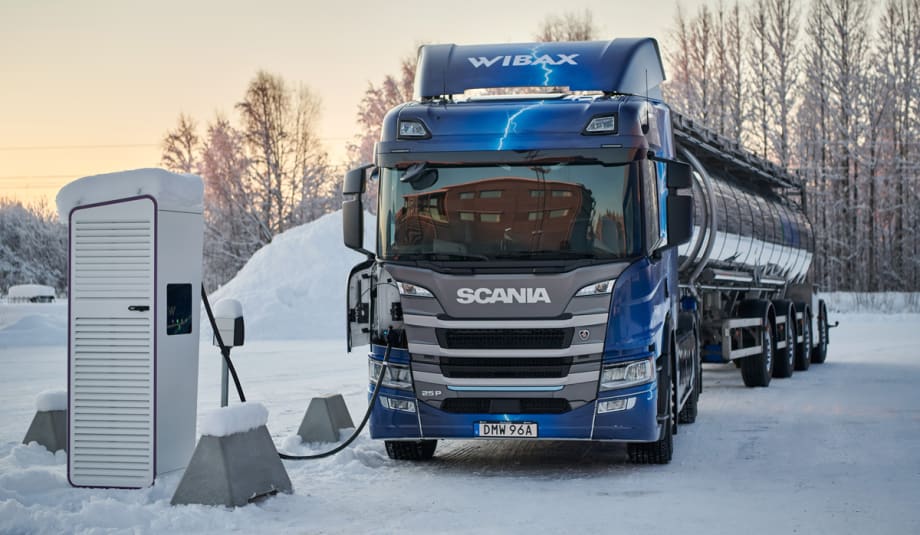
Traton’s goal is for 50% of its long-haul trucks to be zero-emission by 2030 — provided the corresponding regulatory mechanisms and infrastructure are in place.
Photo: Scania
In Europe, the automotive (including heavy trucks), energy generation, electricity and charging infrastructure industries have teamed up to urge the European Parliament and Council to adopt strong, interconnected policies to accelerate the transition to zero-emission and CO2-neutral mobility.
First and foremost, increased investment in charging and refueling infrastructure for alternatively-powered cars, vans, trucks and buses is urgently needed, according to the industry coalition.
To make charging and hydrogen refueling stations commercially viable during the ramp-up phase of electric vehicles, public support, financial incentives, co-funding and mandatory targets are needed. Moving toward climate-neutral transport and mobility only makes sense if the transition to zero-emission energy happens in parallel. The group said government incentives are needed to encourage the use of zero-emission energy in the transport sector.
According to new cross-industry research based on analysis by McKinsey, up to 6.8 million public charging points would be required across the EU by 2030 to reach the proposed 55% CO2 reduction for passenger cars. This means that up to 14,000 public charging points for all vehicle segments would need to be installed EU-wide every week — compared to under 2,000 per week currently.
And for heavy-duty charging, the locations, space and power output levels needed are substantially different to those for passenger cars. According to the research paper, trucks will require 279,000 charging points by 2030, of which 84% will be in fleet hubs. The remaining charging points will be predominantly public, fast along-highway (36,000) and public overnight charging points (9,000).
Auto and truck makers were represented in the coalition by the European Automobile Manufacturers’ Association.
Traton pouring investment into battery-electric R&D
The Traton Group said it plans to invest 2.6 billion euros (about $2.9 billion) in electric mobility research and development by 2026, up from a previous budget of 1.6 billion euros (about $1.8 billion) by 2025. At the same time, the company, which includes brands such as Scania and Navistar, is scaling back its investments in conventional drives.
Battery-electric drives “are clearly the greenest, fastest, and most affordable solution for our customers, even for long-haul transportation, although hydrogen may prove to be a useful addition in certain niches,” said Traton CEO Christian Levin. “Since trucks are charged primarily during peaks in supply and troughs in demand, even the power load on the grid is moderate. This is why we should focus on creating the infrastructure we so urgently need.”
Traton intends to work with Daimler Truck and the Volvo Group to establish a public charging network for battery-electric heavy-duty trucks and coaches as part of a joint venture. The plan is to install at least 1,700 high-performance green energy charging points across Europe within five years of the establishment of the joint venture.
News Briefs from Around the World
Amazon’s UK EVs: For the first time, Amazon is running electric heavy goods vehicles in its UK delivery fleet. The five 37-tonne fully electric vehicles are the first of nine electric HGVs expected by the end of 2022, joining more than 1,000 electric delivery vans currently on the road in the UK. The electric trucks will use first-of-their-kind fast 360 kW electric charging points at Amazon’s Tilbury and Milton Keynes sites.
Global truck sales forecast: The number of medium- and heavy-duty trucks and buses sold globally are forecast to increase 4.2% yearly through 2025, according to “Global Medium- & Heavy-Duty Trucks & Buses,” a report by Freedonia Focus Reports. Rising global manufacturing and construction activity will spur demand for truck freight services, while ongoing technological developments, such as higher fuel efficiency, are expected to drive replacement demand. The report predicts that the semiconductor shortage will end by 2023.
Thumbs-up for Hyundai hydrogen truck: After one year, transport and logistics service provider Gebrüder Weiss gave the Hyundai Xcient Fuel Cell truck good marks. Since the 36-ton truck was delivered in January 2021, it has covered around 70,000 kilometers, used daily in short-distance general cargo transport. Consumption was even lower than the value specified by the manufacturer, and in one year, there was only a single visit to the workshop for the technical inspection. Gebrüder Weiss plans to use hydrogen trucks in Austria and southern Germany in the future. A limiting factor is the availability of hydrogen filling stations, of which nine already exist in Switzerland.
Hotline Global is produced in partnership with UK-based Truck & Bus Builder. A free trial subscription to T&BB is available.This news first appeared in the Jan/Feb issue of Heavy Duty Trucking.
More Fuel Smarts

How Volvo Updated Its D13 for EPA 2027 [Watch]
Volvo’s updated D13 promises lower emissions without sacrificing performance or fuel economy. Take a closer look at what changed inside the engine in this HDT Spotlight video.
Read More →
Diesel Price Spike Shortens Payback for Natural Gas Trucks, Report Says
Energy Vision estimates fleets could recover the higher purchase price of an RNG-fueled Class 8 tractor in 1.3 to 2.8 years under current fuel-price scenarios.
Read More →
Calstart Becomes Catalyst Mobility, Reflecting Broader Focus
Calstart is now Catalyst Mobility, reflecting the nonprofit’s growing national role in clean transportation, including zero-emission trucks, infrastructure and incentive programs.
Read More →

Record Diesel Prices Squeeze Trucking Fleets
Average U.S. diesel prices have climbed to nearly $6 a gallon, surpassing the 2022 record as tight refinery capacity and Middle East disruptions keep fuel costs elevated.
Read More →
How Fuel Delivery Shapes Engine Performance
Fuel delivery depends on more than what happens at the injector. For fleet, maintenance and technical professionals, looking at the full path from pump to injector can provide useful context for understanding engine performance.
Read More →
East Coast Port Launches $45M Electric Truck Push
The Port Authority of New York and New Jersey announced millions in incentives for zero-emission drayage trucks, yard tractors, and new charging hubs near the port.
Read More →
California Bill Could Shed Light on Electric Truck Prices
Why do battery-electric Class 8 trucks remain so expensive? A California bill headed to Gov. Gavin Newsom would give fleets and state agencies more visibility into what manufacturers charge.
Read More →
Detroit Opens Orders for EPA 2027 Engines
Detroit isn’t starting from scratch to meet EPA 2027 diesel emissions standards. Its Gen 6 DD13 and DD15 engines keep much of today’s platform while updating the fuel and aftertreatment systems.
Read More →
Zero-Emission Truck Corridor Planned for West Coast
California, Oregon, Washington, British Columbia and Baja California are coordinating plans for truck charging and hydrogen fueling from Canada to Mexico.
Read More →
A Closer Look at Kenworth’s Electric T880E Vocational Truck [Video]
Learn more about Kenworth's T880E battery-electric vocational truck at the Paccar Technical Center, including its range, applications, upfitting considerations, and PTO options, in this HDT Spotlight video.
Read More →