




Global News Roundup: Daimler Testing Fuel-Cell Truck with Liquid Hydrogen
ICYMI: A roundup of global trucking news from Hino, Traton, Volvo Group, Ballard Power Systems and more.

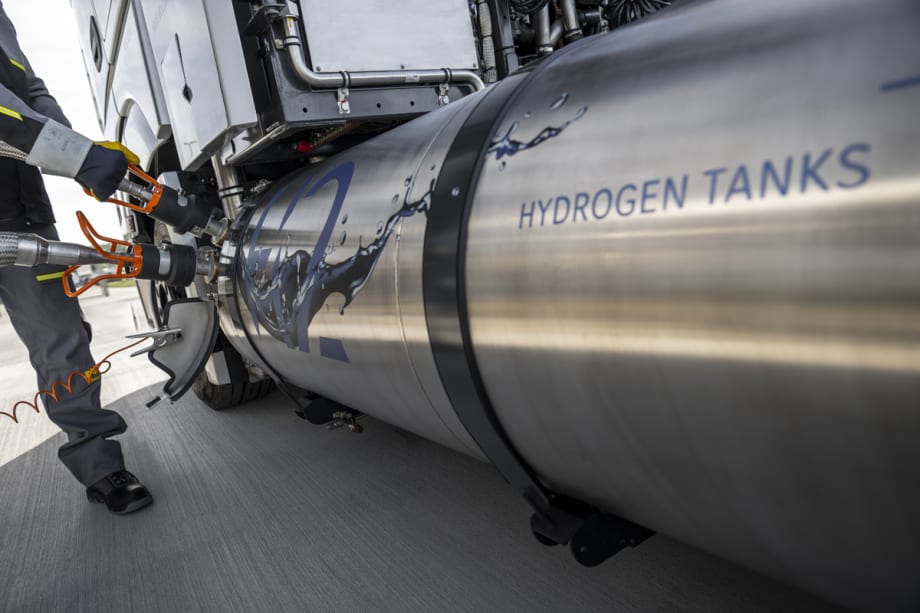
Daimler Truck is putting a fuel-cell truck prototype into operation in Germany to test the use of liquid hydrogen. A prototype filling station at a development and testing center in Worth, Germany, enables refueling with liquid hydrogen.
Photo: Traton
Daimler Truck over the summer started trials of a fuel-cell electric truck fueled by liquid hydrogen in order to determine how the fuel compares to gaseous hydrogen.
The prototype truck is based on the first ‘GenH2’ truck tested last year, which used gaseous hydrogen. The new vehicle is refueled at a prototype filling station installed by Air Liquide. Cryogenic liquid hydrogen at minus 253 degrees Celsius fills up two 40 kg tanks mounted on either side of the chassis. The tanks are insulated well enough to negate the need for active cooling for “a sufficiently long time,” according to Daimler Truck.
Because of the higher energy density than gaseous hydrogen, liquid hydrogen can be stored in smaller and lighter tanks, providing more cargo space and payload. Moreover, liquid hydrogen can be stored in greater quantities, increasing the vehicle’s range. Daimler Truck’s aim is to produce a fuel-cell truck capable of traveling beyond 1,000 km before refueling.
Hino Falsified Emissions Data Nearly 20 Years
Hino Motors has suspended most of its truck shipments in Japan over a scandal involving falsified emissions data.
Hino, which is 51% owned by Toyota, systematically falsified emissions data dating back as far as 2003, according to an investigation.
In March, Hino said it had identified misconduct concerning the falsification of engine performance data in its emissions durability testing for the A05C (HC-SCR) medium-duty engine, and in the measurement of fuel economy performance in certification tests for two heavy-duty engine models, A09C and E13C. Hino has also confirmed that those engines have problems in
engine performance. Hino has decided to suspend the sale of those three engine models and their corresponding vehicles in Japan.
Engine developers knew they couldn’t meet emissions targets so falsified test results, leading to a chain of deception as other workers covered it up. It included altering durability tests related to emissions on a wide range of models, as well as tampering with fuel efficiency information in heavy-duty engines.
A group of outside experts was set up to investigate and has since discovered additional light-duty engines were also subject to falsified results, bringing the total engines affected to more than 600,000.
According to the Wall Street Journal, so far this has only affected products sold in Japan. The company is cooperating with an investigation under way in the U.S.
News from Around the World
Traton’s modular approach: Navistar’s new S13 Integrated Powertrain is the first demonstration of Traton Group’s new modular approach, which allows for mass customization of broad variant offerings across Traton’s global product range. The modular system of cross-brand development and production means faster time to market and lower production costs, while still allowing for regional adaptation and validation of the powertrain for the North American market. There is a high degree of commonality between the International S13 engine and the Scania 13L recently introduced.
Canada’s EV incentives: The Canadian government has launched a new four-year incentive program offering up to 550 million Canadian dollars to buyers of new medium- and heavy-duty zero-emission vehicles that fit the criteria for eligibility.
Making EV batteries: To meet growing demand for battery-electric heavy-duty vehicles and machines, the Volvo Group has started the process to establish a production plant in Sweden to make battery cells designed specifically for commercial vehicle applications. It plans to reach large-scale series production by 2030.
FCEV at IAA: Ballard Power Systems will showcase its latest fuel cell solutions for medium- and heavy-duty trucks at IAA Transportation 2022 in Hanover, Germany, in late September: The FCmove-HD+ fuel cell module for mid-sized commercial vehicles and the FCmove-XD concept engine for heavy-duty trucks.
Hotline Global is produced in partnership with UK-based Truck & Bus Builder. This news appeared in the September 2022 issue of Heavy Duty Trucking.
More Fleet Management

Color Match Smarter: Tools That Restore & Perform
For fleet managers and collision repair professionals keeping heavy-duty trucks on the road, getting the color right the first time isn't just about appearance — it's about efficiency, turnaround time, and bottom-line results. Discover how today's digital color tools are transforming the repair process from guesswork to precision.
Read More →
FMCSA Pauses Biennial-Update Enforcement Amid Motus Transition
Carriers whose updates were due on or after June 1 have more time, while FMCSA works to stabilize its new registration system and warns of phishing sites impersonating its new carrier registration system, Motus.
Read More →
2026 Blueprint for Countering Smarter Supply Chain Theft
Cargo theft is no longer just the cost of doing business. It's a multi-billion-dollar criminal enterprise exploiting vulnerabilities across your fleet, drivers, and supply chain.
Read More →


How Telematics Improves Visibility, Control, and Performance in Refrigerated Fleets
Explore how telematics help refrigerated fleets improve visibility, uptime, efficiency, compliance, and cargo protection across connected cold chain operations.
Read More →
What the U.S.-Canada Trade War Means for Trucking
Escalating U.S.-Canada tariffs could disrupt cross-border freight, reduce truck volumes, raise costs, and create new uncertainty for carriers on both sides of the border.
Read More →
What Are Trucking’s Top Concerns for 2026?
The American Transportation Research Institute wants to know what's worrying trucking fleet managers, drivers, and other stakeholders in its annual Industry Issues survey.
Read More →
American Trucking Associations Looks for a New Leader
ATA President and CEO Chris Spear abruptly left his job at the association on August 21, at a pivotal time for the trucking industry.
Read More →
Public Wi-Fi Cybersecurity Risks: How Truck Drivers and Fleets Can Protect Their Data
Public Wi-Fi can expose truck drivers and fleets to credential theft, malware, and other cyber threats. Here’s how to reduce the risk on the road.
Read More →
For Nicky Cupp, Fleet Innovation Starts With Frustration
HDT Truck Fleet Innovator Nicky Cupp turns everyday pain points at Fraley & Schilling into opportunities for better technology and smarter processes.
Read More →
Adam Buttgenbach’s Approach to Electric Trucks: Start With Where They Fit
HDT Truck Fleet Innovator Adam Buttgenbach helped PepsiCo build one of North America’s largest EV fleets by focusing on where electric trucks make operational sense.
Read More →