




GHG Phase 2 Leading to More Sophisticated Medium-Duty Transmissions
Transmissions in medium-duty trucks have been commodities for years. GHG Phase 2 is changing that; transmissions are becoming much more sophisticated.

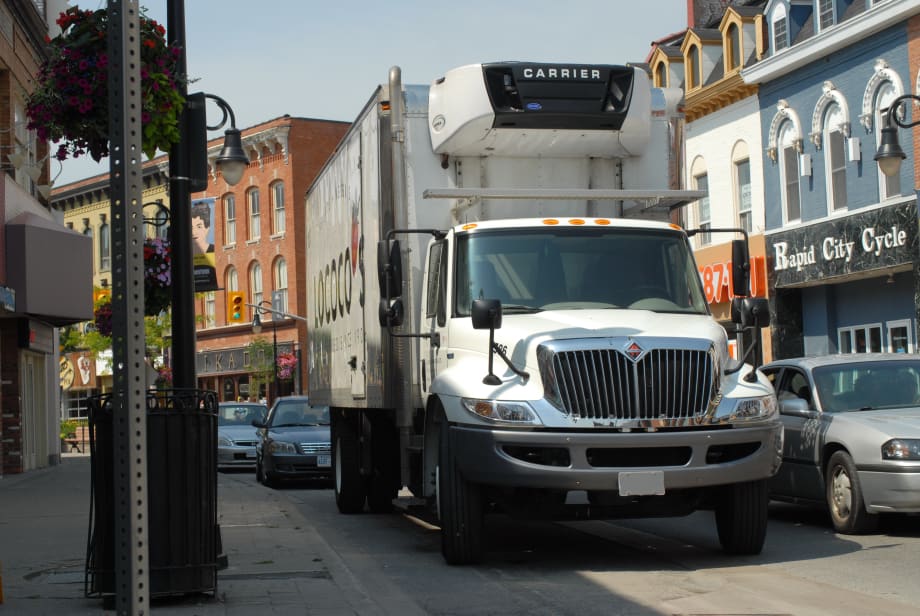
Many medium-duty truck owners are concerned with low cost, reliability and driver recruiting and retention more than fuel economy, but that often comes in the bargain.
Photo: Jim Park
It's easy for gray-haired folk to make fun of the kid next door who doesn't know anything about cars. We all grew up tinkering with stuff under various hoods. We knew things about the cars we drove. Young people today are more likely to be fascinated by the electronics onboard a car than the gears – if they are interested in cars at all. And that why most medium-duty trucks, especially in the lighter classes, come with automatic transmissions.
It's not uncommon for drivers in Europe and Asia to have experience with manual transmissions, but that skill is rare now in North America.
Looking through vehicle spec sheets for the lower weight classes on various OEM websites – GMC, Ford, Isuzu, Hino and others – you find the transmission described simply as, say, a six-speed automatic. That's just fine with a significant majority of medium-duty truck buyers; they don't even think about the transmission when choosing a truck.
“End-users want a reliable product that performs like a truck and drives like a car,” says Andre Kohl, ZF's North American business development manager. “At the end of the day, value attributes combined with the latest technology will make a difference at the time of the decision.”
If it gets good fuel economy, all the better, but even that probably isn't high on their list of must-haves in a truck.
The customer profile for medium-duty trucks is interesting. On one end, you have the bakers and landscapers who need trucks to get their goods to market or tote their tools around. These are the buyers who don't think too much about what's under the hood. On the other end you have the leasing and rental fleets who buy 30,000-40,000 such trucks each year.
They don't worry too much about attributes like fuel economy either, but they want a truck their customers will be happy with. And they want a bulletproof product to keep their maintenance costs and, ultimately, the lifecycle costs as low as possible over 48 to 72 months.
“The lease/rental company is less concerned about fuel economy because they are not paying for the fuel,” says Branden Harbin, Allison's manager of global marketing. “They are thinking about reliability and durability and how much life they will get out of the truck. They want a reasonable upfront price, but they are more concerned about lifecycle costs. What they really don't want is their customer calling in with complaints about the product.”
Of course, there's another customer sub-set, commercial fleets, that want fuel economy on top of reliability and durability. So, while there may not be more transmission options available to those customers who buy the higher weight-class medium-duty trucks, the transmissions they spec get a bit more sophisticated.
Fuel Economy and Beyond
Allison introduced its FuelSense fuel-efficiency package in 2014 that automatically adapts shift schedules and torque to maximize transmission efficiency based on load, grade and duty cycle. Allison upgraded it in 2017 to FuelSense 2.0, introducing DynActive Shifting. The company says that feature delivers up to 6 percent additional fuel savings beyond the original FuelSense software.
One of the selling features of Eaton's Procision transmission was the fuel-saving dual-clutch technology. We never saw many reports from the field indicating how well that transmission did with fuel saving, and since it has been discontinued, we'll probably never know.
Back in 2010, Fuso released a "double-clutch" transmission called the Fuso Duonic. At the time it was declared the world's first dual-clutch transmission for commercial vehicles. While it's technically an automated manual transmission as opposed to a torque-convertor automatic, it was, and still is offered as standard equipment on most Fuso diesel powered trucks. Fuso uses the Allison 1000-series automatics with the FuelSense 2.0 option on its gasoline powered trucks.
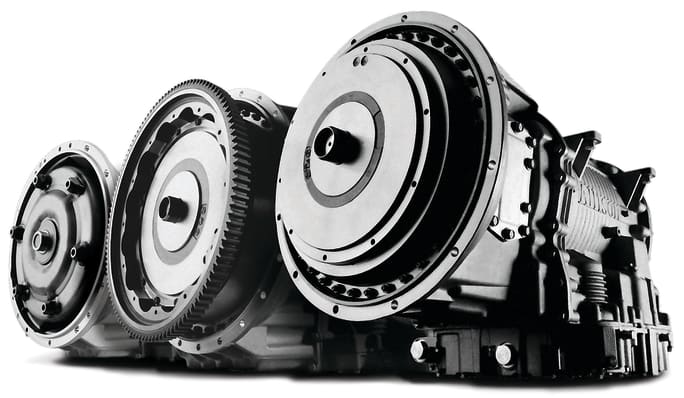
Allison's FuelSense 2.0 is available across the 1000, 2000 and 3000 series automatic transmissions.
Photo: Allison
Over on the heavy-duty side, transmissions have become both the heart and brain of the vehicle's drive train. In many instances, engines take their throttling cues from the transmission as often as the other way around. The transmission has also become a key enabler of downspeeding and other advanced fuel saving features like adaptive cruise control and predictive cruise control.
That's not yet the case in most of the medium-duty sector, but some advanced features are creeping into higher weight class medium-duty transmissions, like Class 6 and 7. We'll see more of that as we near the dawn of the GHG Phase 2 fuel efficiency regulations ratchet up between 2021, 2024 and 2027.
The rules that apply to medium-duty trucks and heavy-duty pickup trucks and vans call for reductions in CO2 emissions and fuel consumption of about 16% beyond Phase 1 when fully phased in by 2027. The fully phased-in Phase 2 standards for medium-duty vocational vehicles (Class 4-6) call for reductions in CO2 emissions and fuel consumption of up to 24% relative to Phase 1.
Those are significant jumps for vehicles that won’t see the benefit of improved vehicle aerodynamics. In the on-highway sector, a high percentage of the overall reduction in tailpipe CO2 emissions will come from enhanced aerodynamics. In the medium-duty and vocational sectors, improvements will come from light-weighting, the use of low-rolling-resistance tires, tire pressure management -- and improvements in engine and powertrain efficiency.
Some portion of the required gains in efficiency will have to come from the transmission.
ZF will soon launch its Powerline 8, eight-speed torque-convertor automatic – early in 2021 we're told – with a number of features OEMs will be looking for to meet GHG Phase 2. These include an integrated stop/start assist feature which shuts off and starts the engine while at traffic lights, skip-shifting, and a coasting feature where it slips into neutral on slight downgrades.
The eight gears provide more latitude for optimizing engine speed, and with a final ratio of 0.64:1 in top gear, downspeeding becomes possible in the right conditions.
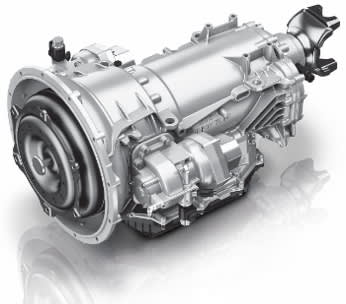
ZF's PowerLine 8, due on the market in early 2021, will help OEMs meet GHG Phase 2 emissions cuts.
Photo: ZF
“With PowerLine, ZF enables more than 10% fuel efficiency improvement compared to today’s 6-speed transmissions,” Kohl claims. “And that is a tremendous benefit to our customers.”
Meanwhile, Allison has just unveiled the 3414 Regional Haul Series (RHS) transmission – an uprated version of the established 3000 Series. It has a dual personality of sorts, with shift schedules suited to mixed duty cycles for fleets that cover city routes on one shift and turn to regional use during a second shift.
“Our food and beverage customers expressed a need for this product and our response is partnering with Allison to bring the 3414 RHS transmission to market in the second half of 2020,” said Kary Schaefer, Daimler Trucks North America’s general manager of product marketing and strategy.
On top of that, Allison plans to release a nine-speed transmission in 2022.
“As you look to 2024 and 2027, emissions standards are getting stricter, even for medium duty trucks," says Harbin. "The OEMs are asking for help meeting those standards, and the new transmission will do that.”
Unfortunately, Harbin wasn't willing to share too much more about the transmission, so we'll have to wait and see what additional tricks Allison has up its sleeve.
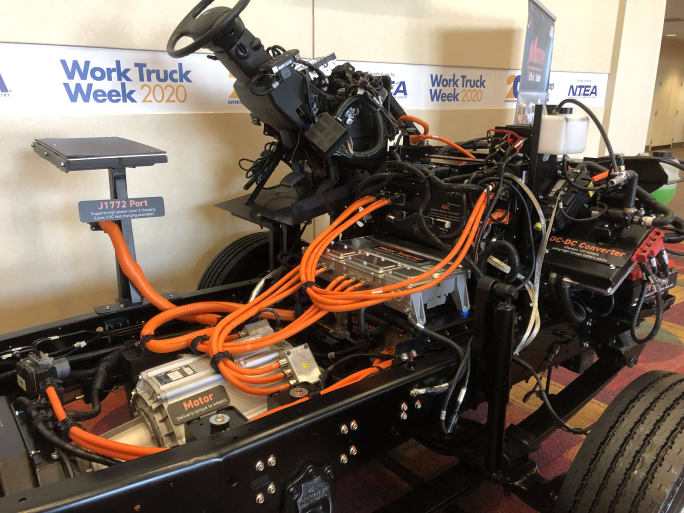
Battery-electric medium-duty trucks may not even need transmissions, but the transmission makers are already getting into the EV game with e-axles and energy-saving, range-shifting gearboxes.
Photo: Jim Park
And not too far over the next hill is the prospect of electrification. Medium-duty trucks appear so far to be the most likely candidates for full conversion to battery electric drivetrains, and those trucks probably won't even have transmissions, at least in the traditional sense. Some will need two- or perhaps three-speed gearboxes for greater efficiency at high speeds and a range of torque capacities that allows for the use of smaller electric motors. Dana is already a big player in the medium-duty EV space, and Eaton offers a two-speed and a four-speed EV transmission. Allison also recently introduced its AXE electric axle series, featuring integrated electric motors and a multi-speed gearbox.
Whether you're a baker buying a truck to haul your buns to market or a last-mile delivery fleet conscious of every nickel you spend on fuel, the transmission may not be a huge factor in your vehicle spec, it's certainly something to consider.
"These two categories of customers have both distinct and common interests, but at the end of the day, the combination of both is the one that is shaping the medium-duty commercial vehicle market and the automatic transmission choice," says ZF's Kohl.
More Equipment

How Volvo Updated Its D13 for EPA 2027 [Watch]
Volvo’s updated D13 promises lower emissions without sacrificing performance or fuel economy. Take a closer look at what changed inside the engine in this HDT Spotlight video.
Read More →
Michelin Tire Improves Efficiency and Durability for Regional Fleets
The Michelin X Multi Energy D2 is a regional haul drive tire engineered to help fleets improve fuel efficiency, durability and traction in demanding stop-and-go operations.
Read More →
ZF Expands Commercial Vehicle Push in North America
ZF is expanding its North American commercial-vehicle presence with new transmission applications, electrification, trailer technology and autonomous-driving systems.
Read More →
Tesla Wants a Self-Driving Semi. Are Cameras Enough?
Could Tesla’s camera-only autonomous driving technology work on an 80,000-pound Semi? In this commentary, HDT's Deborah Lockridge takes a look at Tesla, Cybercab, and how autonomous trucks see the road.
Read More →
Kodiak: Driverless Long-Haul Truck Launch on Track for 2026
Kodiak AI says its driverless long-haul safety case is 93% complete and it remains on track to begin commercial operations by year-end 2026.
Read More →
What DOT’s Automated Vehicle Strategy Means for Trucking
The U.S. Department of Transportation issued a new automated-vehicle strategy that outlines plans for driverless-truck regulations, cross-state freight corridors, and federal safety standards.
Read More →
East Coast Port Launches $45M Electric Truck Push
The Port Authority of New York and New Jersey announced millions in incentives for zero-emission drayage trucks, yard tractors, and new charging hubs near the port.
Read More →
PlusAI Going Public to Fund Autonomous Truck Launch
A SPAC deal could provide PlusAI with up to $300 million as it works toward a 2027 commercial launch of factory-built autonomous trucks.
Read More →
NHTSA Moves to Rewrite Truck Fuel-Economy Rules
The National Highway Traffic Safety Administration says it lacks authority to regulate medium- and heavy-duty truck engines separately from complete vehicles, but the existing standards have not yet been eliminated.
Read More →
Detroit Opens Orders for EPA 2027 Engines
Detroit isn’t starting from scratch to meet EPA 2027 diesel emissions standards. Its Gen 6 DD13 and DD15 engines keep much of today’s platform while updating the fuel and aftertreatment systems.
Read More →