




Gasoline-Diesel Cocktail: A Potent Recipe for Cleaner, More Efficient Engines
Diesel and gasoline fuel sources both bring unique assets and liabilities to powering internal combustion engines
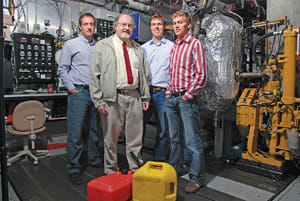
Rolf Reitz, center, and his team of graduate students in the engine research group.
Diesel and gasoline fuel sources both bring unique assets and liabilities to powering internal combustion engines.
But what if an engine could be programmed to harvest the best properties of both fuel sources at once, on the fly, by blending the fuels within the combustion chamber itself?
The answer, based on tests by the University of Wisconsin-Madison engine research group headed by Rolf Reitz, would be a diesel engine that produces significantly lower pollutant emissions than conventional engines, with an average of 20 percent greater fuel efficiency as well.
These dramatic results came from a novel technique Reitz describes as "fast-response fuel blending," in which an engine's fuel injection is programmed to produce the optimal gasoline-diesel mix based on real-time operating conditions.
Under heavy-load operating conditions for a diesel truck, the fuel mix in Reitz's fueling strategy might be as high as 85 percent gasoline to 15 percent diesel; under lighter loads, the percentage of diesel would increase to a roughly 50-50 mix. Normally this type of blend wouldn't ignite in a diesel engine, because gasoline is less reactive than diesel and burns less easily. But in Reitz's strategy, just the right amount of diesel fuel injections provide the kick-start for ignition.
"You can think of the diesel spray as a collection of liquid spark plugs, essentially, that ignite the gasoline," says Reitz, the Wisconsin distinguished professor of mechanical engineering. "The new strategy changes the fuel properties by blending the two fuels within the combustion chamber to precisely control the combustion process, based on when and how much diesel fuel is injected."
Two remarkable things happen in the gasoline-diesel mix, Reitz says.
First, the engine operates at much lower combustion temperatures because of the improved control - as much as 40 percent lower than conventional engines - which leads to far less energy loss from the engine through heat transfer. Second, the customized fuel preparation controls the chemistry for optimal combustion. That translates into less unburned fuel energy lost in the exhaust, and also fewer pollutant emissions being produced by the combustion process.
In addition, the system can use relatively inexpensive low-pressure fuel injection (commonly used in gasoline engines), instead of the high-pressure injection required by conventional diesel engines.
Development of the blending strategy was guided by advanced computer simulation models. These computer predictions were then put to the test using a Caterpillar heavy-duty diesel engine at the Engine Research Center. The results were "really exciting," confirming the predicted benefits of blended fuel combustion.
The best results achieved 53 percent thermal efficiency in the experimental test engine. This efficiency exceeds even the most efficient diesel engine currently in the world - a massive turbocharged two-stroke used in the maritime shipping industry, which has 50 percent thermal efficiency.
"For a small engine to even approach these massive engine efficiencies is remarkable," Reitz says. "Even more striking, the blending strategy could also be applied to automotive gasoline engines, which usually average a much lower 25 percent thermal efficiency. Here, the potential for fuel economy improvement would even be larger than in diesel truck engines."
Thermal efficiency is defined by the percentage of fuel that is actually devoted to powering the engine, rather than being lost in heat transfer, exhaust or other variables.
"What's more important than fuel efficiency, especially for the trucking industry, is that we are meeting the EPA's 2010 emissions regulations quite easily," Reitz says.
That is a major commercial concern as the bar set by the Environmental Protection Agency is quite high, with regulations designed to cut about 90 percent of all particulate matter (soot) and 80 percent of all nitrogen oxides (NOx) out of diesel emissions.
Some companies have pulled from the truck engine market altogether in the face of the stringent new standards. Many other companies are looking to alternatives such as selective catalytic reduction, in which the chemical urea (a second "fuel") is injected into the exhaust stream to reduce NOx emissions. Others propose using large amounts of recirculated exhaust gas to lower the combustion temperature to reduce NOx. In this case, ultra-high pressure fuel injection is needed to reduce soot formation in the combustion chamber.
Both of those processes are expensive and logistically complicated, Reitz says. Both primarily address cleaning up emissions, not fuel efficiency. The new in-cylinder fuel blending strategy is less expensive and less complex, uses widely available fuels, and addresses both emissions and fuel efficiency at the same time.
Reitz says there is ample reason to believe the fuel-blending technology would work just as well in cars because dual fuel combustion works with lower-pressure and less expensive fuel injectors than those used in diesel trucks. Applying this technology to vehicles would require separate tanks for both diesel and gasoline fuel, but so would urea, which is carried in a separate tank.
The big-picture implications for reduced oil consumption are even more compelling, Reitz says. The U.S. consumes about 21 million barrels of oil per day, about 65 percent (13.5 million barrels) of which is used in transportation. If this new blended fuel process could convert both diesel and gasoline engines to 53 percent thermal efficiency from current levels, the nation could reduce oil consumption by 4 million barrels per day, or one-third of all oil destined for transportation.
"That's roughly the amount that we import from the Persian Gulf," says Reitz.
Computer modeling and simulation provided the blueprint for optimizing fuel blending, a process that would have taken years through trial-and-error testing. Reitz used a modeling technique developed in his lab called genetic algorithms, which borrow some of the same techniques of natural selection in the biological world to determine the "fittest" variables for engine performance.
The work was funded by DOE and the College of Engineering Diesel Emissions Reduction Consortium, which includes 24 industry partners.
Brian Mattmiller is the University of Wisconsin College of Engineering's assistant dean for alumni and corporate relations. Mattmiller, a 1986 journalism graduate of UW-Madison, was previously the assistant director of media relations for University Communications from 2005-2009. He also served as director of UW-Whitewater Communications from 2001-2005, and prior to that spent seven years as a UW-Madison science writer, where he became deeply familiar with the great research and academic programs in the College of Engineering.
More Fuel Smarts

How GP Transco Builds Fuel Savings a Fraction at a Time
Aerodynamic specs, solar panels, and driver incentives help GP Transco turn small efficiency gains into savings it can reinvest in its people.
Read More →
Trucking’s Diesel Squeeze Isn’t Letting Up
With diesel topping $6 a gallon nationally, ATA's Bob Costello explains why fleets should prepare for continued pressure at the pump.
Read More →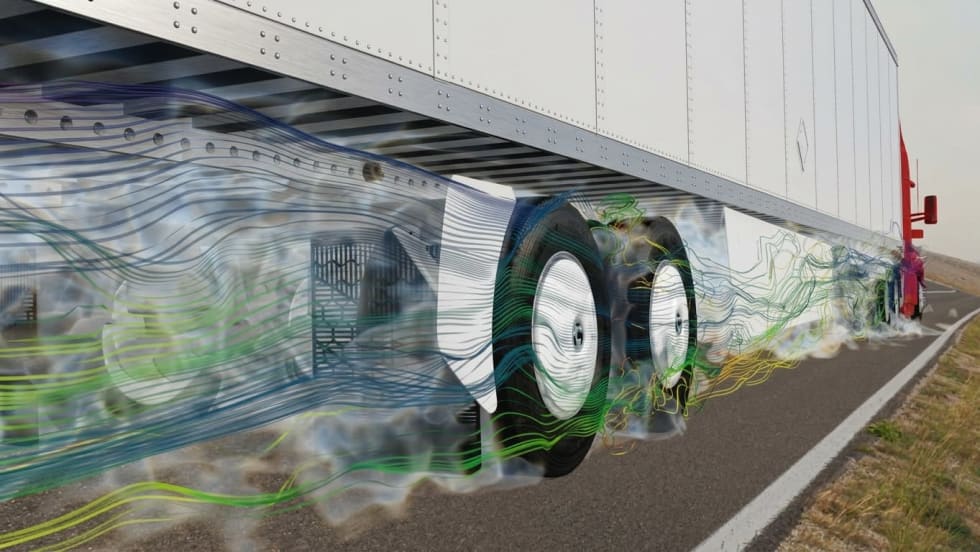
FlowBelow Redesigns Trailer AeroSlider to Cut Fuel Use
The lighter trailer aerodynamic system installs in less than 45 minutes, according to the company, with potential payback in under a year depending on fuel prices and trailer mileage.
Read More →
Why Diesel Price Relief Efforts May Fall Short
Diesel prices have eased from September’s record high, but doubts about additional Russian supply and limits on dyed-diesel tax relief mean trucking fleets still face expensive fuel. And prices could go higher.
Read More →
Why Small Fuel Savings Matter in Trucking
Can better fuel economy help pay for driver raises? In this podcast, GP Transco explains how small efficiency gains create room to reinvest in its people.
Read More →
How GP Transco Cuts Trucking Fuel Costs, a Tenth of a Gallon at a Time
What’s another tenth of a mile per gallon worth? GP Transco shares how equipment upgrades and driver coaching turn small gains into meaningful fuel savings.
Read More →
Electric Yard Tractors Move Beyond Pilots
Operating-cost savings have overtaken sustainability goals as the leading reason surveyed fleets are adopting battery-electric terminal tractors, according to new NACFE research.
Read More →
Geotab Links Fleet Card to Vehicle Data
The new card combines fuel discounts with telematics-based purchase controls. Geotab’s analysis also points to potential savings from choosing lower-priced fuel stops.
Read More →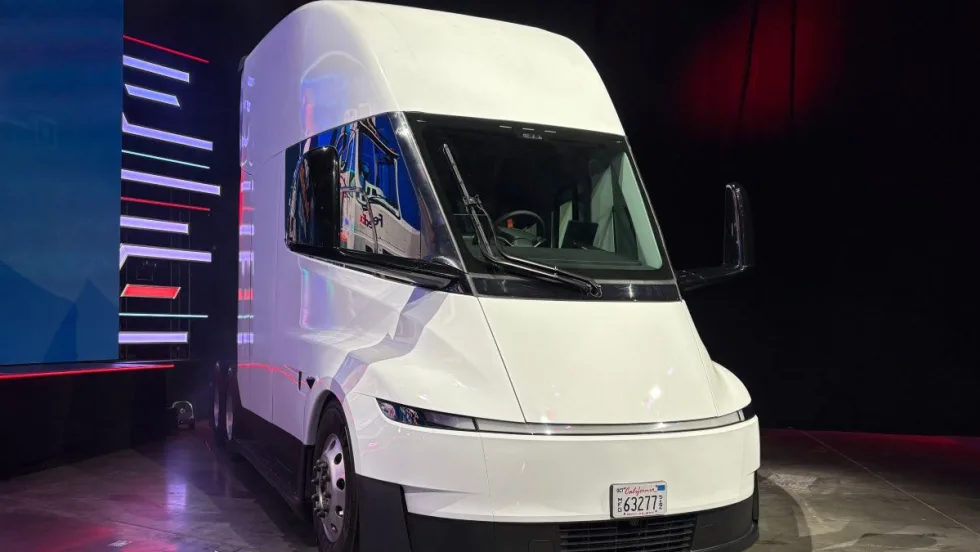
Fleet Economics Shape Electric Truck Outlook
ACT Research expects costs, charging infrastructure, and technology improvements to drive zero-emission commercial vehicle adoption as federal regulations and incentives retreat.
Read More →
Wex Adds Cardless Fuel Payments for Over-the-Road Customers
A new fuel card feature for Wex customers offers convenience and security.
Read More →