





Related: TMC Survey Reveals Misinformed View of Fuel-Efficient Tires
Figuring Out Wide-Base Single Tires
Wide-based single tires have proven weight- and fuel-saving properties, but not every fleet can make them work. Yet there may still be options.
April 29, 2015
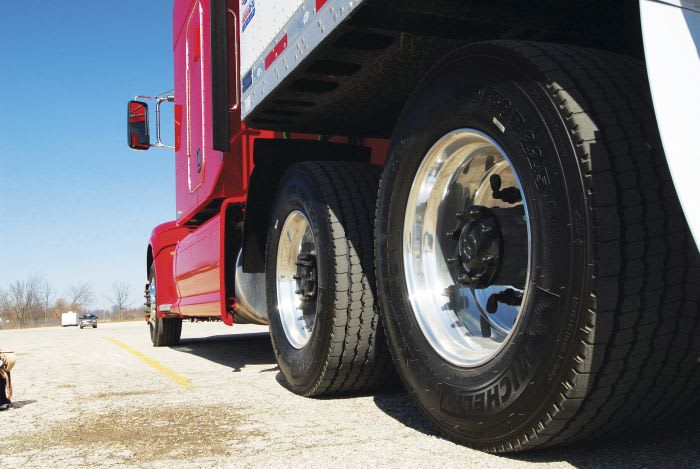
OEMs rely heavily on tires to meet their CAFE requirements under GHG reduction rules. Once fuel-efficient tires are installed, you can’t legally take them off.
6 min to read
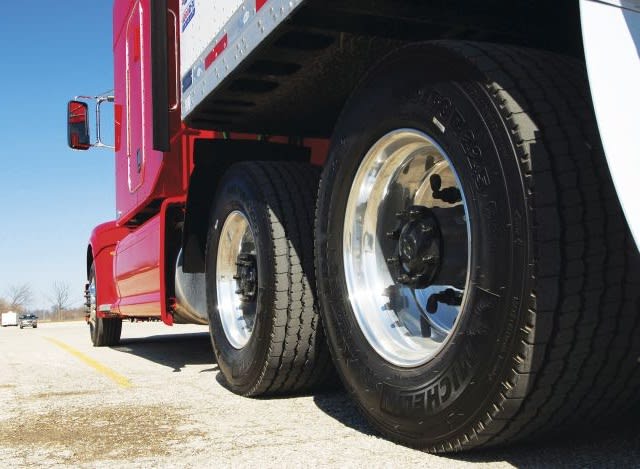
OEMs rely heavily on tires to meet their CAFE requirements under GHG reduction rules. Once fuel-efficient tires are installed, you can’t legally take them off.
Wide-base single tires have been in the marketplace since Michelin introduced the X One in 2000. In the 15 years since, plenty of fleets have tried the tires. Many have stayed with them. Some have migrated back to duals.
Are the next-generation wide tires the answer to all our tire-life, weight and fuel-savings questions?
As of Spring 2014, Michelin had sold more than 2 million X One wide-single tires, doubling the 1 million figure reported just four years earlier. That alone suggests acceptance is growing, and other tire makers are now building market share with wide-singles of their own (see sidebar), though not yet with the model diversity offered by Michelin.
With most of the early-year complaints behind us — premature irregular wear, poorer than expected fuel economy, diminished trade-in value and high in-service transition costs – and improving wheel and axle technology, we are seeing more and better success stories arising from the use of wide-base tires.
However, it’s important to remember that when we talk about wide-single tires, we’re generalizing.
Darren Stricker, the maintenance manager at RE West Transport of Ashland, Tenn., says he has proven a 3% difference in the fuel efficiency of two different brands of wide-base singles in his fleet. He presented his case at the S.2 Tire & Wheel Mini-Tech session at February’s meeting of the ATA’s Technology & Maintenance Council, so, per council tradition, he didn’t name names.
“I initially noticed a difference in fuel consumption based on our telematics data, so I decided to run an SAE Type IV test,” Stricker says.
The test ran for 90 days on two trucks running a 151-mile round trip on I-40 between a fuel stop in Lebanon, Tenn., and a customer in Knoxville.
“The Type IV actually revealed a 3.1% difference whereas the telematics data right from the ECM was showing 3.5%,” he says. “The difference first appeared when we took delivery of a few new tractors with a different brand of wide-single tires [but similar tread] than we were using.”
If the brand and model of wide-single tire you are using isn’t performing the way you’d hope, perhaps a switch is in order.
“With so many options, you have to find the tires that work best in your application,” Stricker says.
That advice is seconded soundly by Scott Perry, vice president of supply management with Ryder System.
Today, Ryder is not a major consumer of wide-single tires, but it has enough of them on the ground to have established best practices to keep those tires running out to a long service life.
“The application is critical,” Perry says. “We use them in several weight-sensitive applications, such as bulk fuel hauling, where additional value can be obtained from the extra revenue earned from hauling more product. However, that often comes with the trade-off of the operating expense and the potential wear characteristics. We find they are great when fully loaded, but as the load diminishes, the wear characteristics tend to change and you get more irregular wear and shoulder wear.”
Perry has been working to develop an optimum inflation pressure for a given GVW, but has not yet come up with a number, and it’s particularly difficult with diminishing loads.
“One solution, which we haven’t tried yet, would be to have a scalable inflation system that would automatically reduce the inflation pressure as the truck empties out,” he says. “That would help, but probably bring with it additional complexity and some other as yet unforeseen challenges.”
Otherwise, when it comes to inflation pressure, wide-base singles are no different from duals: You must inflate them for the maximum load the tire will carry. Michelin, for example, recommends 100 psi for a load of 17,480 pounds across an axle with its line of X One 445/50R22.5 wide-base singles – sufficient for a full tandem load of 34,000 pounds. At 90 psi, the maximum load would be 32,120 on the tandem. Bridgestone and Goodyear’s inflation recommendations are the same.
Air Products and Chemicals, based in Allentown, Pa., uses some wide-single tires, and like Ryder’s fuel-hauling fleet, faces the challenge of diminishing loads. Tim Dzojko, fleet engineering specialist at Air Products, says he runs 100 psi in wide-base tires.
“For us it was a slight challenge because we leave our terminals fully loaded and make deliveries throughout the course of the day, thus decreasing the payload weight as we go,” he says. “We are only ever at that fully loaded weight for a short portion of the trip. Nevertheless, we need to spec for the maximum payload we will encounter, even if it is for a short time.”
Dzojko claims he’s getting better than 200,000 miles from a set of tires, and admits it would probably be better if they could resolve the inflation problem relative to the diminishing payload.
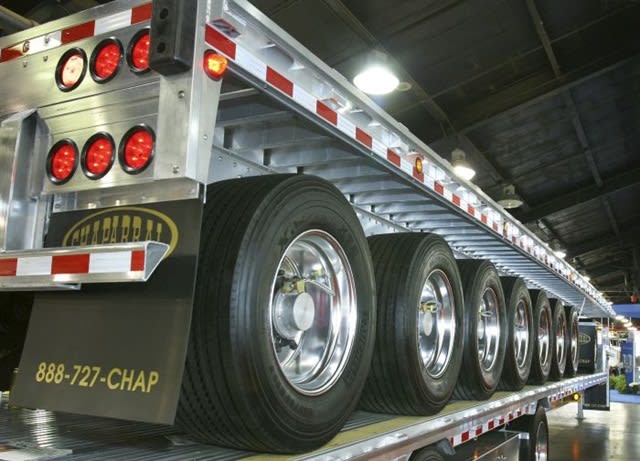
Are poor inflation pressure and wheel-end maintenance to blame for poor tire mileage in trailer positions?
Keys to success
To fully understand why fleets have mixed experiences with wide-base single tires, you have to look at everything, including the application, gross vehicle weight, vehicle configuration, maintenance practices, and the business case with which fleets approach the purchase of wide-singles.
Previously, and still to some extent, fleets hedge their bets on their commitment to wide-singles by spec’ing narrow- or mid-track-width axles so converting back to dual tires remains a possibility. That requires the use of offset wheels, which have been linked to increased inside shoulder wear on the tires due to axle flexing, which creates a negative camber condition at the wheel.
Ryder saw the irregular wear all but vanish after moving to wide-track axles with zero-offset wheels, Perry says, but there were consequences.
“The one trade-off we encountered was with the wide-track axle in the event you had a failure or at the end of its service life. If you wanted to put duals back on the axle you’d be more than 102 inches wide,” he notes.
Stricker, too, says he suffered with irregular wear on the trailer tires for quite some time. Like Ryder, it all but disappeared when he went to a zero-offset wheel.
Hartt Transportation of Bangor, Maine, is a relatively small fleet operating a general freight business. It has gone 100% to wide-base singles at all wheel positions and isn’t looking back. Maintenance Director Todd Cotier says the company initially went to wide-singles for the weight savings and found the fuel economy was a very strong value proposition. He says today, after more than 10 years experience with the tires, maintenance is the key to their survival.
“We check tire pressure every time a truck comes into the shop, and we mark the pressure on the sidewall with a grease pencil for a reference,” he says. “We do a bearing end-play check on every wheel end at every PM interval, and we balance the tires and check vehicle alignment annually.
“We changed up our wheel-end program a few years ago and it made a huge difference, especially with the wide-singles,” he says, even though it takes more time to check the end-play and runout measurements. “The extra time is more than worth it.”
He found, too, that proper wheel bearing adjustment on trailers made a big difference in the inner shoulder wear.
With 15 years of experience with wide-single tires, the industry is still learning how to deal with them. They provide dramatic weight savings. The fuel savings is there, too, but newer dual tires are closing that gap quickly. And as other related equipment, such as axles, wheel bearings, wheels, etc. evolves, it’s likely going to get easier to make wide-base singles work in a wider variety of applications.
Subscribe to Our Newsletter
More Equipment
Kodiak Hauls Produce in California Autonomous Truck Pilot
Kodiak AI and DTL Transport have begun hauling produce between Fresno and Los Angeles under California’s new rules for testing heavy-duty autonomous trucks. A safety driver remains behind the wheel.
Read More →
Used-Truck Remarketing Math Is Changing
Used-truck value is no longer just a concern at trade-in. Decisions made throughout a truck’s first life can influence what it’s worth years later.
Read More →
How Volvo Updated Its D13 for EPA 2027 [Watch]
Volvo’s updated D13 promises lower emissions without sacrificing performance or fuel economy. Take a closer look at what changed inside the engine in this HDT Spotlight video.
Read More →
Michelin Tire Improves Efficiency and Durability for Regional Fleets
The Michelin X Multi Energy D2 is a regional haul drive tire engineered to help fleets improve fuel efficiency, durability and traction in demanding stop-and-go operations.
Read More →
ZF Expands Commercial Vehicle Push in North America
ZF is expanding its North American commercial-vehicle presence with new transmission applications, electrification, trailer technology and autonomous-driving systems.
Read More →
Tesla Wants a Self-Driving Semi. Are Cameras Enough?
Could Tesla’s camera-only autonomous driving technology work on an 80,000-pound Semi? In this commentary, HDT's Deborah Lockridge takes a look at Tesla, Cybercab, and how autonomous trucks see the road.
Read More →
Kodiak: Driverless Long-Haul Truck Launch on Track for 2026
Kodiak AI says its driverless long-haul safety case is 93% complete and it remains on track to begin commercial operations by year-end 2026.
Read More →
What DOT’s Automated Vehicle Strategy Means for Trucking
The U.S. Department of Transportation issued a new automated-vehicle strategy that outlines plans for driverless-truck regulations, cross-state freight corridors, and federal safety standards.
Read More →
East Coast Port Launches $45M Electric Truck Push
The Port Authority of New York and New Jersey announced millions in incentives for zero-emission drayage trucks, yard tractors, and new charging hubs near the port.
Read More →
PlusAI Going Public to Fund Autonomous Truck Launch
A SPAC deal could provide PlusAI with up to $300 million as it works toward a 2027 commercial launch of factory-built autonomous trucks.
Read More →