




Electric Trucks Still Generate a Spark of Interest
Senior Editor Tom Berg looks at the state of the electric truck market as fleets struggle to balance benefits with economics.

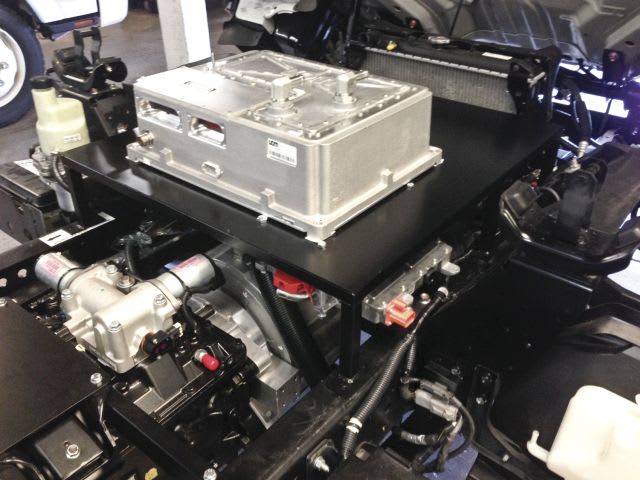
EVI assembled 100 electric-drive vans for UPS using FCCC glider kits, and 15 cab-chassis trucks for Frito-Lay from Freightliner M2 gliders.
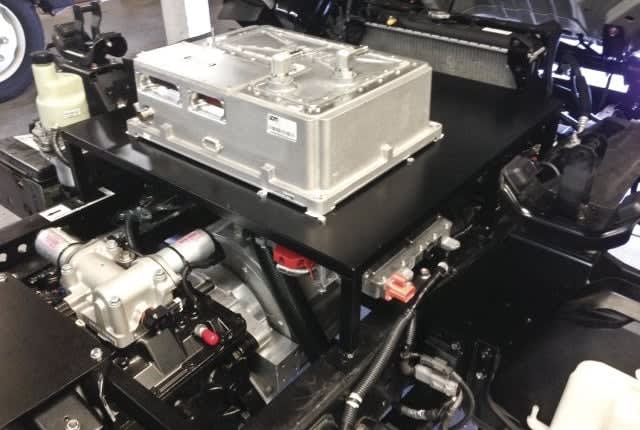
EVI assembled 100 electric-drive vans for UPS using FCCC glider kits, and 15 cab-chassis trucks for Frito-Lay from Freightliner M2 gliders.
There’s still a spark of interest in electric trucks. As a fuel, electricity is cheap, and on the street, vehicles that use it are extremely clean. There is no internal combustion engine to maintain, so operating costs have been low. Drivers love them for their quickness and quietness, and clean-air advocates embrace them for their pollution-reduction potential.
But electric trucks still cost two or three times the price of conventionally powered trucks, needing government support for purchases to make decent business cases. Meanwhile, moderating fuel prices have reduced the potential savings needed to pay off any extra investment.
One start-up company, Boulder Electric Vehicles, shut down its California factory and Colorado headquarters over the summer, according to the Los Angeles Daily News. CEO Carter Brown told the newspaper slow sales were to blame. But Boulder is not filing for bankruptcy and is still servicing the trucks it has sold. Brown hopes changing market conditions will allow the company to be resurrected.
Boulder chose to develop a complete vehicle, including a chassis and a lightweight walk-in-type cab. This was expensive, says Tedd Abramson, president and CEO of Zero Truck in southern California, which converts Isuzu NPR low-cab-forward trucks to electric power.
“We remove the engine and transmission and sell them, and put in our own powertrain,” Abramson explains. The battery is a high-energy lithium polymer type, made in the U.S. by Xalt.
Zero sold its first truck in early 2010 to the City of Santa Monica, where it’s still in use. The company is now processing orders for 12 trucks that will go to municipalities and fleets.
“We don’t like to see any of the electric vehicle companies go out of business, because it affects the perception in the marketplace,” Abramson says.
He contends there’s enough business for everybody. "There are 88,000 large municipalities all over the U.S. that have fleets, and most of their trucks drive less than 80 miles per day. The economics of an electric truck are very positive.“
One company that shut down but says it's coming back is Smith Electric Vehicles. It had built about 800 trucks before “pausing” production in April.
“The restructuring and recapitalization effort went well,” says President and CEO Bryan Hansel of a $42 million infusion from Sinopoly Battery Limited. It's a Hong Kong-based maker of lithium-ion batteries and related equipment, which Smith will use when it resumes production. However, the company can use domestic batteries when bidding for business with companies with "Buy America" requirements, he says.
Orders are in hand, Hansel says, and this fall Smith will resume building Newton low-cab-forward trucks, which combine a stripped chassis with a cab from Ashok Leyland of India. Smith won’t revive the Edison van.
“We can’t say how many orders we have because we’re moving toward a public market,” which will raise additional capital, Hansel says. “Almost every customer who has bought from us has come back. We’re on the cusp of real movement.”
Back in southern California, TransPower is assembling Class 8 drayage tractors by buying and converting International ProStar daycab models to electric power. One is in field testing at the Port of Los Angeles. The company is building seven more under a government grant, and is seeking operators to test and hopefully acquire them, says Mike Simon, president and CEO.
TransPower bought complete ProStars from Navistar, and workers removed their diesel powertrains and sold them. Engineers then designed in the company’s ElecTruk drive system, consisting of a motor from JJE of China, an Eaton UltraShift 10-speed automated transmission, and a specialized controller.
Zenith Motors in northern Kentucky also converts existing chassis, in this case Ram ProMaster vans, to electric power. It has been doing one a week, and “we can make money at that rate,” says Christine Smith, vice president of sales and marketing. Most have been passenger shuttles, but a pair of cargo vans went to Alameda County, Calif., which bought them for building maintenance.
The Zenith electric van uses a Borg-Warner electric drivetrain, including a 180-horsepower motor and a 62.5-kilowatt-hour bank of lithium-ion phosphate batteries. Its operating range is 70 to 85 miles and top speed is 60 mph. It comes in two models with 2,500- and 3,000-pound payload capacity, and two roof heights. A Zenith 350’s list price is $89,500.
“There’s lots of interest, and we will have really exciting news in a couple of months,” Smith says.
A different approach was taken by Electric Vehicles International, in northern California. It used engine-less glider kits from Freightliner Custom Chassis Corp. to assemble 100 walk-in vans with Morgan Olson bodies for UPS, and Freightliner M2 gliders to build 15 cab-chassis trucks for Frito-Lay, explains Brett Gipe, vice president, sales and marketing. Those two fleets are EVI’s “core partners,” but it has other projects in the works.
“There are all kinds of grants, programs and demonstration projects out there to prove that they work,” Gipe says. “We need to go to a single federal program that would work everywhere in the country for everyone, instead of the state and local programs, the DOE and EPA grants that work through applications that require corporate resources to deal with.”
That would drive volume and help bring down costs for medium- and small-size fleets, as well as the big ones. But that would take action by Congress, which let incentives for various alternative-fuel cars and trucks expire at the end of 2013.
More Fuel Smarts

New California Law Could Shed Light on Electric Truck Prices
Why do battery-electric Class 8 trucks remain so expensive? A California bill signed by Gov. Gavin Newsom would give fleets and state agencies more visibility into what manufacturers charge.
Read More →
How Volvo Updated Its D13 for EPA 2027 [Watch]
Volvo’s updated D13 promises lower emissions without sacrificing performance or fuel economy. Take a closer look at what changed inside the engine in this HDT Spotlight video.
Read More →
Diesel Price Spike Shortens Payback for Natural Gas Trucks, Report Says
Energy Vision estimates fleets could recover the higher purchase price of an RNG-fueled Class 8 tractor in 1.3 to 2.8 years under current fuel-price scenarios.
Read More →

Calstart Becomes Catalyst Mobility, Reflecting Broader Focus
Calstart is now Catalyst Mobility, reflecting the nonprofit’s growing national role in clean transportation, including zero-emission trucks, infrastructure and incentive programs.
Read More →
Record Diesel Prices Squeeze Trucking Fleets
Average U.S. diesel prices have climbed to nearly $6 a gallon, surpassing the 2022 record as tight refinery capacity and Middle East disruptions keep fuel costs elevated.
Read More →
How Fuel Delivery Shapes Engine Performance
Fuel delivery depends on more than what happens at the injector. For fleet, maintenance and technical professionals, looking at the full path from pump to injector can provide useful context for understanding engine performance.
Read More →
East Coast Port Launches $45M Electric Truck Push
The Port Authority of New York and New Jersey announced millions in incentives for zero-emission drayage trucks, yard tractors, and new charging hubs near the port.
Read More →
Detroit Opens Orders for EPA 2027 Engines
Detroit isn’t starting from scratch to meet EPA 2027 diesel emissions standards. Its Gen 6 DD13 and DD15 engines keep much of today’s platform while updating the fuel and aftertreatment systems.
Read More →
Zero-Emission Truck Corridor Planned for West Coast
California, Oregon, Washington, British Columbia and Baja California are coordinating plans for truck charging and hydrogen fueling from Canada to Mexico.
Read More →
A Closer Look at Kenworth’s Electric T880E Vocational Truck [Video]
Learn more about Kenworth's T880E battery-electric vocational truck at the Paccar Technical Center, including its range, applications, upfitting considerations, and PTO options, in this HDT Spotlight video.
Read More →