




ELDs: What Happens When You Have to Rent a Truck?
Truck rental and leasing companies say the electronic logs mandate presents problems for them and their customers.

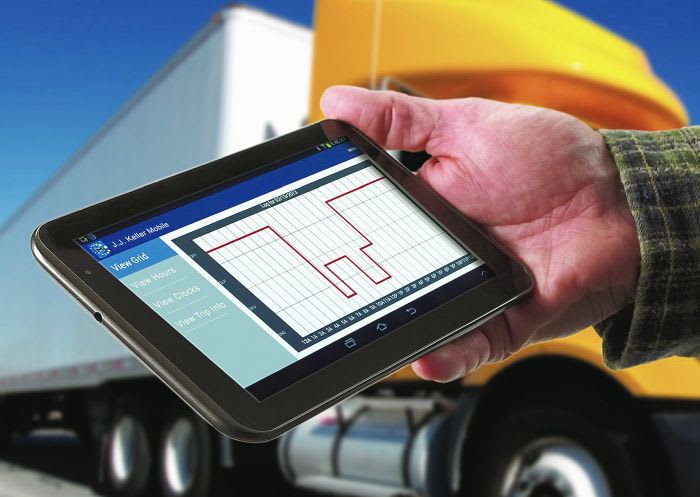
Photo: J.J. Keller
Photo: J.J. Keller
The electronic logging device mandate might seem to an outsider like a simple change that was desired to improve highway safety and driven into being by the advance of technology. But trucking experts know all too well that implementing the ELD rule, which takes effect in December of next year, to replace paper logs with electronic recordings is not a simple matter of out with the old and in with the new.
Add to the list of hiccups the concern of truck rental and leasing companies that the rule doesn’t address the difficulty in recording and accessing ELD data coming from different technology sources.
When the final ELD rule was rolled out last December, the Truck Rental and Leasing Association said it was “disappointed to learn that its comments regarding a rental vehicle exemption were not accepted by FMCSA for the final rule.” TRALA’s concern centers on when trucks are rented to multiple consumer and commercial customers who have varying obligations to comply with electronic log requirements.
TRALA also contends that since many different technology platforms will be used by many different drivers and companies, it “could be difficult to reconcile, with no clear indication by FMCSA as to whether the owner of the vehicle or the operator would be required to maintain [ELD] data.”
While the association concedes that the vast majority of member customers would be exempt from the rules (due to their 100- and 150-mile radius exemptions), a certain percentage of those customers are covered by hours of service regulations.
“In effect,” said TRALA, “the rule could require that every truck in a company’s rental fleet be retrofitted and equipped with an ELD to ensure compliance, whether or not the rental customer needs to utilize the technology.”
“This issue presents a great challenge to truck and lease companies as well as fleets,” says Jim Griffin, chief technology officer for Fleet Advantage, Fort Lauderdale, Fla., which provides business analytics and equipment financing to large private fleets.
He says having to deal with ELD data generated by different devices and platforms makes it essential for fleets “to identify the right telematics partner that has the technology to capture and analyze ELD data from many disparate sources,” including trucks and engines of different makes and vintage.
Before selecting an ELD solution, Griffin recommends that fleets first answer these key questions:
Is the technology limited to compliance with the ELD mandate?
Does the technology provide easy access to reliable applications and reports that can provide actionable information for improving operating performance and safety?
Does the technology provide a “growth path” to leverage the value of predictive and descriptive diagnostics? “Many providers will tell you they are providing it today,” Griffin says. ”However, this is an emerging area still in its infancy that will continue to evolve. Don’t get left behind by choosing a limited technology partner.”
Does the provider have the resources, understanding and cultural climate to navigate this journey with your organization and be a true partner?
“Although the thought of implementing the new ELD mandate with a telematics solution can appear to be overwhelming,” he contends, “the benefits of doing so will be well worth the investment of cost, time and effort.”
More Safety & Compliance

FMCSA Pauses Biennial-Update Enforcement Amid Motus Transition
Carriers whose updates were due on or after June 1 have more time, while FMCSA works to stabilize its new registration system and warns of phishing sites impersonating its new carrier registration system, Motus.
Read More →
ZF Expands Commercial Vehicle Push in North America
ZF is expanding its North American commercial-vehicle presence with new transmission applications, electrification, trailer technology and autonomous-driving systems.
Read More →
Truck Drivers Need More Than Another Alert
Fleets have more visibility into truck health, safety events, and driver activity than ever. The next challenge is turning all that information into useful guidance for the person who has to decide what to do next.
Read More →
Tesla Wants a Self-Driving Semi. Are Cameras Enough?
Could Tesla’s camera-only autonomous driving technology work on an 80,000-pound Semi? In this commentary, HDT's Deborah Lockridge takes a look at Tesla, Cybercab, and how autonomous trucks see the road.
Read More →
What DOT’s Automated Vehicle Strategy Means for Trucking
The U.S. Department of Transportation issued a new automated-vehicle strategy that outlines plans for driverless-truck regulations, cross-state freight corridors, and federal safety standards.
Read More →
NYC Expands Speed, Pedestrian Safety Tech Across Fleet
New York City is expanding intelligent speed assistance and pedestrian-alert systems across its municipal fleet, moving the technologies from pilot programs into vehicle procurement and retrofit requirements.
Read More →
FMCSA Removes 110 Truck Driver Training Schools from Certified ELDT List
Federal regulators also are targeting more than 160 additional training providers and launching a nationwide audit of third-party CDL skills testers as part of a broader crackdown on trucking fraud.
Read More →
Beyond DOT Compliance: What Makes a Trucking Fleet Truly Safe?
A trucking fleet can follow every rule and still make unsafe decisions. The real test comes when safety conflicts with freight, productivity, or cost.
Read More →
Hours of Service Pilot Programs: FMCSA Readies for 2027 Rollout
Two pilot programs could eventually reshape hours-of-service rules, giving truck drivers options to pause their 14-hour clock or use longer split sleeper rest periods.
Read More →
New Guide Offers Pet Safety Tips for Truck Drivers
Hundreds of thousands of pets travel in truck cabs. A new safety guide from Volvo Trucks and the Center for Pet Safety offers practical advice for truck drivers who bring dogs and cats along for the ride.
Read More →