




EDI: Learning the Language
Oklahoma-based Melton Truck Lines used to handle its Electronic Data Interchange (EDI) transactions in-house. The in-house process was expensive, and monitoring freight availability and finding loads was labor-intensive and time-consuming for the flatbed carrier
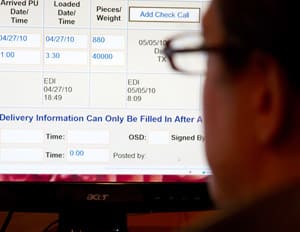
EDI allows carriers to monitor loads and respond quickly. Many say it's necessary to deal with shippers. (Photo by Aljex)
Oklahoma-based Melton Truck Lines used to handle its Electronic Data Interchange (EDI) transactions in-house. The in-house process was expensive, and monitoring freight availability and finding loads was labor-intensive and time-consuming for the flatbed carrier.
After the company installed Intelek Technologies' EDI solutions, Melton was able to save time and money.
"With DiamondMine and StripMiner software from Intelek Technologies, we are realizing significant savings compared to when we handled EDI transactions and load procurement internally," says Randy Rhines, senior vice president of IT at Melton. "We're also gaining immeasurable amounts of business we might not have secured otherwise."
With its DiamondMine EDI software handling and speeding up the process of mapping, Melton could devote at least half of a programmer's time to other duties, saving about $40,000 a year in salary and benefits. Using the StripMiner software, Melton can monitor shipper loads and respond quickly. With this, the company was able to eliminate the need to double the staff required for this task, saving $90,000 a year.
"Without this package of solutions, we would be realizing a loss of business and higher costs from managing EDI transactions in-house," says Rhines.
Everyone's doing it
Within the transportation community, EDI is the method of choice for communicating in a standard way, explains Ken Weinberg, vice president with Carrier Logistics. Weinberg defines EDI as the idea of transmitting data between two parties electronically. "For all intents and purposes, it's a language."
These days, it's a language carriers are going to have to use if they want to do business with the big players in the shipping community. EDI first came on the scene in the 1970s. Today, it's not just considered an add-on solution; for a lot of trucking companies, it's a given.
"The majority of your big shippers require some kind of EDI now," says Jimmy Star, owner of Woodfield, a carrier out of Camden, Ark. "It's just how business is done nowadays." Woodfield operates on Horizon EDI software from Melton Technologies, or MTI (not to be confused with Melton Truck Lines.)
Using this EDI standardized language, MTI's system manages Woodfield's communications with shippers automatically, reducing the human element. With the technology, the carrier has been able to save on personnel, speed up its receivables, and improve customer satisfaction. "People don't want to talk on the phone anymore," Star says.
Transaction sets
According to Carrier Logistics' Weinberg, EDI is a "non-standard standard." While there are certain transaction sets for different types of communications and data being sent, shippers may use the fields within the transaction set in different ways. Some of the most common transaction sets include:
* 204: Load Tender
* 990: Response to Load Tender (accept or reject)
* 210: Invoice
* 214: Transportation Carrier Shipment Status Message
* 997: Functional Acknowledgement
Using these transaction sets, which can be automated, carriers can relieve the back office burden, according to John Gaither, MTI's vice president of sales and marketing. "When it's done in this manner, it's so automated that our customers don't have to do anything."
MTI's Bob Hogan, implementation specialist, says his company's software eliminates the need for duplicating data entry, as it captures information from the shipper automatically. The data is then presented to the user in MTI's suite. That lets the carrier focus on the management decision of whether to accept the load or not, he says. The system also has the potential to automatically book the load if the carrier is contracted with a particular shipper. This type of system also promotes accuracy because there is little human intervention.
The American National Standards Institute facilitates the development of EDI standards by establishing consensus among qualified groups. The American Trucking Associations' Information Technology and Logistics Council publishes Electronic Data Interchange Implementation Guidelines to help members understand the standards and provide ideas for putting them into place.
VAN vs. direct
Carriers have two different options for sending EDI data to the shipper. The direct method requires the carrier to access the web sites of all its shipper customers and set up communication for each. Or, carriers can use Value-Added Networks, or VANs, which serve as "post offices for EDI," or clearinghouses of data, says Tom Heine, president of Aljex Software. There are several companies that provide VAN services, which involve converting the transaction sets into the format the shipper or carrier wants.
Every shipper prefers a different format for receiving the transaction sets. Some may want FTP (file transfer protocol), others Applicability Statement 2 (AS2), etc. For a monthly fee and a per-character fee, a VAN will translate the data into the needed format and send it to the other party over a secured network, according to Carrier Logistics' Weinberg.
Using a VAN can get expensive, and it's easier to trade information directly, especially with the Internet, says Heine. However, it can also be hard for a carrier to juggle all the different communications for each customer. The system has to be up and running 24 hours a day, seven days a week in order to manage this, according to Doug Anderson, vice president of sales at Kleinschmidt, which provides EDI VAN services.
If you have a small number of trading partners, it will be more feasible to connect directly and do it all yourself, Anderson says. But if you have a lot of shippers and you don't have a big IT department, it may pay to let someone else handle it for you.
Kleinschmidt can translate data into any format the shipper wants. Its servers never go down, providing 100 percent uptime, he says. The company offers two production sites, multiple Internet service providers, and 24/7 staff availability.
EDI software companies provide different options for going direct and with a VAN. Carrier Logistics built its software so customers can "map" their customers' requests without a VAN. The company's system connects directly to the customer, while its staff will also assist.
With MTI, users can connect directly or through a VAN.
Intelek Technologies also helps carriers to bypass VAN charges where possible, although it helps customers handle both direct and VAN communications. Gary Hopkins, president of Intelek, says the company offers outsourcing services, so you don't need technical staff. Intelek can either supplement a carrier's staff or be their technical staff. Its DiamondMine EDI software can be deployed via Internet/phone connection, on its IBM iSeries platform, through software-as-a-service run on Intelek's servers, or through a Web-based solution.
According to Aljex's Heine, 70 percent of the Aljex's third-party logistics customers connect directly. Aljex provides an EDI solution that caters to third-party logistics customers, the intermediary between shippers and carriers in some cases.
"[EDI] changes the whole landscape for a company," says Heine. EDI locks in a carrier or a broker to the business, putting a barrier in the way for others looking to take your customers, he says. "Once you're part of the system, you're part of the system."
XML
The next big thing in EDI is XML, says Kleinschmidt's Anderson. Sound like alphabet soup? XML, or Extensible Markup Language, is another supported way of exchanging data electronically. According to Anderson, XML is another format for EDI that is more readable by humans than the traditional EDI formats. Someone new to the industry or unfamiliar with traditional EDI formats can pick it up more quickly, and the software used to translate XML is less expensive, he says.
The downside, however, is that XML docum
More Fleet Management

Color Match Smarter: Tools That Restore & Perform
For fleet managers and collision repair professionals keeping heavy-duty trucks on the road, getting the color right the first time isn't just about appearance — it's about efficiency, turnaround time, and bottom-line results. Discover how today's digital color tools are transforming the repair process from guesswork to precision.
Read More →
FMCSA Pauses Biennial-Update Enforcement Amid Motus Transition
Carriers whose updates were due on or after June 1 have more time, while FMCSA works to stabilize its new registration system and warns of phishing sites impersonating its new carrier registration system, Motus.
Read More →
2026 Blueprint for Countering Smarter Supply Chain Theft
Cargo theft is no longer just the cost of doing business. It's a multi-billion-dollar criminal enterprise exploiting vulnerabilities across your fleet, drivers, and supply chain.
Read More →


How Telematics Improves Visibility, Control, and Performance in Refrigerated Fleets
Explore how telematics help refrigerated fleets improve visibility, uptime, efficiency, compliance, and cargo protection across connected cold chain operations.
Read More →
What the U.S.-Canada Trade War Means for Trucking
Escalating U.S.-Canada tariffs could disrupt cross-border freight, reduce truck volumes, raise costs, and create new uncertainty for carriers on both sides of the border.
Read More →
What Are Trucking’s Top Concerns for 2026?
The American Transportation Research Institute wants to know what's worrying trucking fleet managers, drivers, and other stakeholders in its annual Industry Issues survey.
Read More →
American Trucking Associations Looks for a New Leader
ATA President and CEO Chris Spear abruptly left his job at the association on August 21, at a pivotal time for the trucking industry.
Read More →
Public Wi-Fi Cybersecurity Risks: How Truck Drivers and Fleets Can Protect Their Data
Public Wi-Fi can expose truck drivers and fleets to credential theft, malware, and other cyber threats. Here’s how to reduce the risk on the road.
Read More →
For Nicky Cupp, Fleet Innovation Starts With Frustration
HDT Truck Fleet Innovator Nicky Cupp turns everyday pain points at Fraley & Schilling into opportunities for better technology and smarter processes.
Read More →
Adam Buttgenbach’s Approach to Electric Trucks: Start With Where They Fit
HDT Truck Fleet Innovator Adam Buttgenbach helped PepsiCo build one of North America’s largest EV fleets by focusing on where electric trucks make operational sense.
Read More →