




Driver Ergonomics: Round Pegs and Oval Holes
As well as being in short supply, trucking’s new recruits are also, shorter generally, and thinner, as well as less likely to want a truck to look and feel like a truck. The challenge for truck makers comes in designing truck cabs to fit an expanding body-size profile, while making the driving environment appealing to people who have different expectations about trucks – all without alienating the existing driver population.

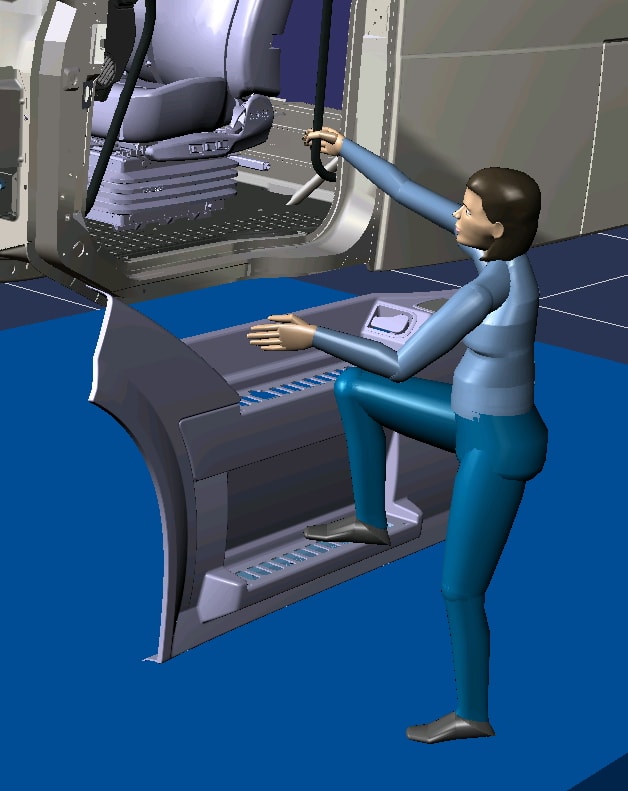
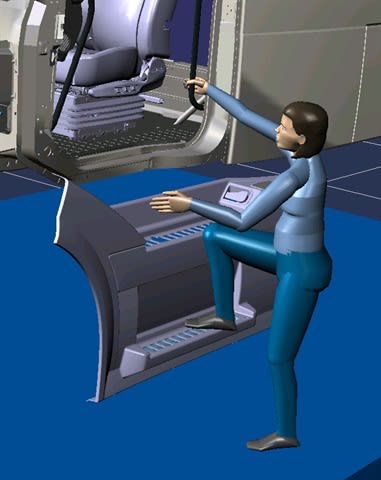
As well as being in short supply, trucking’s new recruits are also, shorter generally, and thinner, as well as less likely to want a truck to look and feel like a truck. The challenge for truck makers comes in designing truck cabs to fit an expanding body-size profile, while making the driving environment appealing to people who have different expectations about trucks – all without alienating the existing driver population.
Jason Spence, Volvo Trucks product marketing manager and formerly market research and industry trends manager, says there have been subtle but obvious changes in drivers’ weight and form in recent years. Spence says drivers are getting smaller.
“There has been a downward shift in the prevalence of what we describe as morbid obesity to more of an overweight status, and even further into what you could call a normal body mass index,” he says. “There are a number of reasons for that, but it does not appear to be because of improving health. The driver population isn’t trimming down; the larger ones are being trimmed out.”
Volvo’s analysis shows in 2008, the average driver weight was 232 pounds, but 2013 it was down to 216 pounds.
Volvo uses the National Institute for Occupational Safety and Health’s large-scale body-type surveys, and Spence has seen a change in the group representing the 95th percentile male to the 5th percentile female.
“The range in body size has increased with the influx of smaller Latino, Eastern European, and South Asian males and generally smaller female drivers,” Spence notes.
This can affect design items such as door handle placement, the amount of force required to open the door and even the step placement, considering the height from the ground and the distance between the steps.
To put it succinctly, truck cabs and all their amenities and service points have to comfortably accommodate body types ranging from something like a 5-foot, 2-inch, 110-pound female to a 6-foot, 5-inch, 300-pound male.
Truck makers have to account for various eye positions relative to the dash behind the steering wheel, visibility over and around the hood and the mirrors. Drivers have to be able to reach the inspection points on the engine, and, of course, have the strength to open the hood.
Andy Weiblen, Peterbilt’s assistant chief engineer, says the force required to open the hood on the Model 579 is about half that of previous truck generations.
“I think it’s about 25 pounds now,” he says. “And our clutch pedal now needs about 30 pounds of force to depress, where it used to be closer to 50 pounds.”
Overall, Peterbilt has increased seat adjustment by 20% and increased steering column adjustment by 77% in the new product line, and it seems to have satisfied the objective.
“We had a woman who was 4 feet, 11 inches visiting the Paccar Technical Center in Renton, Wash., say the truck fit her,” Weiblen says. “She was very surprised because she had had trouble getting a car or van to fit her small frame.”
When Paccar was developing its new cab dimensions, shared between the Kenworth T689 and Peterbilt’s Model 579, it invited 850 drivers to try the cab on for size. In fact, the drivers decided the dimensions of the cab using an adjustable mock-up of the cab that could be lengthened or shortened in all directions. The mock-up also allowed them to adjust the space between the driver and passenger seats for access to the sleeper, optimize the steering column position and how foot pedals should be aligned and distanced, and more.
“That exercise provided us with the right size for the cab and entryway to the sleeper,” says Jim Bechtold, Kenworth’s director of product planning.
“From the pressure required to flip a switch to the effort required to open the hood, driver size and weight play a role,” says T.J. Reed, director of product marketing at Freightliner Trucks. “We have come up with six or seven body types, and we create digital mock-ups first. And then we build physical mock ups and get real people that fit the type and get them to try the design.”
Reed notes that in working with the Women In Trucking association, the company has refined things like the seat travel and the steering column in the Cascadia. “Now, pretty much anyone can reach the pedals and drive a Cascadia,” Reed says.
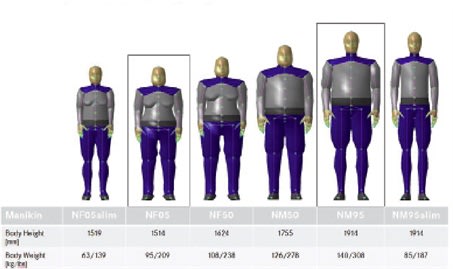
DTNA engineering uses a range of digital mannequins developed from a
statistical analysis of measurements taken from actual truck drivers.
Next gen drivers
A number of years ago, the International Brotherhood of Teamsters tried to write into its National Freight Agreement a “belly-room clause” that set minimum dimensions for the space between the steering wheel and the seatback. That effort didn’t move forward, but what came of the discussion between the Society of Automotive Engineers Cab and Occupant Environment steering group, the union, truck makers and other interested parties was a better understanding of the fact that the typical truck driver was not representative of the male population in general.
Jerry Hubble, chairman of the SAE Cab and Occupant Environment steering group, says it led to a more exhaustive study of truck driver body types and brought us closer to today’s design parameters.
“That exercise brought us the Sanders Study [also known as U.S. Truck Driver Anthropometric Study and Multivariate Anthropometric Models for Cab Designs], which gave us parameters for headroom, belly room, shin-to-dashboard clearance, etc., based on truck drivers’ dimensional parameters,” he says. “Compared to the general population, the truck driver is bigger in many ways than the 95-percentile male.”
“The other end of that spectrum,” notes Hubble, “are women, Asians, Latinos and others who are typically slighter in build than what we once defined as the typical truck driver. SAE’s goal now is to accommodate 95% of the truck driver population.”
More recently, the University of Wisconsin-Stout in Menomonie, Wis., partnered with Women In Trucking to identify opportunities for improvement in the designs for seats, dashes, steering and in-cab ergonomics for female drivers. Ryder System got involved with the research and identified custom vehicle designs that better meet the needs of female drivers.
“We found there was a lot of room for improvement in some of the cab designs, especially related to entry and exit as well as how the seat and dash are positioned relative to the pedals,” says Scott Perry, Ryder’s vice president of supply management. “Externally, we saw the need to lighten the pull pressure on some fifth-wheel locks. We saw hoods that were a little heavy, so there’s room for lift-assist devices or lighter hoods. There’s a lot when you get into it. Ryder is moving forward with some of these changes and we’re pushing the OEs to go further.”
Driver comfort
It’s one thing to shoehorn larger or smaller bodies into the cab. It’s another to keep them comfortable and satisfied with the environment. Seating plays an important role, since that’s figuratively where the rubber meets the road.
Volvo’s Spence advises that seats from different manufacturers come in different widths to accommodate different behinds. “Seats are customer choice items, so the seat you choose should be one that will keep you happy,” he says.

Women In Trucking says more than 200,000 women are employed as drivers, prompting truck makers and fleets to evaluate how well their trucks meet women’s needs.
In bygone days, truck and cab design seems to have been driven by form rather than function. Compare, for example the Mack R-model or the Peterbilt 359 cabs to the present models. Although many drivers miss the classic look, they also were smaller, noisier, hotter, had less room and were measurably less human-friendly.
Mack’s construction product marketing manager, Stu Russoli, says the Mack cab, with its history in the construction and severe service sectors, has undergone quite a transformation in accommodating non-traditional sized drivers while bringing a distinctive style to the product.
“Styling is very important, and it’s a fine line between too trucky and too automotive,” he says. “Today we have a wide variety of expectations to meet, from the old-guard driver to the younger people who want their truck to look and feel like a car. We are constantly surveying to stay ahead of what the market seems to want.”
Research for the Saunders Study was done more than 40 years ago, and it served designers well for a long time. We can be sure, with the emergence of a different sort of truck driver, that the next round of significant changes won’t wait that long.
Alarming alarms
Conversations about the in-cab environment also are increasingly addressing the question of how to best deal with the amount of information being served up to drivers in todays’ trucks.
The last thing a driver needs when something is going wrong is a confusing message about what’s going wrong. We’ve seen a proliferation of warning devices in truck cabs, and as yet, there are no standards for all those sounds and blinking lights.
T.J. Reed, director of product marketing at Freightliner Trucks, says a warning should alert the driver to the problem, while keeping the driver’s eyes focused on the road and their hands on the wheel, not get them searching around wondering what the beep or buzzer means.
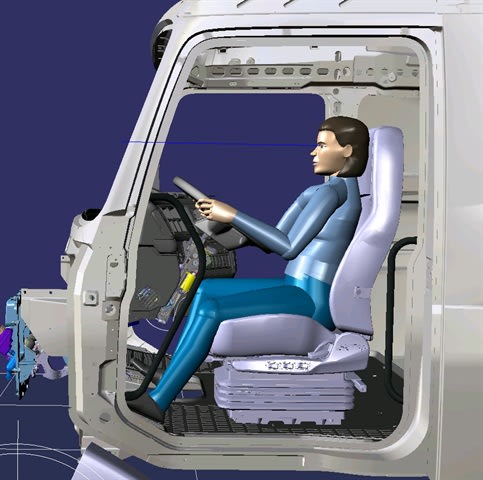
Various eye-points are examined to ensure optimum visibility from the driver’s seat. There can be no compromises in here.
“Secondary devices that require an individual gauge or a module that goes to the B-panel is something else to search for on the dash,” he says. “We’re integrating these warnings into the cluster, right in front of drivers where they can see it.”
But since the A panel on most trucks is getting pretty full, where do we put the additional warning lamps?
Heads-up displays, or HUDs, are one option.
HUDs are still in the advanced concepts realm at the moment, says Andy Weiblen, Peterbilt’s assistant chief engineer.
“Some are projected onto windshields, but windshields in trucks are tricky,” he says. “They frequently need to be replaced, so having an embedded display wouldn’t work because the HUD would increase the replacement cost.”
Instead, Weiblen is looking at projection technology that would be dash-mounted and displayed through a signal combiner mounted on top of the dash.
“You can still see through it, but it would not be subject to the replacement costs,” he says. “Regardless of how we do it, we want to make sure the driver’s eyes remain focused on the road. We want the display as close to the line of sight as possible, as opposed to a gauge on the far right side that is blinking red.”
More Drivers

From One Generation to the Next: How Mentorship Builds Safer Truck Drivers
After three decades in trucking, Harold Perry shares what he's learned about driver safety, mentorship, and helping the next generation build confidence behind the wheel.
Read More →
Truck Drivers Need More Than Another Alert
Fleets have more visibility into truck health, safety events, and driver activity than ever. The next challenge is turning all that information into useful guidance for the person who has to decide what to do next.
Read More →
FMCSA Removes 110 Truck Driver Training Schools from Certified ELDT List
Federal regulators also are targeting more than 160 additional training providers and launching a nationwide audit of third-party CDL skills testers as part of a broader crackdown on trucking fraud.
Read More →
Hours of Service Pilot Programs: FMCSA Readies for 2027 Rollout
Two pilot programs could eventually reshape hours-of-service rules, giving truck drivers options to pause their 14-hour clock or use longer split sleeper rest periods.
Read More →
Medical Cards, English Proficiency Reshape Roadcheck Violations
Medical-card violations jumped to the top of the driver out-of-service list during CVSA’s 2026 International Roadcheck, while English-language proficiency violations appeared among the leading violations for the first time.
Read More →
Driver Trust Can Make or Break the Success of Fleet Safety Technology
New Teletrac Navman research suggests that onboarding, transparency about driver data, and positive feedback can play a significant role in how commercial drivers respond to safety and coaching technology.
Read More →
EEOC Sues KLLM Over Alleged Sex Discrimination in Driver Training
KLLM is facing a federal sex-discrimination lawsuit over policies the EEOC alleges put female truck driver trainees at a disadvantage.
Read More →
FMCSA Moves to Codify English Language Requirements for Commercial Drivers
By changing regulations on English-language proficiency requirements for commercial drivers, rather than relying on a guidance memo, the FMCSA said future administrations won't be able to walk back the Trump administration's stricter enforcement with just a memo.
Read More →
Drivers Put Western Star Trucks to the Test at Star Nation Experience
Watch to get an inside look at the Western Star trucks, technology, and community behind the Star Nation Experience 2026!
Read More →
Trump Administration Looks to Put More Veterans Behind the Wheel
The Freedom Haulers program pulls together existing and expanded programs at several federal agencies to recruit veterans to drive commercial heavy-duty trucks and cut the red tape for them to get a CDL, training, and employment.
Read More →