




Don’t Overlook Trailer Maintenance
Can outsourcing help heavy-duty trucking fleets get eyeballs and hands on increasingly more sophisticated trailer assets?

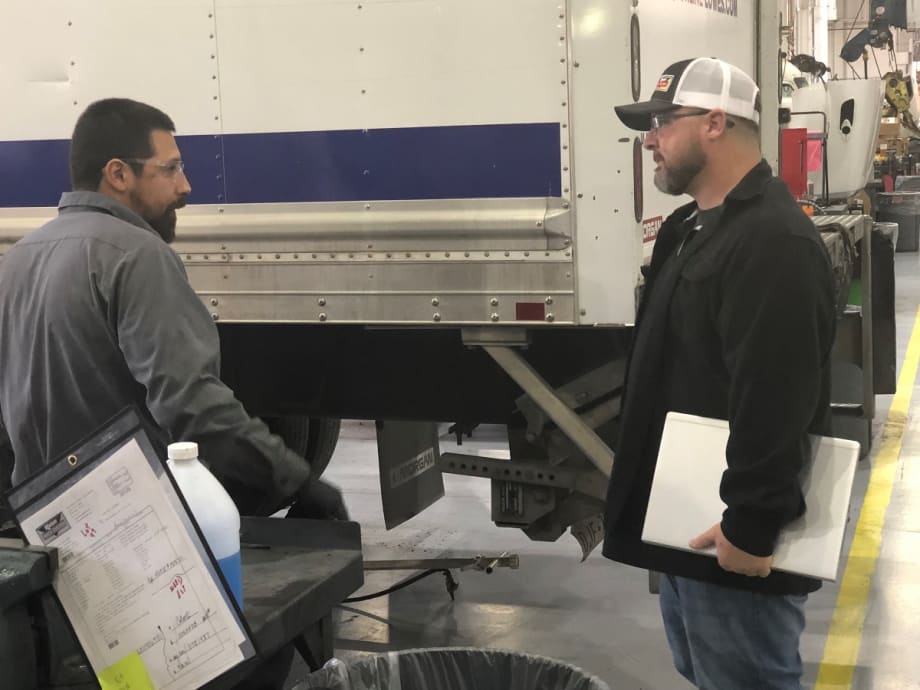
Having a discussion with both managers and technicians is a good way to determine if an outside maintenance provider will be on the same page as you when it comes to inspecting, maintaining, and repairing trailers.
Photo: Jack Roberts
Most fleets tend to focus on the power side of the tractor-trailer equation, leaving trailers on the short end of the maintenance stick.
Many fleets have turned to outside service providers that specialize in trailer repairs and maintenance as a way to ensure at least a minimum level of preventive maintenance and repairs is being performed.
But Charles Willmott, a fleet consultant and CEO of WillGo Consulting, says a new generation of trailers will soon be entering the trucking industry that will require levels of technical expertise and attention to detail on par with the standard for power units.
And he should know. Willmott recently retired after a 25-year career at Strick Trailers. He says the days of “big, light, stupid and cheap” trailers are coming to an end.
“We are on the cusp of a new frontier in trailer design,” Willmott says. “Trailers are the last asset in trucking to get a full technological makeover. But make no mistake — that makeover is coming.”
Tractors today can easily cost $200,000 a unit, Willmott notes, while dry van trailers cost in the neighborhood of $40,000 new, with reefers generally running $10,000 to $20,000 more, depending on options and features.
“Just that cost delta alone creates a natural priority for fleets to focus on their power units,” he says. “On top of that, most technicians are trained to work on power units — and trailers are much more basic designs when it comes to maintenance and repairs.
"With technicians increasingly difficult to recruit and retain, many fleet managers simply don’t want to pay the rates those talented individuals require to work on the ‘little wagons’ that run behind the tractors.”
A New Era of Technology for Trailers
But that technology gap between the tractor and the trailer is closing fast, Willmott adds. He says a revolution is coming to trailers — one that will initially focus on creating and monitoring data generated by a trailer’s telematics system, and eventually spread to broader information technologies such as blockchain and real-time transparency of where cargo is and what condition it is in.
“We are seeing the beginning of these trailer technologies today,” Willmott says. “But they are still operating on Thomas Edison-era electric systems and operate in information silos. That’s not suitable technology to haul cargo in a digital age.
"So we are seeing change coming with a number of new trailer-focused data management systems from various suppliers that are going to add much deeper levels of technology and associated maintenance to these units in the very near future.”
Mark Finger, vice president of operations for outsource maintenance provider Transervice, agrees with Willmott’s assessment of the challenges looming for trailer maintenance.
“The technological challenges fleets are facing are already more complex today and require an ever-growing skill set on the part of technicians,” he says.
Moreover, Finger argues, the increased demand for maintenance is straining the resources of all but the largest fleets to keep both power units and trailers in safe operating order.
“As trailers grow more technically complex, fleets are going to have to be involved in actively developing, attracting, and retaining technicians with those specialized skill sets. And they’re already struggling to do that on the tractor side of the equation," Finger says.
"When you combine those factors with other issues — maybe they don’t have the right infrastructure to adequately deal with trailers, or they don’t have the right fleet maintenance system in place to drive overall costs down — more and more fleets are recognizing they need an outside partner to help them.”
And those factors don’t even consider the legal aspect of trailer maintenance. Darry Stuart, CEO of DWS Fleet Management Services, says he’s seen multiple recent court cases where wheel-end failures on trailers led to massive payouts and awards levied by juries against truck fleets.
“Trailers are getting more sophisticated,” he says. “You see them now with solar panels, telematics systems and tire pressure monitoring systems — and that’s just the beginning. Trailers are no longer just a box on wheels. They are now increasingly expensive fleet assets. And they can cost you a lot of money if they’re not being maintained properly.”
Your trailer maintenance program — not theirs
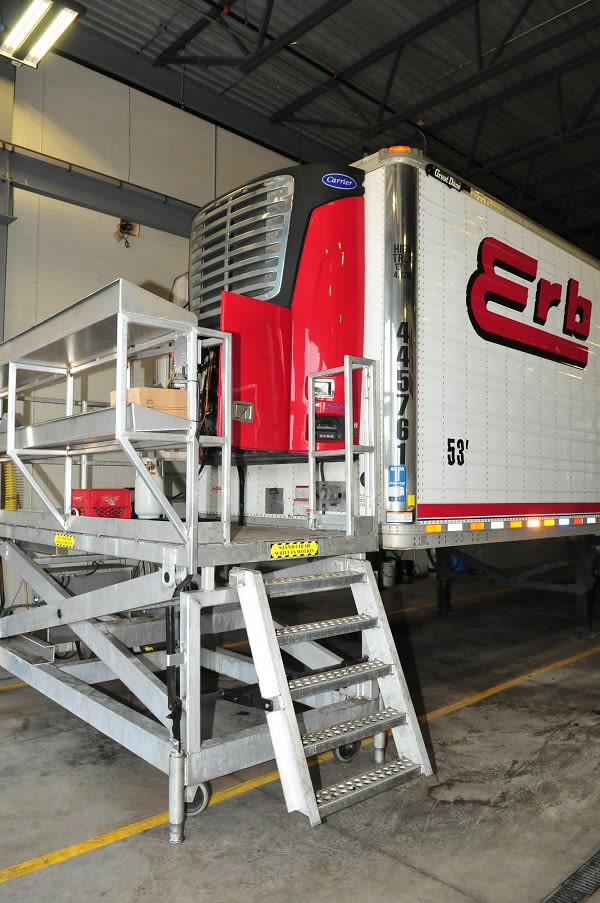
Not all trailers are created equal. Reefers, for example, will require more equipment and attention to detail from any maintenance provider you’re considering.
However, when it comes to outsourcing trailer maintenance, offerings vary widely.
There are national players such as Finger’s Transervice, which operates in major cities around the country, all the way down to single technicians with a service truck in business for themselves.
Unlike truck OEMs, which have aggressively pushed their national dealer networks to expand their maintenance offerings, trailer dealerships are still mostly privately held and often lack any kind of nationally coordinated, comprehensive maintenance program.
That means fleets operating in large geographic areas may have excellent outsource maintenance providers for trailers in one location — and none at all in another.
“For a lot of fleet managers, trailer maintenance really hinges on a spreadsheet approach,” Willmott says. “Because it often boils down to where our trailer is, what kind of work it needs, and what list of possible providers are nearby — and what kinds of services do they offer. There are relatively few locations nationally where a fleet can be assured all of the services they need will be available.”
“Truck stop chains are making a kind of power play for this business,” Stuart says. “And that makes a lot of sense given their geographic footprints. And we’re seeing a lot of extended warranty programs offered by trailer OEs that requires work be done by dealerships. But there are still a lot of highly qualified, reputable small vendors who can help small and medium fleets.”
Follow Up With Outside Trailer Maintenance Vendors
But, Stuart cautions, finding a vendor is only the first step. Too many fleets make the critical error of outsourcing their trailer maintenance and then doing little or nothing to follow up.
“Just because you outsource something, that doesn’t mean that the job is automatically being done correctly or efficiently,” he warns.
“Outsourcing a problem doesn’t mean that it just goes away. Like anything else, you have to be proactive up front when selecting your provider, and you have to stay on top of them and verify they’re doing things in the manner that you requested. And that is key — because it is your maintenance program. Not theirs.”
Stuart is known for being old school and hands-on when it comes to assessing maintenance operations. And his advice for sizing up potential trailer maintenance suppliers follows a similar logic.
He suggests meeting with the manager of the operation and finding out not only what kinds of standard services it offers, but also if the provider is willing to offer maintenance packages customized by you for your specific operations. Stuart likes to talk to the technicians in addition to the manager to understand how they do their job, what issues they look for, and what procedures they follow.
He also likes to look over service trucks to see what kind of shape they’re in and what kind of equipment is onboard, based on his theory that many books actually can be judged by their covers.
Finger recommends making sure you have a handle on what systems are critical for safe, efficient trailer operations and creating a measurement system with your provider.
“It’s about drilling down to discover what issues need to be addressed,” he says. “Once you have those, you can relay those concerns to an outside maintenance provider and come up with a comprehensive plan for addressing them and bringing costs under control.”
More Maintenance

Color Match Smarter: Tools That Restore & Perform
For fleet managers and collision repair professionals keeping heavy-duty trucks on the road, getting the color right the first time isn't just about appearance — it's about efficiency, turnaround time, and bottom-line results. Discover how today's digital color tools are transforming the repair process from guesswork to precision.
Read More →
Wrong Repair Prompts Recall of Freightliner, Western Star 4x2 Trucks
DTNA is recalling more than 2,400 trucks that received an incompatible software fix instead of the hardware repair required to address brake valve corrosion.
Read More →
Truck Drivers Need More Than Another Alert
Fleets have more visibility into truck health, safety events, and driver activity than ever. The next challenge is turning all that information into useful guidance for the person who has to decide what to do next.
Read More →
The Maintenance Checks Trucking Fleets Should Prioritize Before Fall Freight Picks Up
Making it through August isn’t the same as being ready for the next several months of operation. Find out what systems may have suffered from summer heat and need to be checked out before fall.
Read More →
What Three Fleets Are Doing Differently When Buying Truck Parts in 2026
With freight improving but costs still climbing, fleet maintenance executives explain how they're balancing price, quality, and supplier relationships.
Read More →
Paccar Recalls 2027 Trucks Built This Summer for Possible Electrical Problem
The nearly 6,000 Kenworth and Peterbilt trucks in the recall could potentially lose engine power, among other things.
Read More →
Will API PC-12 Oil Change Trucking Fleet Maintenance?
The new API PC-12 heavy-duty engine oil category reflects the changing demands of modern diesel engines. But fleets like Foodliner are looking to getting their own data before making decisions on adopting the new oils and questions such as extending oil drain intervals.
Read More →
Brake Safety Week to Focus on Drums and Rotors
Commercial vehicle inspectors are focusing on truck brakes during CVSA's Brake Safety Week, August 23-29.
Read More →Possible Battery-Cable Fires Prompt Recall of 15,000+ International MV and HV Trucks
On the recalled vehicles, manufacturing variations can cause the battery interconnect cable to contact the auxiliary stud and hold down the bracket.
Read More →
Rush, MCT Team Up to Grow Refrigeration Service Network
The joint venture will operate MCT's network of Carrier Transicold dealerships and mobile service locations, with the companies promising greater service capacity and uptime for refrigerated fleets.
Read More →