




Delivering Green: One Energy Provider Sets a Green Example
Vermont-based Bourne's Energy, a family-owned company that delivers fuel and propane to households and businesses, has a long-term goal of producing a usable biofuel in Vermont
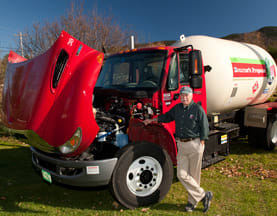
Bourne's Energy chose to lease two hybrids from Ryder, including this propane-hauling truck, displayed next to President Peter Bourne.
Vermont-based Bourne's Energy, a family-owned company that delivers fuel and propane to households and businesses, has a long-term goal of producing a usable biofuel in Vermont.
The company has been providing biofuels, "bioheat," as well as solar water heating solutions to its customers for years. But that wasn't enough of an environmental push for the energy provider.
President Peter Bourne felt the company had a responsibility to set an example to the company's customers on what they should be doing to go green, and this meant looking at its own operations. With a fleet of 13 vehicles hauling fuel and propane throughout area and burning fuel at the same time, the company's delivery trucks were the ideal place to start.
Recently, the company took delivery of two hybrid vehicles that it leased from Ryder through its RydeGreen program. The trucks are Durastar Hybrids from International, designed for medium-duty, in-city use.
"We see transition to hybrid delivery vehicles as a solid business decision, as well as testament to a long-term environmental commitment that goes above and beyond mandates and regulations," said Bourne. "If there is a way to serve our customers while using less fuel, that benefits the bottom line for everyone. But perhaps more importantly, we also feel that as a community fuel dealer, we have an obligation to lead the way in showing our customers how to reduce their carbon footprint in every way possible."
Bourne found these trucks to be the perfect application for the company's delivery fleet, because the trucks have to run all day as they pump fuel into homes and businesses. With the hybrid configuration, the power take-off runs on an electric charge for about 15 minutes while the driver pumps the fuel out. It allows for maximum battery storage. The PTO is not activated until the driver is ready to turn the pump on, saving fuel and reducing emissions from idling.
The company expects that implementing the trucks into the daily delivery routes could result in about 30 to 40 percent improvement in fuel efficiency as well decreased diesel emissions. Bourne says each truck will save about three hours a day on idling, which amounts to about 30 hours a week in total savings. The company will evaluate these savings in April, when it will consider adding more hybrid trucks if the venture proves successful. "I'm looking for the proof and the pudding," Bourne says.
Before the company could take delivery of the leased trucks, it had to address the issue of hauling hazardous materials. The vehicles had to be customized to meet hazmat transport requirements, and Ryder worked closely with Navistar to accomplish this. The vehicle's fan that cools the hybrid's lithium batteries would blow flammable fumes, and these fumes needed to be blown into fresh air. A special device was installed on the vehicle, which takes in air from the front of the vehicle, where fumes are more diluted and nonflammable. This prevents the fumes from being pulled by the cooling fan into battery heat.
According to the company, this is one of the first home heating fuel/hazmat applications for a hybrid in the Northeast. Bourne has even bigger dreams for the initiative, with the hope that his efforts will set a good example for the rest of the oil delivery industry by making this type of equipment standard in three to four years.
Bourne's Energy has already been setting an example with its no idling policy, which prohibits its drivers from idling unless the truck is on the move. Onboard computers and GPS devices keep track of idle time. Even if a driver is waiting for the truck to warm up, filling out paperwork or loading, he cannot allow the truck to idle.
According to Bourne, if the hybrid project proves successful, they'll most likely deploy the hybrids in half of the entire fleet. Even if the company simply breaks even on the costs with the trucks, it will be seen as a success. "It's not a money issue."
From the January 2010 issue of Heavy Duty Trucking.
More Fuel Smarts

How Volvo Updated Its D13 for EPA 2027 [Watch]
Volvo’s updated D13 promises lower emissions without sacrificing performance or fuel economy. Take a closer look at what changed inside the engine in this HDT Spotlight video.
Read More →
Diesel Price Spike Shortens Payback for Natural Gas Trucks, Report Says
Energy Vision estimates fleets could recover the higher purchase price of an RNG-fueled Class 8 tractor in 1.3 to 2.8 years under current fuel-price scenarios.
Read More →
Calstart Becomes Catalyst Mobility, Reflecting Broader Focus
Calstart is now Catalyst Mobility, reflecting the nonprofit’s growing national role in clean transportation, including zero-emission trucks, infrastructure and incentive programs.
Read More →

Record Diesel Prices Squeeze Trucking Fleets
Average U.S. diesel prices have climbed to nearly $6 a gallon, surpassing the 2022 record as tight refinery capacity and Middle East disruptions keep fuel costs elevated.
Read More →
How Fuel Delivery Shapes Engine Performance
Fuel delivery depends on more than what happens at the injector. For fleet, maintenance and technical professionals, looking at the full path from pump to injector can provide useful context for understanding engine performance.
Read More →
East Coast Port Launches $45M Electric Truck Push
The Port Authority of New York and New Jersey announced millions in incentives for zero-emission drayage trucks, yard tractors, and new charging hubs near the port.
Read More →
California Bill Could Shed Light on Electric Truck Prices
Why do battery-electric Class 8 trucks remain so expensive? A California bill headed to Gov. Gavin Newsom would give fleets and state agencies more visibility into what manufacturers charge.
Read More →
Detroit Opens Orders for EPA 2027 Engines
Detroit isn’t starting from scratch to meet EPA 2027 diesel emissions standards. Its Gen 6 DD13 and DD15 engines keep much of today’s platform while updating the fuel and aftertreatment systems.
Read More →
Zero-Emission Truck Corridor Planned for West Coast
California, Oregon, Washington, British Columbia and Baja California are coordinating plans for truck charging and hydrogen fueling from Canada to Mexico.
Read More →
A Closer Look at Kenworth’s Electric T880E Vocational Truck [Video]
Learn more about Kenworth's T880E battery-electric vocational truck at the Paccar Technical Center, including its range, applications, upfitting considerations, and PTO options, in this HDT Spotlight video.
Read More →