




Daimler Gives an Inside Look into SuperTruck II Development
As OEMs get ready to unveil their SuperTruck II projects, Daimler explains how engineers and designers collaborated on the project.


DTNA Advanced Vehicle Systems Manager Darek Villeneuve (left) discusses a point of aerodynamic efficiency with Jeff Cotner, DTNA's chief designer.
Photo: DTNA
With the U.S. Department of Energy’s SuperTruck II program now drawing to a close, the industry is anxiously awaiting the results of the five teams’ efforts. Most of the results will be released sometime this year. In the meantime, Daimler Truck North America says the design and engineering work that went into it’s SuperTruck II project was a special dance of collaboration and creativity.
SuperTruck II is a research and development program co-funded by the DOE and five OEM teams to develop a highly efficient tractor-trailer combination incorporating next-generation technologies. The original SuperTruck program ran from 2009 to 2015. SuperTruck II kicked off in 2016 and is just now wrapping up, with design and engineering work mostly completed and teams in the final stages of evaluation and reporting.
Building on the achievements of SuperTruck I, the SuperTruck II goals were very ambitious, including a greater than 100% improvement in vehicle freight efficiency relative to a 2009 model-year truck, a dynamometer-demonstrating minimum 55% engine thermal efficiency (current engines are about 42% efficient at turning diesel fuel into motion), and the development of cost-effective, marketable energy saving technologies — including active aerodynamics, advanced engine combustion with enhanced air handling and intercooling and hybridization.
The co-funding component allows manufacturers to investigate high-risk, high-reward technologies to clear the technical pathway for their development and potential integration in series production. The goal is to develop commercially viable solutions that benefit the customer. Particularly, within the transformation from clean diesel combustion engines to battery-electric transportation.
“We see SuperTruck in a different way than other projects,” said DTNA Chief Designer Jeff Cotner, in a press release. “It allows us to take risks … we feel very much that this is our opportunity to push a little bit and reach further out than we otherwise would. Normally, we might not have the time or resources to support investigating something that is not necessarily doable. So, for SuperTruck, we get to experiment.”
With the initial SuperTruck project, the team focused more on fundamental research and development, ultimately finding success with improved freight efficiency of 115%. For SuperTruck II, which is to be revealed later this year, the team based its engineering and design concepts on technologies that are likely to hit the market in a few years. The results of DTNA’s SuperTruck I efforts shattered expectations. SuperTruck II is expected to do the same.
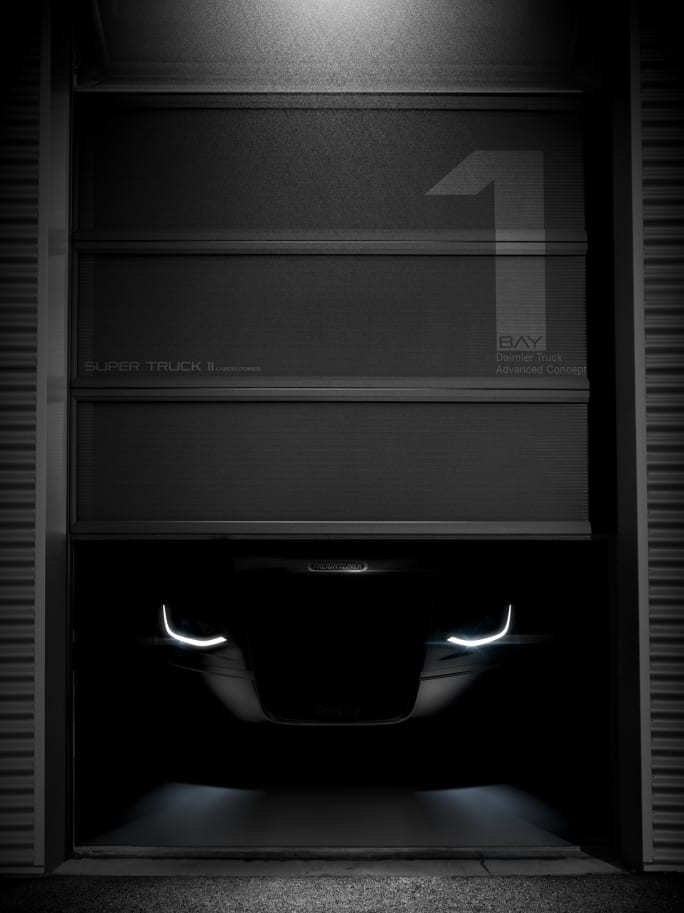
Complete results of Daimler’s SuperTruck II project will be unveiled later this year.
Photo: DTNA
“These objectives were to develop technologies that are commercially cost-effective in terms of a payback in the next couple of years,” said Darek Villeneuve, advanced vehicle systems manager at DTNA. “The most difficult part is picking the right technologies with the right balance of performance for systems that are critical for energy conservation while making them complement the vehicle.”
With a total project budget of $40 million ($20 million from DOE), DTNA and its project partners (including Schneider National, Strick Trailers, Michelin, Oak Ridge National Laboratory, National Renewable Energy Laboratory, University of Michigan, and Clemson University) worked in several chassis channels including powertrain technologies, truck and trailer aerodynamics, parasitic drag reduction, hybridization, energy management and storage. On the engine side, DTNA is working on improvements to combustion efficiency, better heat loss reduction, better air management, friction reduction and more.
A more informed picture (but by no means complete) of DTNA’s plans for SuperTruck II can be found in the Annual Merit Review presentations, and listing of all the SuperTruck II Merit Review presentations is also available. Key in the search word “SuperTruck” to find links to the presentations.
The Design Team
With all the engineering work going on under the hood, so to speak, it’s falls in the shoulders of the design team to package all that new technology into a sleek and forward-looking package — which is also totally functional from an aerodynamic perspective.
The Design Center Studio at DTNA is based in Portland, Oregon, and is a key area where ideas and concepts start to become reality. The team is comprised of highly experienced creative individuals responsible for the interior and exterior design of all commercial vehicle products within the DTNA portfolio. With designers, surface modelers, fabricators and studio engineers, the design team collaborates globally to create the most cutting-edge designs that continue to push DTNA’s products forward.
The design team also welcomed a bit of competition for the overall design. Multiple designers begin sketching initial concepts and a friendly competition ensues.
“Something really amazing happens in that process because as a designer comes up with really cool and interesting ideas, it inherently inspires the other designers,” Cotner said. “There is this organic evolution, and inspiration, and excitement that comes from the competition.”
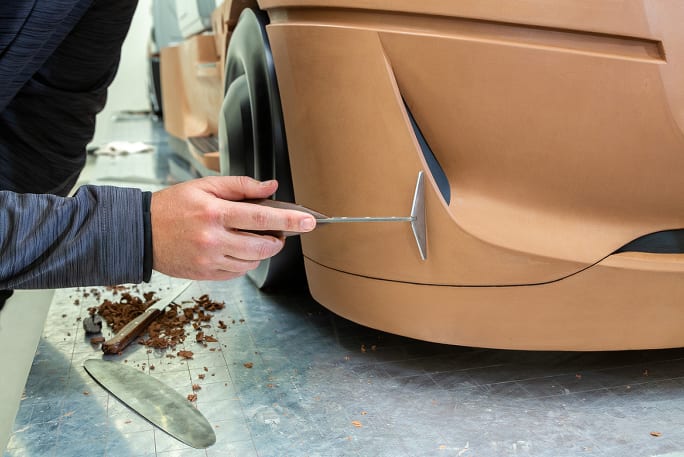
Designers and engineers collaborated closely on the SuperTruck II project to not only package all the new technology in a sleek aerodynamic design, but one that has all the hallmarks of the Freightliner brand.
Photo: DTNA
As engineering worked to perfect their technology, the design studio kept close tabs on their work. Ultimately, even with the coolest design, the design team understood their work would not matter unless it helped engineering reach their goals and ultimately improve customers’ efficiency targets. A constant flow of communication helped the designers focus on the most important parts of the truck for aerodynamics and energy efficiency. As Villeneuve noted, technology cannot be developed in a vacuum and requires strong partners, both internal and external.
“We understand that the design studio needs to be given freedom to explore,” Villeneuve said. “There was a lot of give and take throughout the whole process, along with challenging each other to figure out what’s really critical. I think the product will speak for itself that it’s a fantastic looking vehicle and the performance is the best we’ve ever produced.”
A number of innovative features from DTNA’s first SuperTruck are already in production and featured on the latest edition of the Freightliner Cascadia, including enhanced aerodynamics, improved engine thermal efficiency and powertrain integration technologies such as down speeding, and predictive powertrain controls.
“We want SuperTruck II to stand out and be seen. Something transport company owners and drivers will get excited about,” Cotner said.
More Equipment

How Volvo Updated Its D13 for EPA 2027 [Watch]
Volvo’s updated D13 promises lower emissions without sacrificing performance or fuel economy. Take a closer look at what changed inside the engine in this HDT Spotlight video.
Read More →
Michelin Tire Improves Efficiency and Durability for Regional Fleets
The Michelin X Multi Energy D2 is a regional haul drive tire engineered to help fleets improve fuel efficiency, durability and traction in demanding stop-and-go operations.
Read More →
ZF Expands Commercial Vehicle Push in North America
ZF is expanding its North American commercial-vehicle presence with new transmission applications, electrification, trailer technology and autonomous-driving systems.
Read More →
Tesla Wants a Self-Driving Semi. Are Cameras Enough?
Could Tesla’s camera-only autonomous driving technology work on an 80,000-pound Semi? In this commentary, HDT's Deborah Lockridge takes a look at Tesla, Cybercab, and how autonomous trucks see the road.
Read More →
Kodiak: Driverless Long-Haul Truck Launch on Track for 2026
Kodiak AI says its driverless long-haul safety case is 93% complete and it remains on track to begin commercial operations by year-end 2026.
Read More →
What DOT’s Automated Vehicle Strategy Means for Trucking
The U.S. Department of Transportation issued a new automated-vehicle strategy that outlines plans for driverless-truck regulations, cross-state freight corridors, and federal safety standards.
Read More →
East Coast Port Launches $45M Electric Truck Push
The Port Authority of New York and New Jersey announced millions in incentives for zero-emission drayage trucks, yard tractors, and new charging hubs near the port.
Read More →
PlusAI Going Public to Fund Autonomous Truck Launch
A SPAC deal could provide PlusAI with up to $300 million as it works toward a 2027 commercial launch of factory-built autonomous trucks.
Read More →
NHTSA Moves to Rewrite Truck Fuel-Economy Rules
The National Highway Traffic Safety Administration says it lacks authority to regulate medium- and heavy-duty truck engines separately from complete vehicles, but the existing standards have not yet been eliminated.
Read More →
Detroit Opens Orders for EPA 2027 Engines
Detroit isn’t starting from scratch to meet EPA 2027 diesel emissions standards. Its Gen 6 DD13 and DD15 engines keep much of today’s platform while updating the fuel and aftertreatment systems.
Read More →