





Related: The Quest for Uptime
Coolant Confusion Crisis
Many fleet managers today have no idea what coolants are in their trucks — or even what coolants are supposed to be in them. Here’s how suppliers are working to correct that problem.
April 21, 2017

Coolants are the least understood fluid in a heavy duty truck engine today. But a little attention to them can avert serious problems for your fleet. Photos: Prestone
7 min to read

Coolants are the least understood fluid in a heavy duty truck engine today. But a little attention to them can avert serious problems for your fleet.Photos: Prestone
If you’re a maintenance manager or owner-operator who is thoroughly confused as to what type of engine coolant should be in your heavy-duty diesel truck (much less what type of coolant is actually in the system) don’t feel bad. You’re far from alone. Heavy-duty engine coolant suppliers realize they have a problem on their hands today with multiple-colored coolants on the market — a situation further exacerbated by two different red-colored coolants with very different performance properties.
As is often the case, the confusion today arose from sincerely good intentions, says Dr. Frank Cook, chief technology officer at Old World Industries, which manufactures the Peak brand of engine coolants. Up until the 1990s, there wasn’t really an application-specific heavy duty diesel coolant on the market. Most fleets simply poured green-colored automotive-grade coolants into their trucks and then added supplemental coolant additives (SCAs) to insure increased wet sleeve liner protection.
This all changed, Cook says, when Old World decided to simplify things for its customers and began to offer its then-new FleetCharge heavy duty coolant with SCAs already formulated in the mixture. “At the time, SCAs were red in color,” Cook recalls. “And when you mixed them with fresh, green, automotive coolant, you ended up with a brown-colored fluid. So to differentiate our product, and help customers out, we decided to make FleetCharge coolants a fuchsia pink color. And that’s really where all these different colors we have today began.”
Two reds make it wrong
Before long, different-colored coolants began to appear. Including a yellow, extended-life coolant, and a new, red-colored coolant developed by Shell. “In the late ‘90s, we were working with Caterpillar, and they were concerned about liner life in their engines,” says Stede Granger, OEM technical manager for Shell Lubricants. “As a solution, they wanted to add nitrites to coolants, which boosted cylinder liner protection. And we decided to make that new Rotella coolant a red color in order to differentiate it in the market.”
Initially, Granger says, the new, nitrite coolants worked well, and most OEMs eventually started requiring their use as a warranty condition on new engines. “But engines back then weren’t built with much aluminum in them,” Granger says. “That’s not the case, now. Diesel engines have far more aluminum components to save weight and boost fuel economy. And now, after years of experience with these engines, we understand that in certain conditions, there can be a catastrophic chemical reaction between nitrites and aluminum in a diesel engine. This damage doesn’t happen all the time. But it is bad when it does.”
Colin Dilley, vice president, technology, Prestone, says that initially, nitrated organic acids helped prevent cavitation — a common physical reaction in a closed coolant system where miniature, imploding bubbles of air literally rip pieces of metal off of wet sleeve cylinder wall linings.
Problems begin, Dilley says, when nitrites under pressure react with the flux used in controlled atmospheric braising components in aluminum heat exchangers and radiators in the cooling system. “This process causes the formation of ammonia, and the coolant to become unstable and more basic, or less acidic,” Dilley says. “And, as a result, the protective additives in the coolant are depleted. So you end up with a fluid that is now causing corrosion inside the engine while offering severely reduced protection.”
The main culprit in this process is the liquid ammonia, Granger confirms. “You mix nitrites and aluminum and liquid ammonia forms,” he says. “This raises the Ph levels in the engine, which leaves aluminum surfaces open to corrosion — and can actually penetrate the surface of the metal in some cases. Worse, it affects other engine components as well — all the way down to engine seals.”
Once the problem was identified, Granger says Shell moved quickly to offer a solution. “We responded with a nitrite-free coolant blend before the 2010 engines launched,” he says. “And, initially, we dyed it yellow to differentiate it.”
But very quickly, Granger says, another problem emerged. “It was very hard to see that yellow coolant in a surge tank,” he says. “And we decided that red was a color that really worked well in that regard. So we decided to stay with it.”
And therein lies the problem: Some OEMs today recommend coolants with nitrite, while others recommend nitrite-free blends. And both solutions are dyed red. And, Granger cautions, mixing coolants degrades all of them, since they work in very different ways, chemically speaking, to protect an engine. “Once you mix coolants,” he says, “you quickly end up with a situation where you don’t have enough of the proper additives in any formulation to protect against corrosion.”
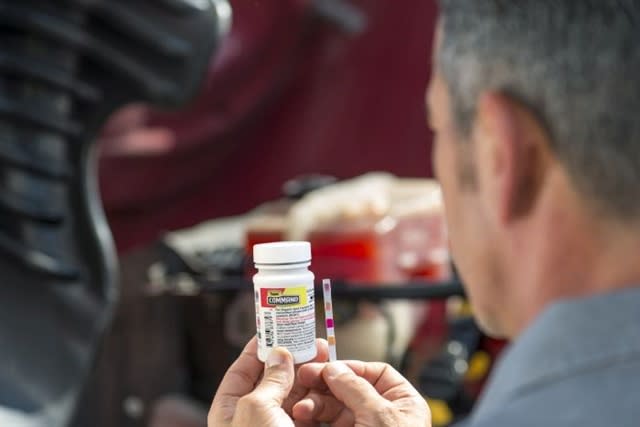
Suppliers offer test strips to identify which coolants or coolant mixes are in an engine’s cooling system. Using the strips may be the only way to know exactly what’s in there.
Simplified solutions on the horizon
“Most fleet managers today do not know exactly what is in their engine cooling systems,” Dilley says. “This starts with confusion over colors, and is amplified by topping off coolants when the truck is away from its home shop. You never know what is being poured in the radiator in those situations. As part of our research on this problem, Prestone has tested thousands of trucks, and there is almost always a mix of coolants in the radiator. So the problem is widespread.”
Dilley says coolant suppliers, including Prestone, responded to this problem with a host of new products, including new test strips to confirm and correct coolant blends, and new coolants that will simplfy that process. We are trying to remove as much confusion around these coolants as we can while not creating any additional issues,” he says. “Prestone simple, clearly marked test strips allow fleet managers to understand fully what type of coolant they have as well as any problems with the mixture. These products dovetail with Prestone customer outreach programs, including simplified coolant correction procedures and technical service bulletins to further educate fleets and help fix any coolant problems before they become catastrophic.”
“The good news is that it takes just a little bit of attention to correct the problem,” Cook says. “And no matter what a system has been topped off with in the field, you don’t always have to drain a system in order to correct the formulation of your coolant.”
To start with, Cook says, simply understand from the get-go your OEM’s recommendation for the correct coolant type and follow it. “The problem, of course, is for mixed fleets. In that case, or in the case where your coolant program has been lax, you’ll need to make the use of very simple test strips to check for nitrite in the coolant part of your routine maintenance procedures.”
In addition to its own line of simplified test strips, Granger says Shell will have a new, corrective, coolant additive on the market later this year that will remove a great deal of the guesswork surrounding red-colored coolant mixes today. “Our Rotella ELC Correction Fluid will include simple test strips that deliver a simple, ‘Go — No-Go’ reading on coolant additives and instructions for how much of the new fluid to add to correct accordingly,” he says.
Old World’s Final Charge coolant has a proprietary blend of organic acids that protect cooling systems without the need for nitrites, according to Cook. “The reality today is that some OEMs want nitrite in their coolants, while others do not. But Final Charge is a way to ensure protection across your entire fleet — even if it is a mixed-model truck fleet. And Final Charge can also be used to top off coolant with nitrites.”
Cook says that in many cases, a phobia he calls “chem-intimidation” is the problem, since many fleet managers suddenly feel like they’re back in high school chemistry class when coolant characteristics are being discussed. “Coolants are a lot like oil,” he says. “And it requires some level of attention in order to get them right. But even if you are completely confused as to what to do, you can always pull coolant samples and send them to your coolant provider. At Old World, we do forensic evaluations of coolant every day and provide our customers with clear instructions on how to proceed once a problem is identified.”
Subscribe to Our Newsletter
More Maintenance

Sponsored•September 16, 2026
Color Match Smarter: Tools That Restore & Perform
For fleet managers and collision repair professionals keeping heavy-duty trucks on the road, getting the color right the first time isn't just about appearance — it's about efficiency, turnaround time, and bottom-line results. Discover how today's digital color tools are transforming the repair process from guesswork to precision.
Read More →
Wrong Repair Prompts Recall of Freightliner, Western Star 4x2 Trucks
DTNA is recalling more than 2,400 trucks that received an incompatible software fix instead of the hardware repair required to address brake valve corrosion.
Read More →
Truck Drivers Need More Than Another Alert
Fleets have more visibility into truck health, safety events, and driver activity than ever. The next challenge is turning all that information into useful guidance for the person who has to decide what to do next.
Read More →
The Maintenance Checks Trucking Fleets Should Prioritize Before Fall Freight Picks Up
Making it through August isn’t the same as being ready for the next several months of operation. Find out what systems may have suffered from summer heat and need to be checked out before fall.
Read More →
What Three Fleets Are Doing Differently When Buying Truck Parts in 2026
With freight improving but costs still climbing, fleet maintenance executives explain how they're balancing price, quality, and supplier relationships.
Read More →
Paccar Recalls 2027 Trucks Built This Summer for Possible Electrical Problem
The nearly 6,000 Kenworth and Peterbilt trucks in the recall could potentially lose engine power, among other things.
Read More →
Will API PC-12 Oil Change Trucking Fleet Maintenance?
The new API PC-12 heavy-duty engine oil category reflects the changing demands of modern diesel engines. But fleets like Foodliner are looking to getting their own data before making decisions on adopting the new oils and questions such as extending oil drain intervals.
Read More →
Brake Safety Week to Focus on Drums and Rotors
Commercial vehicle inspectors are focusing on truck brakes during CVSA's Brake Safety Week, August 23-29.
Read More →
Possible Battery-Cable Fires Prompt Recall of 15,000+ International MV and HV Trucks
On the recalled vehicles, manufacturing variations can cause the battery interconnect cable to contact the auxiliary stud and hold down the bracket.
Read More →
Rush, MCT Team Up to Grow Refrigeration Service Network
The joint venture will operate MCT's network of Carrier Transicold dealerships and mobile service locations, with the companies promising greater service capacity and uptime for refrigerated fleets.
Read More →