




Commentary: Shedding Pounds
Lightweighting. You’ll hear this word a lot in the next few years. It refers to engineering efforts to slice weight from just about every single component on a truck or tractor in the name of fuel efficiency. And where better to start than with a truck’s backbone, its frame?
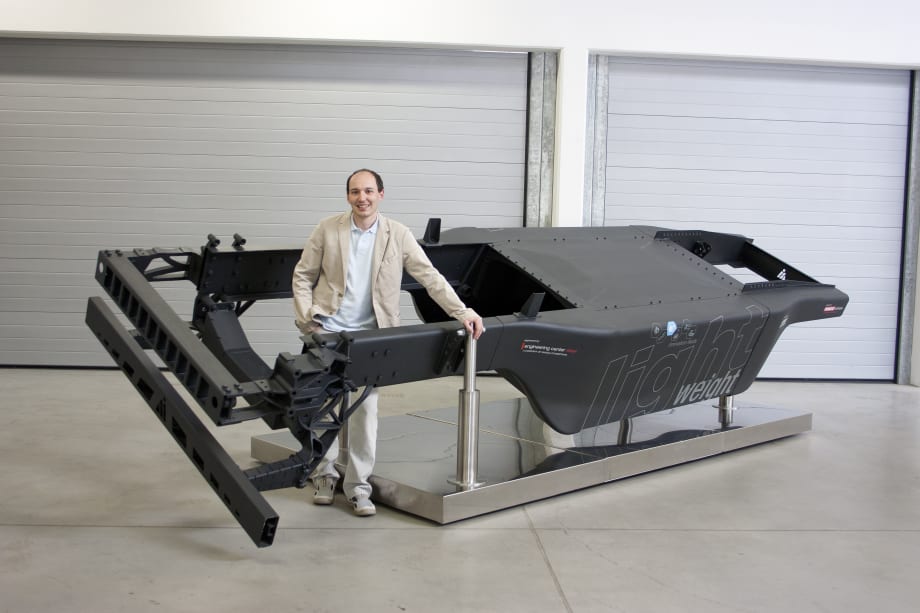
Gregor Schwarz of Austria’s Engineering Center Steyr stands proudly with the lightweight monocoque truck frame he designed.
Lightweighting. You’ll hear this word a lot in the next few years. It refers to engineering efforts to slice weight from just about every single component on a truck or tractor in the name of fuel efficiency. And where better to start than with a truck’s backbone, its frame?
Gregor Schwarz of Austria’s Engineering Center Steyr stands proudly with the lightweight monocoque truck frame he designed.
Who would have guessed that a monocoque truck chassis could be built? It’s been done by Canadian company Magna International and its European subsidiary, Magna Steyr.
(Monocoque is a type of construction where the outer skin carries all or a major part of the stresses, like an airplane fuselage.) Magna’s body and chassis unit, Cosma International, is also much involved in the Peterbilt Model 579 and Kenworth T680 introduced last year.
I first learned about the chassis through a friend of mine in India. Eliott Lobo had written an excellent piece about it in Autocar Professional. Magna displayed its lightweight steel frame for the first time at last fall’s IAA show in Germany.
Intended for use in European long-haul transport but with possible applications here, at 1,312 pounds, it weighs a very significant 30% less than conventional frames.
It was developed by Engineering Center Steyr (ECS), Magna Powertrain’s truck research and development operation, in co-operation with Cosma. And it’s ready for market.
“The significant reduction in weight has been achieved by replacing the standard-type chassis frame with a unique steel monocoque structure, while maintaining the same or better technical performance,” says Franz Dorfer, general manager of ECS.
As Eliott wrote, engineers long ago exhausted any weight-reduction potential in the good old C-profile steel frame with crossmembers, which goes back to the ladder-type chassis in Gottlieb Daimler’s Phoenix in 1896. The use of high-strength steels became their only real option.
Aluminum and carbon fiber have also been explored, but so far nobody’s come up with a way to beat their cost and durability limitations. If anything is to be done, it’s going to be on the design side, not materials.
Enter Gregor Schwarz of ECS, who came up with the monocoque idea and wrote his thesis on it while a student at the Graz University of Technology in Austria.
The frame he designed is for a 4x2 tractor with a 142-inch wheelbase. It actually combines modular and monocoque design concepts and is built almost entirely of S355 structural sheet steel. It forces no change to the typical European powertrain and suspension package of leaf springs up front and air springs at the rear.
There are four modules: a cast front-end module, a double-walled front-axle module, a single-wall monocoque middle module, and a rear-axle module with outer and inner shells. The monocoque, which accounts for the dramatic reduction in weight, has a wall thickness that’s only about 15% of the standard ladder frame. And the overall structure has a torsional stiffness claimed to be 10 times that of a ladder frame.
Magna Steyr is shopping its idea around Europe, but it could be applied to North American needs as well. Schwarz is convinced he can attack other chassis components – fifth wheels, for example – and ultimately shave as much as 1,543 pounds off the weight of a European tractor. Wow.
Thanks to Eliott Lobo for letting me borrow a bit from his article: http://autocarpro.in/contents/othersDetails.aspx?OtherID=59. See also www.magna.com and www.cosma.com.
Rolf Lockwood is vice president, editorial, at Newcom Business Media, which publishes Today’s Trucking. He writes for HDT each month on the making, maintaining and using of trucks.
More Equipment
Tesla Wants a Self-Driving Semi. Are Cameras Enough?
Could Tesla’s camera-only autonomous driving technology work on an 80,000-pound Semi? In this commentary, HDT's Deborah Lockridge takes a look at Tesla, Cybercab, and how autonomous trucks see the road.
Read More →
Kodiak: Driverless Long-Haul Truck Launch on Track for 2026
Kodiak AI says its driverless long-haul safety case is 93% complete and it remains on track to begin commercial operations by year-end 2026.
Read More →
What DOT’s Automated Vehicle Strategy Means for Trucking
The U.S. Department of Transportation issued a new automated-vehicle strategy that outlines plans for driverless-truck regulations, cross-state freight corridors, and federal safety standards.
Read More →
East Coast Port Launches $45M Electric Truck Push
The Port Authority of New York and New Jersey announced millions in incentives for zero-emission drayage trucks, yard tractors, and new charging hubs near the port.
Read More →
PlusAI Going Public to Fund Autonomous Truck Launch
A SPAC deal could provide PlusAI with up to $300 million as it works toward a 2027 commercial launch of factory-built autonomous trucks.
Read More →
NHTSA Moves to Rewrite Truck Fuel-Economy Rules
The National Highway Traffic Safety Administration says it lacks authority to regulate medium- and heavy-duty truck engines separately from complete vehicles, but the existing standards have not yet been eliminated.
Read More →
Detroit Opens Orders for EPA 2027 Engines
Detroit isn’t starting from scratch to meet EPA 2027 diesel emissions standards. Its Gen 6 DD13 and DD15 engines keep much of today’s platform while updating the fuel and aftertreatment systems.
Read More →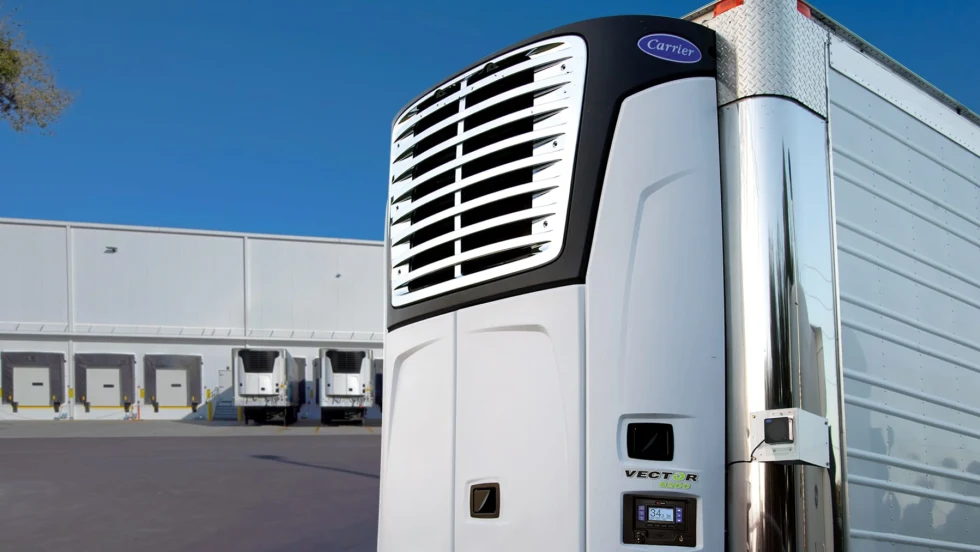
Carrier Transicold Adds All-Electric TRU for Stationary Cold Storage
Carrier Transicold’s new Vector 8200 all-electric transport refrigeration unit gives fleets a diesel-free option for temporary refrigerated and frozen trailer storage.
Read More →
A Closer Look at Kenworth’s Electric T880E Vocational Truck [Video]
Learn more about Kenworth's T880E battery-electric vocational truck at the Paccar Technical Center, including its range, applications, upfitting considerations, and PTO options, in this HDT Spotlight video.
Read More →
Kenworth T880E Brings EV Power to Vocational Trucks
A closer look at the Kenworth T880E’s range, charging, powertrain and upfit options — and where fleets are showing the most interest.
Read More →