




Commentary: Does Truck Platooning Have a Future?
Daimler announced that it would no longer invest in platooning but other manufacturers are still betting on the technology's benefits, so who's right?
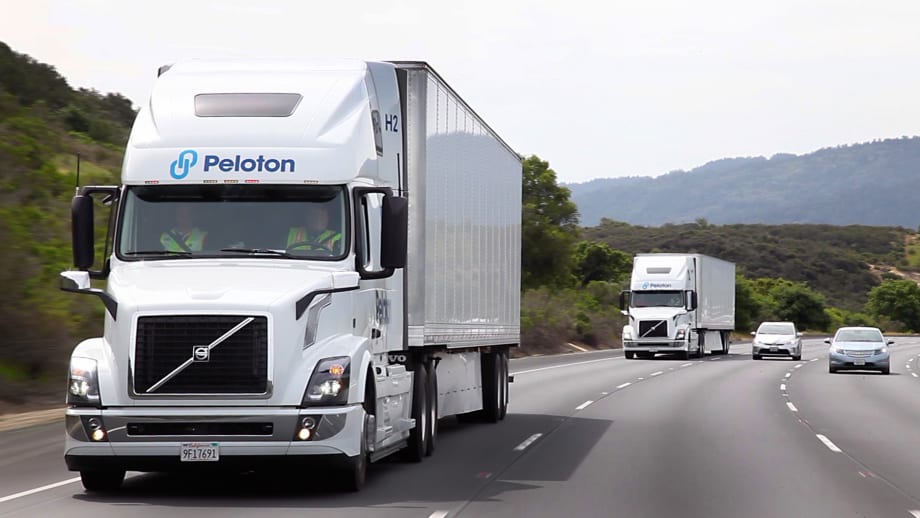
Daimler has pulled out of platooning development but companies like Peloton still believe the technology's potential benefits.
Photo via Peloton
Has Martin Daum showered serious rain on the platooning parade? Is he right to stop investing in the technology? Will he dissuade others from doing so?
He’s not without influence, after all. As head of Daimler’s Commercial Vehicles unit, and formerly the chief at Daimler Trucks North America, Daum is a weighty fellow whose opinions are always well considered and straightforwardly expressed. He doesn’t beat around many bushes, so when he said last fall that platooning might not be worth the trouble, a zillion ears perked up.
Speaking at the IAA commercial vehicles show in Germany last September, he said, “When it comes to automated vehicle technology, there is a very compelling business case for these systems. However, platooning might not be the holy grail we initially thought.”
As reported by my colleague Jack Roberts, Daum allowed that past platooning tests yielded good results in boosting fuel economy on older rigs. However, more recent testing has shown that fuel-saving results were “not as high as expected” for newer tractor-trailer combinations with already-efficient aerodynamics.
“Therefore,” Daum added, “I am a little bit critical of platooning today, but at Daimler we will continue testing this technology and see where it eventually leads us.”
At the recent CES show in Las Vegas, “a little bit critical” became dismissal. “We will not prioritize [platooning] for series production,” he said. “We tested it for several years... Results show that we have to re-assess how much fuel is actually saved. Platoons do improve aerodynamics and fuel efficiency considerably in an ideal world, but not in real-world traffic.”
Swedish truck-maker Scania (part of Volkswagen’s Traton Group) would beg to differ. It seems to be more committed to platooning than ever, as do other European truck makers. Which is a little odd if you think about the congested nature of roads over there and the fact that no national jurisdiction has made it legal. In the U.S., 18 states allow platooning, and even Daum has said the wide interstates are an ideal environment for trucks running nose to tail.
Scania contends that current adaptive cruise control brings a 3-4% reduction in fuel consumption with trucks travelling around 1.5 seconds apart at 60 mph, a 130-foot gap.
“There will be further savings when we have a smaller gap and much richer information being transmitted between the trucks,” said Christian Bergstrand, a project manager at Scania, quoted on the SMMT website (SMMT represents the U.K. automotive industry, trucks included). “When we introduce autonomous technologies as well and no longer have to take the driver into consideration, we can have a really short gap. In the case where we will have one driver for a platoon of four trucks, we could cut fuel consumption by 10% or more for the time the trucks are in the platoon.”
In the meantime, the challenges have more to do with operational and legal matters than technical ones. Given those operational issues, Bergstrand said the early adopters will almost certainly be large fleets creating in-house platoons.
“They can plan for coordinated departures and match-make within the fleet. We want to then grow the volume so that [in time], smaller customers can benefit from more ad hoc platooning.
“The requirements have not been defined that would determine a possible introduction in, say, three to five years. Even so, I strongly believe that before 2025 we will have many semi-autonomous platooning trucks on European roads,” Bergstrand concluded.
Martin Daum seems not to agree.
Anyone taking bets?
More Fuel Smarts

Why Diesel Price Relief Efforts May Fall Short
Diesel prices have eased from September’s record high, but doubts about additional Russian supply and limits on dyed-diesel tax relief mean trucking fleets still face expensive fuel. And prices could go higher.
Read More →
Why Small Fuel Savings Matter in Trucking
Can better fuel economy help pay for driver raises? In this podcast, GP Transco explains how small efficiency gains create room to reinvest in its people.
Read More →
How GP Transco Cuts Trucking Fuel Costs, a Tenth of a Gallon at a Time
What’s another tenth of a mile per gallon worth? GP Transco shares how equipment upgrades and driver coaching turn small gains into meaningful fuel savings.
Read More →
Electric Yard Tractors Move Beyond Pilots
Operating-cost savings have overtaken sustainability goals as the leading reason surveyed fleets are adopting battery-electric terminal tractors, according to new NACFE research.
Read More →
Geotab Links Fleet Card to Vehicle Data
The new card combines fuel discounts with telematics-based purchase controls. Geotab’s analysis also points to potential savings from choosing lower-priced fuel stops.
Read More →
Fleet Economics Shape Electric Truck Outlook
ACT Research expects costs, charging infrastructure, and technology improvements to drive zero-emission commercial vehicle adoption as federal regulations and incentives retreat.
Read More →
Wex Adds Cardless Fuel Payments for Over-the-Road Customers
A new fuel card feature for Wex customers offers convenience and security.
Read More →
New California Law Could Shed Light on Electric Truck Prices
Why do battery-electric Class 8 trucks remain so expensive? A California bill signed by Gov. Gavin Newsom would give fleets and state agencies more visibility into what manufacturers charge.
Read More →
How Volvo Updated Its D13 for EPA 2027 [Watch]
Volvo’s updated D13 promises lower emissions without sacrificing performance or fuel economy. Take a closer look at what changed inside the engine in this HDT Spotlight video.
Read More →
Diesel Price Spike Shortens Payback for Natural Gas Trucks, Report Says
Energy Vision estimates fleets could recover the higher purchase price of an RNG-fueled Class 8 tractor in 1.3 to 2.8 years under current fuel-price scenarios.
Read More →