Second in a Series: Shop Lifts
Part 1: Shop Lifts can Increase Productivity, Employee Satisfaction
 MENU
MENU SEARCH
Vehicle lifts come in a dizzying variety of configurations, usually targeted to certain intended applications. Deciding what you want to do with a lift is the first step in choosing the right machine for your shop.
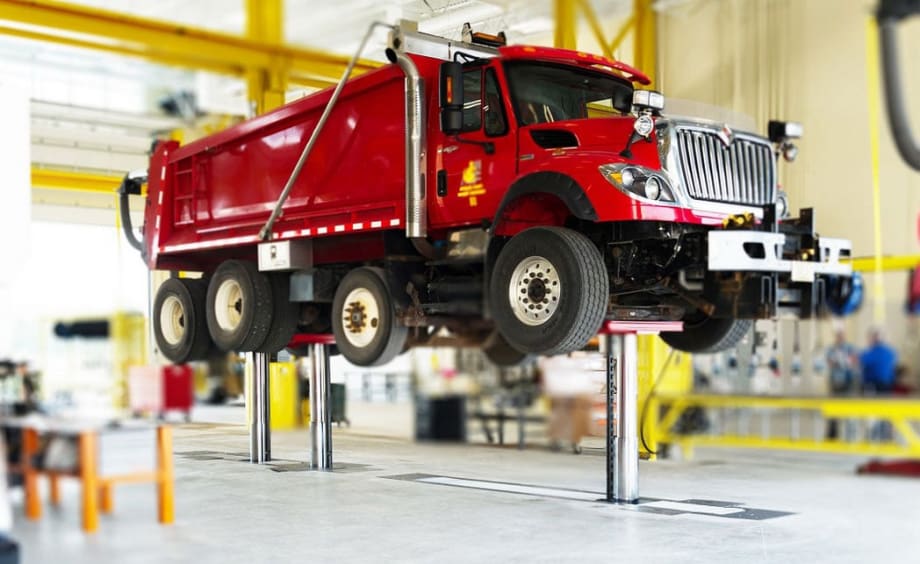
Inground hydraulic piston lift require breaking the concrete floor to install the hydraulics and the lifting mechanisms. Such installations my not be suitable for fleets renting or leasing their facilities.
Photo: Stertil-Koni
In Part I of this three-part series on shop lifts, Equipment Editor Jim Park looked at how these time-saving systems can save improve both shop productivity and employee satisfaction on the job. In Part II, he looks at the process of selecting the right lift for your operation.
Vehicle lifts come in a dizzying number of configurations, usually targeted to certain intended application. Aside from what you plan to do with your lift, there are a few things to consider before you start narrowing your choices.
Some lifts, such as inground piston or scissor lifts will require infrastructure modification, such as digging pits to make room for the operating hydraulics. Others, such as platform lifts, will need a direct line of access for vehicles and room for the runway ramps -- if required -- and obviously adequate clearance above and around the lift and access to vehicle lifting points.
But all that would come naturally after an assessment of you needs, both present and future.
"Don’t just choose a lift for the current state of your business," warns Doug Spiller, Rotary Lift's director of heavy-duty product management. "Look at where you want your business to be down the road. The type of services your facility performs and will perform in the future are the most important considerations in choosing the right lifts."
For some facilities, a single model of lift is appropriate for all of the work they perform. Many fleets, however, can benefit from having a variety of lift styles, so that the service manager can assign particular jobs to the most appropriate bays.
Representatives from the various lift makers can walk you through the steps for choosing the lift that best suits your needs, your space and your budget, but there's something else to consider first: are you buying a certified product?
"One of the most important considerations from a safety perspective is whether or not the lift has been third-party tested and certified to meet all the requirements of North America’s applicable electrical and mechanical safety standards," says Bob O’Gorman, president of the Automotive Lift Institute. "Those lifts that have been tested and certified by ALI to meet all the requirements of ANSI/ALI ALCTV carry the Gold ALI Certification Label. They are also listed in an online directory. If a lift is not listed, it’s not certified."
The primary standard that applies to all vehicle lifts can be found in the current edition of "Standard for Automotive Lifts -- Safety Requirements for Construction, Testing and Validation," published by the American National Standards Institute (ANSI) and the Automotive Lift Institute, Inc. (ALI) .
ALI recommends working with representatives of reputable lift manufacturers to evaluate your specific needs and recommend the best solutions. In the meantime, here are a few things to think about in choosing a lift for your maintenance and repair operations.
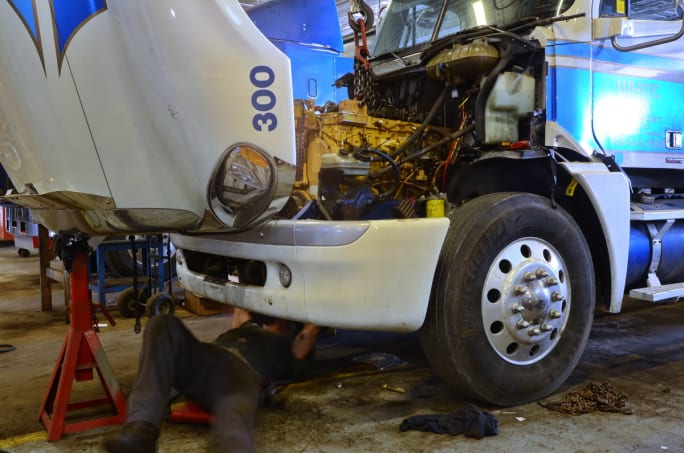
Getting technicians off their back and onto their feet is bound to improve morale in the shop.
Photo: Jim Park
Labor relations: Most technicians prefer to stand up rather than lie on a creeper under a truck because they find there's less physical strain and it's much more efficient and productive. "With technicians in short supply these days, a quality work environment can be as enticing as raise in pay," notes Spiller.
The technician shortage is expected to worsen as the demand for trained techs increases. Fleets will need every advantage possible to recruit and retain employees, including better working conditions than your competitors offer. Getting the techs up off their hands and knees might be just the ticket better tech retention and a generally happier workforce.
Services Performed: The style of lifts you choose can have a significant impact on the speed and quality of the work you perform. Some lifts are better suited to specific types of work, like fast-turnaround under-vehicle inspections versus repairs where major components will be removed from the truck.
For example, fleets expecting to do a lot of wheel-end work may need a lift that engages somewhere on the chassis other than the wheels, such as mobile column lift which usually pickup vehicles using wheel cradles.
"A mobile column lift is the most user-friendly type of lift, but when you work on a vehicle, 70-80% of the repairs are on the wheels, tires, steering and brakes," says Peter Bowers, technical sales support manager at Stertil-Koni. "If you do a lot of wheel-end work you might want something that leaves the wheels free when it's in the air. While mobile column lifts can be used to support the axles or chassis with adapters, a hydraulic piston lift might be a better option. but they require infrastructure work."
Vehicle Types, Size & Weight: Consider lifting capacity and vehicle configuration, such as three-axle tractors, multi-axle vocational equipment or tractor trailer combinations. Lifts are available to accommodate most configurations and lifting capacities are available to suit almost any vehicle.
Facilities: Some types of lifts require dedicated infrastructure, or their own corner of the shop. Mobile column lifts, on one hand, can be stored in a corner when not is use, leaving the floor space open for other projects. Four-post lifts, platform lifts and piston lifts, on the other hand, require permanent installation, which means that certain areas of the shop are effectively limited to work done on the lift. On top of that, there's the question of digging up someone else's building.

All heavy-duty vehicle lifts must carry the Gold Automotive Lift Institute certification label to show it has been third-party tested and certified to meet all the requirements of North America’s applicable electrical and mechanical safety standards.
Photo: Rotary Lift
"Fleets that rent or lease their facilities may be limited in what they can do on the premises" notes Bowers. "First of all, there may be contractual limits on the extent of the alterations a tenant can make to the building. And then there's the question of making an investment in the infrastructure of a building you do not own. If you decide to move, that's money you'll never recover."
The yard layout and access to the service bays should be considered, too, allowing for adequate turning room, in and out of the bays, the length of the bays and direct access to the bay door from the yard.
Maintenance & Service: Compare the maintenance schedules on lifts you’re considering as well as local availability of technicians to perform the service or repair the device. In all likelihood, the company that installed the lift will offer a maintenance and service contract. Make sure they have local or regional offices that can provide parts and service on relatively short notice. "Anytime a lift is down for maintenance, productivity will suffer," notes Spiller.
Safety: First and foremost, look for the gold label that reads: "ALI Certified." Only lifts that have passed independent safety testing can carry this label. Also, compare safety features on the lifts you're considering. Do you really want your techs working under the cheapest lift you can find?
In the third and final installment, we'll discuss the type of lifts on the market and how they functionality can fit in, or not, with your work plans.

For fleet managers and collision repair professionals keeping heavy-duty trucks on the road, getting the color right the first time isn't just about appearance — it's about efficiency, turnaround time, and bottom-line results. Discover how today's digital color tools are transforming the repair process from guesswork to precision.
Read More →
DTNA is recalling more than 2,400 trucks that received an incompatible software fix instead of the hardware repair required to address brake valve corrosion.
Read More →
Fleets have more visibility into truck health, safety events, and driver activity than ever. The next challenge is turning all that information into useful guidance for the person who has to decide what to do next.
Read More →
Making it through August isn’t the same as being ready for the next several months of operation. Find out what systems may have suffered from summer heat and need to be checked out before fall.
Read More →
With freight improving but costs still climbing, fleet maintenance executives explain how they're balancing price, quality, and supplier relationships.
Read More →
The nearly 6,000 Kenworth and Peterbilt trucks in the recall could potentially lose engine power, among other things.
Read More →
The new API PC-12 heavy-duty engine oil category reflects the changing demands of modern diesel engines. But fleets like Foodliner are looking to getting their own data before making decisions on adopting the new oils and questions such as extending oil drain intervals.
Read More →
Commercial vehicle inspectors are focusing on truck brakes during CVSA's Brake Safety Week, August 23-29.
Read More →On the recalled vehicles, manufacturing variations can cause the battery interconnect cable to contact the auxiliary stud and hold down the bracket.
Read More →
The joint venture will operate MCT's network of Carrier Transicold dealerships and mobile service locations, with the companies promising greater service capacity and uptime for refrigerated fleets.
Read More →