




Charged Up: Battery Advances
Lead acid batteries - the most common type of battery found in trucking and automotive applications - were developed in the mid-1800s. After more than 160 years, the technology still delivers, because lead acid batteries are relatively inexpensive when compared with other types of batteries

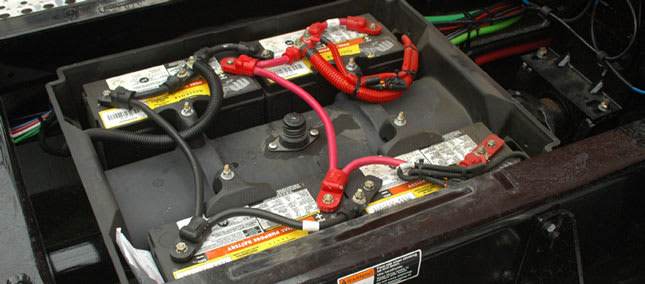
Lead acid batteries - the most common type of battery found in trucking and automotive applications - were developed in the mid-1800s. After more than 160 years, the technology still delivers, because lead acid batteries are relatively inexpensive when compared with other types of batteries.
"I think lead-acid, whether flooded, AGM or gel, is still very much on the front with regard to the next several years because of the capability to build batteries [that are] fairly inexpensive that can do the work," says Gale Kimbrough, engineering and technical services manager with Interstate Battery.
Most trucks on the road use flooded lead acid batteries, but gel and AGM-type batteries are becoming more common in the industry, and are offered as standard equipment on many new truck models. All three types use the same basic chemistry on the inside - lead plates with an electrolyte. In the gel and AGM (absorbent glass mat) type of batteries, the liquid electrolyte is contained, either in a gel or in the glass mats, reducing the need to add water during routine maintenance.
"The industry is moving toward AGM," says Brad Bisaillon, North American sales manager for Trojan Battery Co.'s automotive division. "Flooded lead acid batteries were the ones used for years," he notes, but recent truck and engine introductions have starting and power requirements that a flooded battery can't meet. "This technology shift will continue from flooded to AGM," he predicts.
More than starting a truck
Increased demand has been put on batteries by changes in truck design over the last 8 to 10 years.
"The trucking industry has been in a state of electrical change over the last few years, where the fleets and drivers gradually placed more and more electrical conveniences and/or hotel loads, RV loads you might want to say, on the truck," Interstate's Kimbrough notes. Those accessories have been added to the truck while the engines are required to be shut down, forcing battery manufacturers to make a more robust battery, he explains.
Trojan's Bisaillon notes that if you go back to 2001, before the last several rounds of emissions regulations, all a battery really had to do was turn over a 12-, 13- or 14-liter diesel engine. "A flooded battery with 750 cold cranking amps could easily do that," he says. Then electronics started appearing on trucks in order to control the emissions systems. GPS became prevalent in the market, adding more electronics. With the 2010 engines and SCR or EGR technology, there are even more electronics.
"As the trucks have advanced, more and more computers and electronic control modules are showing up on the truck," Bisaillon says. "And because there are more electrical loads on the vehicle, the battery that was sufficient seven or eight years ago can no longer sustain itself and provide the required power to power the onboard electronics that are required for a vehicle today. The average electrical load just to operate a truck today is 80 to 85 amps. It requires something that can handle a little more deep discharge but can also retain the cranking ability while providing power to the onboard equipment."
Kimbrough points out that it's not just the long-haul over-the-road sleeper cab fleet that is putting more demands on batteries. "Even inner city delivery trucks with liftgates and lighting to power often require a high cycle or dual-purpose type battery for adequate performance and life," he says.
These increased loads have led to the development of dual-purpose batteries that can deliver the cranking power to start the truck as well as the deep-cycle ability to run not only the hotel loads, but equipment such as liftgates or APUs.
"More APU batteries are being used today," notes Kimbrough. "Whether it's a straight APU with a four-battery system or an APU where the battery is only used to start a generator."
If truckers are using a four- or six- battery system to power an APU, Kimbrough explains, these batteries typically need to be a sealed lead acid with deep cycle capability. For an APU, the batteries need to be designed to sustain 400-500 deep cycles at 60 percent-80 percent depth of discharge (20 percent to 40 percent state of charge levels). He cautions that AGM and gel batteries have different charging requirements than the flooded lead acid, so be cautious about charging them through the same system.
Bisaillon agrees that increased APU use will mean trucks will carry more batteries, especially given the trend he sees of the industry moving from diesel-powered APUs to all-electric versions.
"When you look at the idle reduction market, you have OE and you have aftermarket. I think on the aftermarket side the trend will shift from diesel power to battery power. But I also see there will be a trend from an aftermarket APU to OE APU that's installed at the factory while the truck is coming down the line."
In these kinds of uses, some battery manufacturers are offering application-specific batteries: starting batteries with lots of cranking power and deep-cycle batteries to power equipment such as liftgates or APUs.
Battery manufacturers have developed longer-lasting, more powerful lead acid batteries, but that may not be translating into increased life at the fleet level.
"Because there are more and more loads placed on batteries, it's kind of hard to keep up," Kimbrough says. "Had we had the same battery we have today several years ago, for a truck that didn't have the kinds of loads on it that today's truck has, I think it would double the life. A lot of great things are happening within the battery, but it's been countered by the demands placed on them."
Maintenance requirements
One area where fleet managers have seen marked improvement is in maintaining batteries. The job is nowhere near as difficult as in the past. New designs have reduced maintenance requirements even further.
"When flooded batteries became maintenance-free in that you didn't add water, where maintenance wasn't minimized was maintenance at the terminals," Trojan's Bisaillon says. Because of the liquid in the battery, there is still corrosion at the terminals, especially if exposed to road salts. "The terminals on AGM batteries don't corrode. You don't get the green build-up that you do with a flooded battery. That in itself is a big deal for a maintenance manager."
Kimbrough says "the battery has gone through a complete turnaround as far as maintenance. They are now considered maintenance-free. You may look at the batteries for their CCA or power, but you don't have to put water in." And corrosion has become less of a problem because of the use of certain chemicals and lead alloys within the battery, he says.
Maintenance requirements now mean ensuring there is still plenty of cranking power, the connections are good and the hold-downs are secure.
"If the fleet is using an AGM product, always check for securement of the terminal, check the hold-down of the battery and twice a year, check the voltage," says Bisaillon. "A twice-a-year voltage or CCA check should be sufficient with AGM technology. If they are using flooded, that is something they might want to do more often."
Looking ahead
While battery technologies continue to evolve, don't expect huge changes in the technology in the short term.
"Everyone is looking for lighter batteries that will produce more energy. It all comes down to energy per cubic centimeter of space - internal energy vs. physical weight," says Kimbrough. "I think that will change drastically over the next 15 years. It won't be an instant change. I see the trucking industry moving in that direction because in the trucking industry weight is so important."
Jeff Kessen, director of automotive marketing for A 123 Systems, notes that lithium-based batteries can deliver the weight savings and more power today. The company manufactures power pac
More Maintenance

Color Match Smarter: Tools That Restore & Perform
For fleet managers and collision repair professionals keeping heavy-duty trucks on the road, getting the color right the first time isn't just about appearance — it's about efficiency, turnaround time, and bottom-line results. Discover how today's digital color tools are transforming the repair process from guesswork to precision.
Read More →
Wrong Repair Prompts Recall of Freightliner, Western Star 4x2 Trucks
DTNA is recalling more than 2,400 trucks that received an incompatible software fix instead of the hardware repair required to address brake valve corrosion.
Read More →
Truck Drivers Need More Than Another Alert
Fleets have more visibility into truck health, safety events, and driver activity than ever. The next challenge is turning all that information into useful guidance for the person who has to decide what to do next.
Read More →
The Maintenance Checks Trucking Fleets Should Prioritize Before Fall Freight Picks Up
Making it through August isn’t the same as being ready for the next several months of operation. Find out what systems may have suffered from summer heat and need to be checked out before fall.
Read More →
What Three Fleets Are Doing Differently When Buying Truck Parts in 2026
With freight improving but costs still climbing, fleet maintenance executives explain how they're balancing price, quality, and supplier relationships.
Read More →
Paccar Recalls 2027 Trucks Built This Summer for Possible Electrical Problem
The nearly 6,000 Kenworth and Peterbilt trucks in the recall could potentially lose engine power, among other things.
Read More →
Will API PC-12 Oil Change Trucking Fleet Maintenance?
The new API PC-12 heavy-duty engine oil category reflects the changing demands of modern diesel engines. But fleets like Foodliner are looking to getting their own data before making decisions on adopting the new oils and questions such as extending oil drain intervals.
Read More →
Brake Safety Week to Focus on Drums and Rotors
Commercial vehicle inspectors are focusing on truck brakes during CVSA's Brake Safety Week, August 23-29.
Read More →Possible Battery-Cable Fires Prompt Recall of 15,000+ International MV and HV Trucks
On the recalled vehicles, manufacturing variations can cause the battery interconnect cable to contact the auxiliary stud and hold down the bracket.
Read More →
Rush, MCT Team Up to Grow Refrigeration Service Network
The joint venture will operate MCT's network of Carrier Transicold dealerships and mobile service locations, with the companies promising greater service capacity and uptime for refrigerated fleets.
Read More →