




Building a Culture of Fuel Economy
Driving truck fleet fuel efficiency gains needs to go deeper than hanging another aero device on your trailer.


Ploger Transportation may be a small fleet, but it has pushed to be a leader in trying new fuel economy specs.
Photo courtesy Ploger Transportation
Boosting fleet mpg numbers entails more than just spec’ing a few new components and bolting some aerodynamic panels on your trucks and trailers. To be truly successful in shifting from an operation where fuel efficiency is “good” to one where it is expected takes a fundamental change in your fleet’s culture — from the people in the corner office to the men and women sitting behind the steering wheels.
“Changing your culture cannot be understated,” says Brent Nussbaum, CEO of Nussbaum Transportation, an Illinois-based truckload fleet. “And once you make the decision to boost your fleet’s fuel economy, you have to commit to it 100% throughout your organization, or it’s not going to work.”
For Nussbaum, it all started during a panel discussion on fuel economy in 2009. “We were getting 5.9 mpg across our fleet,” he recalls. “And one of the carriers on the panel was getting 8 mpg — which was huge at the time.”
Nussbaum cut his teeth maintaining and driving trucks in the fleet his father founded. The more he thought about the numbers presented during the discussion, the more he wondered what the guys on the panel knew that he didn’t.
“That was the beginning of a journey,” Nussbaum says. Almost immediately, he learned the first of many lessons about how hard the quest he’d started was going to be. “Among the first things we discovered were 6x2 drive axles,” he says. “And so we jumped on the phone with our dealer to find out everything we could about them.”
But it turned out Nussbaum’s dealer wasn’t a fan of 6x2 axle systems. “From the get-go he was trying to talk us out of the idea,” he says. “He told us nobody would want to buy the trucks when we wanted to get rid of them and just wasn’t very helpful.”
Freightliner had just unveiled the fuel-saving Freightliner Innovation Truck. And so, on a whim, Nussbaum gave the company a call. “Right away we were on the phone with engineers in Portland walking us through the pros and cons of 6x2 drive axles,” he says. “And they convinced us we could make this spec work. We purchased five new Freightliners to begin evaluating them. And that is a relationship that continues to this day.”
Ditch ‘Because we’ve always done it that way’
Another important aspect of driving a shift toward a culture of fuel economy is being willing to look at everything and discard long-entrenched practices that aren’t paying you any dividends, says fleet consultant Bruce Stockton, principle with Stockton Solutions and a longtime fleet equipment and maintenance exec.
“One of the simplest things you can do to improve your fuel economy is cut weight off your trucks,” Stockton says. “And that is always a difficult thing to do.” But a careful look at your specs could reveal things that can be cut out. For instance, he says, when he evaluates the truck specs of a new client, it almost always includes a block heater. “And no one ever uses a block heater. But they’re on every truck.”
The same principle applies to fuel tanks, Stockton adds. “Most fleets I work with spec anywhere from 240- to 300-gallon fuel tanks on their trucks. And yet when I look at the figures for their average fuel fills across the fleet, they’re usually around 65 gallons or so. The last one I did just a couple of days ago averaged 86 gallons per fill. So you have to ask yourself why you’re carrying the weight of a block heater and all that extra fuel around when you don’t need it and never use it. Make some reasonable cuts in those areas, and you’ll not only lighten up your truck, but you’ll free up real estate on the frame and capital that you can use to invest in other fuel-enhancement systems.”
“You have to be willing to play with things,” says Joel Morrow, director of research and development with the small yet innovative Ohio-based fleet Ploger Transport, who has been buying trucks with smaller-displacement engines, 6x2s, and some other unusual specs.
“It’s not easy. It’s time-consuming,” Morrow says. “And not everything you try is going to work out. And in the beginning, you’re going to have to do a lot of this by yourself with very little outside help. Sales reps at dealers generally want to sell you a truck they know they can resell once you’re done with it and turn it in. The OEMs are a lot more enthusiastic about fuel economy. But unless you’re a large fleet, or you just manage to build a relationship with them like I did, it’s hard to catch their attention for very long.”
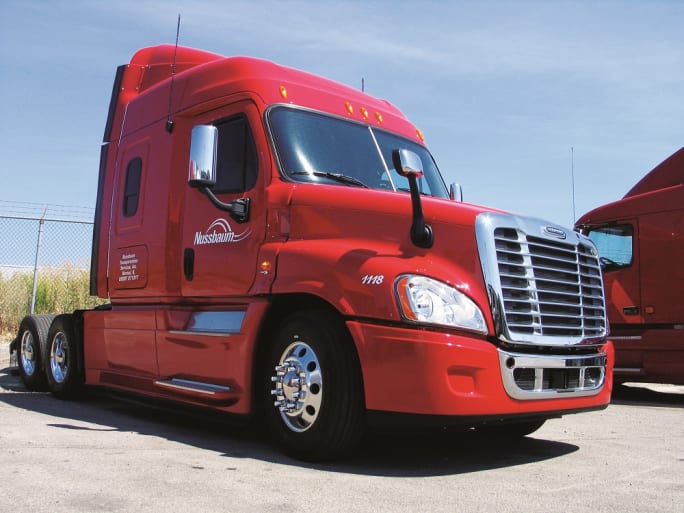
In 2012, Nussbaum Transportation was already leading the way in adoption of 6x2 drivelines.
Photo: Deborah Lockridge
Focusing on the bottom line
“It is very difficult in real-world use to determine the impact of a single add-on system, equipment or devices,” says James Lamarca, founder and executive vice president of System Freight Inc., a New Jersey-based fleet specializing in dedicated freight transport. He says SFI has come a long way on the fuel economy front, given the extreme mix of geographic conditions its trucks run in, logging a fleet-wide average of 7.1 mpg last year.
SFI began its fuel economy specification by ordering equipment from the standpoint of maximum fuel economy and what is practical to use in its operation. From there, communication became vital as fleet managers discussed the specification changes with employees so they understood why the changes were being made as well as the anticipated impact those changes would have on the company’s financials.
“It is difficult to argue against when you put it in terms like that,” he notes. “And then, as results began to trickle in, we shared those results with our employees to really drive the message home.”
As SFI’s fuel economy initiative progressed, experience showed Lamarca and his managers that using a “systems” approach to spec’ing, testing, and validating new technology or methods was key, particularly when combined with careful attention to selecting and spec’ing vehicles based on what the OEMs are doing.
“The new Macks coming out of production now are a perfect example of this,” Lamarca says. “They have a new, ‘wave’ piston design along with turbo compounding and which are dialed in with the mDrive [automated manual transmission]. These new trucks are up to 9% more fuel efficient than their predecessors. So we’ve ordered some and we’re continually evaluating their performance now. And this is the approach we now take with all OEMs and utilizing their integrated drivetrain systems.”
Lamarca says as you progress, you’ll typically never come to a hard, bottom-line number in terms of fuel savings — which can be discouraging for many fuel efficiency novices. “Initially you see results and have a gut feel for the improvement,” he notes. “But then you have to monitor it over a long period of time to confirm that intuition.”
Ambient temperature and seasonal temperatures are among the many factors that can cause variations in fuel economy results and make it difficult to determine consistent trends. “In order to determine if whatever system you are testing boosted your fuel economy, you really need to test for four quarters before you’ll have enough data to make a judgement call,” Lamarca says. “It is a slow process.”
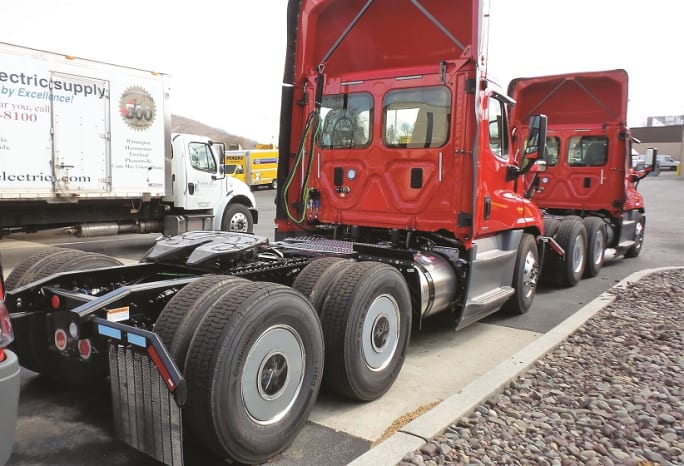
For System Freight Inc., as its fuel economy initiative progressed, experience showed that using a “systems” approach was key.
Photo courtesy Kenworth
Get advice from industry leaders
One factor in your favor is that many of the industry’s leading fuel economy fleets are willing to share their secrets with others just getting started.
“I guess I’m kind of strange,” says Morrow, who also drives and posts fuel economy results on social media. “I just happen to love doing this stuff. It fascinates me. And there’s always something new to work on. So I’m willing to talk about fuel economy a lot more often than my friends and family like!”
Brent Nussbaum is so committed to helping boost fleet fuel efficiency nationwide that he publishes his fleet’s entire spec for anyone to see. “Everybody thinks that there’s some great competitive advantage that you’re giving away by helping others with fuel efficiency,” he says. “And I don’t see it that way at all.”
Nussbaum says 92% of fleets running in North America today are made up of fewer than 20 trucks and don’t have the resources he does to purchase, install, and evaluate new fuel-efficiency components and technology.
“But I want to give something back,” he says. “When I retire one day, I want to be able to look back and feel like I contributed in a positive way. And there is no doubt that running more efficiently is good for our industry and our country.”
The other point fuel economy experts make is to not try to do everything all at once. Large fleets have the capital, personnel and assets to jump in and spec a fuel-efficient truck with multiple new technologies and systems on it. Small fleets don’t have that kind of buying power or manpower. The trick, Morrow says, is to start with technologies or components that are within your budgetary range. And then, once you start to boost your fuel economy and dollars start dropping to your bottom line, you’ll be able to build on what you’ve learned by adding additional specifications to your new and existing vehicles.
Related: 3 Proven Fuel-Saving Strategies for Truck Fleets
More Fuel Smarts

New California Law Could Shed Light on Electric Truck Prices
Why do battery-electric Class 8 trucks remain so expensive? A California bill signed by Gov. Gavin Newsom would give fleets and state agencies more visibility into what manufacturers charge.
Read More →
How Volvo Updated Its D13 for EPA 2027 [Watch]
Volvo’s updated D13 promises lower emissions without sacrificing performance or fuel economy. Take a closer look at what changed inside the engine in this HDT Spotlight video.
Read More →
Diesel Price Spike Shortens Payback for Natural Gas Trucks, Report Says
Energy Vision estimates fleets could recover the higher purchase price of an RNG-fueled Class 8 tractor in 1.3 to 2.8 years under current fuel-price scenarios.
Read More →

Calstart Becomes Catalyst Mobility, Reflecting Broader Focus
Calstart is now Catalyst Mobility, reflecting the nonprofit’s growing national role in clean transportation, including zero-emission trucks, infrastructure and incentive programs.
Read More →
Record Diesel Prices Squeeze Trucking Fleets
Average U.S. diesel prices have climbed to nearly $6 a gallon, surpassing the 2022 record as tight refinery capacity and Middle East disruptions keep fuel costs elevated.
Read More →
How Fuel Delivery Shapes Engine Performance
Fuel delivery depends on more than what happens at the injector. For fleet, maintenance and technical professionals, looking at the full path from pump to injector can provide useful context for understanding engine performance.
Read More →
East Coast Port Launches $45M Electric Truck Push
The Port Authority of New York and New Jersey announced millions in incentives for zero-emission drayage trucks, yard tractors, and new charging hubs near the port.
Read More →
Detroit Opens Orders for EPA 2027 Engines
Detroit isn’t starting from scratch to meet EPA 2027 diesel emissions standards. Its Gen 6 DD13 and DD15 engines keep much of today’s platform while updating the fuel and aftertreatment systems.
Read More →
Zero-Emission Truck Corridor Planned for West Coast
California, Oregon, Washington, British Columbia and Baja California are coordinating plans for truck charging and hydrogen fueling from Canada to Mexico.
Read More →
A Closer Look at Kenworth’s Electric T880E Vocational Truck [Video]
Learn more about Kenworth's T880E battery-electric vocational truck at the Paccar Technical Center, including its range, applications, upfitting considerations, and PTO options, in this HDT Spotlight video.
Read More →