




Bosch Demonstrates Emerging Safety, Self-Driving Technology
Technology presented at the Bosch Mobility Experience in Flat Rock, Michigan, could migrate into the commercial vehicle space very soon, such as system redundancy and advanced driver assistance systems – precursors on the path to automated driving.


The first fully autonomous trucks are likely to operate from hubs based outside major population centers with will serve as transhipment points between manually driven regional and local trucks and over-the-road autonomous trucks. Image: Bosch

Bosch Demonstrates Emerging Safety and Self-Driving Technology at Bosch Mobility Experience 2018 in Flat Rock, Michigan.Photo: Jim Park
With technology about to transform transportation as we know it, global automotive technology supplier Bosch, is right in the thick of things. The company has an extensive list of partnerships with new and established "mobility" manufacturers extending across automation, connectivity and electrification, and it's leveraging those affiliations to change the relationship drivers have with their vehicles.
In late May, the company pulled back the curtain on some emerging technologies at the Bosch Mobility Experience U.S. 2018 event, held at the Bosch Proving Grounds in Flat Rock, Michigan.
Mike Mansuetti, president of Bosch in North America, spoke of the impending collision (metaphorically speaking) between traditional forms of transportation and the vehicles of the future.
"The automotive industry is currently the epicenter of innovation," he said during his opening remarks. "Autonomous vehicles, electrified mobility and ubiquitous connectivity are expected to transform the entire concept of transportation. There will be debates on what approach will win; established versus new, fast versus measured. But rather than debate the collision of forces within our industry, we suggest the developments on the horizon are a convergence."
Mansuetti said the focus of the debate should be shifted from which approach or companies will prevail to how to manage drivers' changing relationships with their vehicles and the vehicles' relationships with their surroundings.
"The center of development isn't whose approach is right or what vehicle is the best; the center of development is really the human being," he noted. "The primary focus is on the people inside of these next generation vehicles, their safety and their overall experience. Together we can foster consumer trust instead of anxiety, uncertainty and fear. When we take a convergent approach, rather than a disruptive one, we bring together the benefits of multiple worlds for the benefit of society. And this is what we call at Bosch, "Invented for Life."
Emerging Technology
Most of the technology presented at the Mobility Experience event was focused on passenger cars, but all of it could, and probably will, migrate into the commercial vehicle space very soon, such as system redundancy and advanced driver assistance systems (ADAS) – precursors on the pathway to automated driving.
ADAS has been a major growth driver for Bosch. As early as 2019, the company expects to generate sales of 2 billion euros globally with driver assistance systems, and its sales are growing faster than the market. While the global market for radar and video sensors is forecast to grow 20% this year, sales of Bosch radar and video sensors are expected to increase by 40% globally.
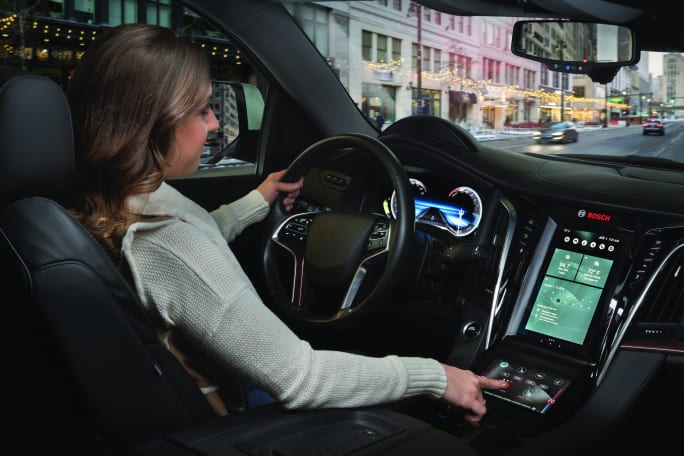
Connectivity can improve the driving experience by using multiple displays and electronics run from a single electronic control unit. The system implements smart, multimodal human machine interface including voice print, smart voice recognition, driver identification and a haptic control panel to make the vehicle increasingly driver-centric. Photo: Bosch
Bosch showed for the first time in North America an automatic emergency braking technology that uses sensors to detect cyclists alongside and ahead of the vehicle. Called AEB Cyclist, it monitors speed, distance and direction of travel to calculate the risk of a collision. In the case of an imminent collision, the system automatically brings the vehicle to a stop to avoid or reduce the severity of an accident.
Bosch also demonstrated its highway assist system, a partially automated driving function installed in a 2018 Maserati Ghibli. It combines ACC Stop & Go and lane centering functions to control the vehicle's speed, acceleration and braking.
"Consumer acceptance and understanding of driver assistance systems saves lives in the short term but also helps to build the confidence needed to grow automation in the future," said Scott Winchip, regional president, chassis systems control, North America, Robert Bosch LLC.
Bosch has created a website called Automated Mobility Academy that details how automation works.
The company is also working on redundant solutions for all levels of automated driving to ensure safety in vehicles where a human driver may no longer be able to operate as the backup function. Bosch presented a redundant braking system that combines Bosch’s electromechanical brake booster (iBooster) and electronic stability control (ESP) systems, each of which is capable of independently performing braking functions for the vehicle in the rare case of a single failure (this is for use with hydraulic brake systems in passenger cars and light trucks).
Bosch's Servolectric Paraxial Servo Unit (EPSapa) provides operational steering in the event the primary system is unable to operate, another redundant solution that makes highly automated driving possible.
Connectivity
Bosch sees connectivity at the center of all future mobility experiences, whether in-vehicle interaction or the architecture within the vehicle and the outside infrastructure. The demonstration included vehicle-to-anything (V2X) technologies, which sense what is beyond the line-of-sight by facilitating communication between vehicles and the world around them. This gives drivers more time to react to potentially dangerous situations in scenarios such as left turns and pedestrians in intersections. The technology also will provide autonomous vehicles with decision-making information.
"The V2X control unit senses what is beyond the line-of-sight through real-time communications with other vehicle and infrastructure," said Alan Manna, regional president, car multimedia, Robert Bosch LLC.
Bosch also showed how connectivity can improve the driving experience by using multiple displays and electronics run from a single electronic control unit. The system implements smart, multimodal human-machine interfaces, including voice print, smart voice recognition, driver identification, and a haptic control panel to make the vehicle increasingly driver-centric. It also includes Motion Intelligence HALO Software, which limits use of the screen of any smart device that enters the driver’s area, preventing dangerous activities such as texting, posting to social media, or emailing while driving.
There was also discussion on vehicle electrification, featuring a Nikola NZT electric UTV. Bosch is a major supplier to Nikola, and already offers e-axle, e-machine, and power electronics technologies to many manufacturers – both established and new. Bosch electrified components are already featured in more than 800,000 vehicles around the world, and the organization has carried out over 30 production projects with OEM partners, the company says.
V2X, ADAS, and Commercial Vehicles
As noted, much of the technology showcased at Bosch Mobility Experience U.S. 2018 was targeted at passenger cars; however, much of it will migrate to heavy trucks, especially the V2X connectivity and automated driving technologies. A precursor to that development is what Bosch calls the Servotwin electric-over-hydraulic steering system.
The demonstration consisted of showing how the driver's steering control input could be varied with electric motor assistance. It's very light and easy to swing the wheel at low speeds and stiffer at highway speeds. The electric side of the system can also help the driver with steering in the even of a hydraulic system failure or engine-off situation – another example of system redundancy required for future automated driving safety.
Such a steering system will be required for autonomous trucks.
Jason Roycht, vice president, North America regional business leader for commercial vehicle and off-road, said the first fully autonomous trucks are likely to operate from hubs based outside major population centers such as Los Angeles, Las Vegas, Denver, Salt Lake City and others.
"If we lay out a logical hub-to-hub system separated by 200 to 600 miles, we could start developing the infrastructure needed to switch from regional trucks to automated linehaul," he said. "Those hubs would become natural stations for fueling whether it's an electric charging station or a hydrogen distribution center.
It was clear from what emerged at the Mobility Experience that Bosch is at the center of all this emerging technology and it plans to stay there. The company sees a future where advanced driver assistance systems and fully autonomous vehicle will make roadways safer and more accessible all road users. For trucking, Bosch sees few limits for the applications of alternative fuels such as electric power and hydrogen fuel cells. Bosch is convinced that fully autonomous commercial vehicles will be operating on U.S. highways sooner than most people expect and is actively working toward that goal with the development of the necessary technology.
Related: Bosch Demonstrates Automated, Connected Tech at NACV
More Equipment

How Volvo Updated Its D13 for EPA 2027 [Watch]
Volvo’s updated D13 promises lower emissions without sacrificing performance or fuel economy. Take a closer look at what changed inside the engine in this HDT Spotlight video.
Read More →
Michelin Tire Improves Efficiency and Durability for Regional Fleets
The Michelin X Multi Energy D2 is a regional haul drive tire engineered to help fleets improve fuel efficiency, durability and traction in demanding stop-and-go operations.
Read More →
ZF Expands Commercial Vehicle Push in North America
ZF is expanding its North American commercial-vehicle presence with new transmission applications, electrification, trailer technology and autonomous-driving systems.
Read More →
Tesla Wants a Self-Driving Semi. Are Cameras Enough?
Could Tesla’s camera-only autonomous driving technology work on an 80,000-pound Semi? In this commentary, HDT's Deborah Lockridge takes a look at Tesla, Cybercab, and how autonomous trucks see the road.
Read More →
Kodiak: Driverless Long-Haul Truck Launch on Track for 2026
Kodiak AI says its driverless long-haul safety case is 93% complete and it remains on track to begin commercial operations by year-end 2026.
Read More →
What DOT’s Automated Vehicle Strategy Means for Trucking
The U.S. Department of Transportation issued a new automated-vehicle strategy that outlines plans for driverless-truck regulations, cross-state freight corridors, and federal safety standards.
Read More →
East Coast Port Launches $45M Electric Truck Push
The Port Authority of New York and New Jersey announced millions in incentives for zero-emission drayage trucks, yard tractors, and new charging hubs near the port.
Read More →
PlusAI Going Public to Fund Autonomous Truck Launch
A SPAC deal could provide PlusAI with up to $300 million as it works toward a 2027 commercial launch of factory-built autonomous trucks.
Read More →
NHTSA Moves to Rewrite Truck Fuel-Economy Rules
The National Highway Traffic Safety Administration says it lacks authority to regulate medium- and heavy-duty truck engines separately from complete vehicles, but the existing standards have not yet been eliminated.
Read More →
Detroit Opens Orders for EPA 2027 Engines
Detroit isn’t starting from scratch to meet EPA 2027 diesel emissions standards. Its Gen 6 DD13 and DD15 engines keep much of today’s platform while updating the fuel and aftertreatment systems.
Read More →