




Avoiding Brake-Related Out-of-Service Incidents
Braking system preventive maintenance is a driver/technician success opportunity.
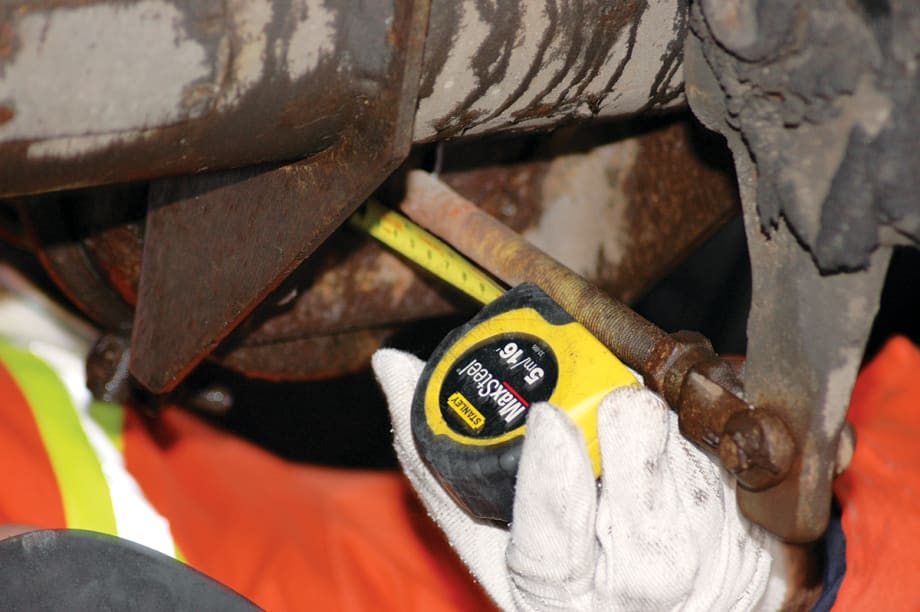
A good place to start is making sure you’re checking the same things roadside inspectors are.
Photo: Jim Park
Because most fleets conduct robust brake maintenance, brake issues are more likely to be discovered by a roadside inspector than at any other time, resulting in totally inconvenient, largely unnecessary, expensive service delays. But if brake maintenance processes are solid, why are so many trucks being sidelined by inspectors?
Inspection statistics show brake systems consistently are the biggest culprit for out-of-service declarations at roadside inspections. 2019’s annual Roadcheck week by the Commercial Vehicle Safety Alliance, although focused on steering systems, was no exception, with more than 28% of reported out-of-service events related to brake systems.
Any out-of-service declaration is not only inconvenient, but also has the added downside of impacting CSA scores. And given the attention on driver hours of service under new electronic logging device rules, downtime due to a roadside inspection includes the penalties of delaying service to a customer and complicating hours-of-service — all over a largely preventable occurrence.
So how can a fleet, especially one with trucks operating across a wide geographic territory, prevent or reduce the possibility of its trucks being sidelined by a roadside inspection event?
Review Your PM Process
The first step is to ensure that a fleet’s first line of defense, preventive maintenance, fully embraces the Federal Motor Carrier Safety Administration’s Rule 396.17 on braking performance. A good summary starting point is a review of CVSA’s Level I Inspection checklist. Using the 11 items related to braking systems, fleets can compare that to their own PM checklist.
Both the CVSA and the Technology & Maintenance Council of the American Trucking Associations offer excellent resource material providing inspection and maintenance detail on each braking system component.
One common misconception involves automatic slack adjusters, also called automatic brake adjusters. Just because they’re automatic doesn’t mean they are maintenance-free. In addition to requiring periodic lubrication at each PM, they can lose their adjustment criteria for mechanical reasons.
Manually adjusting an automatic slack adjuster is never recommended, as doing so masks the underlying problem and may give the driver a false sense of security. The National Transportation and Safety Board has very strongly worded language against manually adjusting an automatic slack adjuster.
Instead, within their PM process, fleets should always include an operational check of slack adjuster travel, regardless of slack adjuster type, and repair/replace adjusters that fail to conform operationally. In the case of automatic slack adjusters, when they do not operate properly, it’s very likely the cause lies beyond the adjuster itself.
Routine PM processes for a fleet should include these elements:
Correcting brake adjustment, either manually or, if equipped with automatic slacks, assuring adjuster rates of travel is correct;
Antilock brake system warning light operation;
Inspection of air hoses and tubing, preferably with the brakes applied;
Assurance that all hardware is in place and secure;
Proper thickness of linings and drums exists;
No presence of air leaks;
The low air warning system operates properly.
A block of wood can be a handy helper in brake maintenance. Cut to a length allowing it to be wedged as to assure full application of the foot brake pedal, it can be used to apply the brakes, allowing the technician or the driver to conduct a walk-around to listen for air leaks and visually inspect tubing and connections for bulges or looseness.
Another use for this seemingly primitive tool is to check for wheel end play or wobble after removed wheels are reinstalled following the performance of brake or related wheel-end maintenance, such as lining, bearing or seal replacement.
On the other end of the sophistication scale for brake inspection tools, some state inspectors and fleets use a Performance Based Brake Tester (PBBT) in their inspection and/or maintenance processes. This tool includes the loaded weight of the vehicle, per axle, and calculates the effectiveness of the truck’s actual braking performance under load. While being a generally accurate test, it also can pinpoint specific axles with braking system issues, allowing focus on that axle specifically.
The Driver’s Role
It is an industry given that commercial drivers are required to perform a pre-trip inspection. But it is also an industry given that a typical driver’s pre-trip inspection is less comprehensive than most fleets would prefer and/or admit. Although the pre-trip inspection is the first line of defense in preventing an inspection-related out-of-service violation, many drivers perform this function in a sub-standard fashion, and fleets suffer the consequences.
Just as up-to-date training is essential in educating technicians on the latest PM processes, the same is true for drivers. Reinforcing the importance of a high-quality pre-trip inspection through training can be money and time well spent. Unfortunately, this step is often missed by fleets who prefer to presume their drivers are performing this task as thoroughly now as when they were testing for their commercial driver’s license.
Proactive fleets conduct driver inspection workshops on a regular basis, which includes the process of testing and adjusting brakes on tractors and trailers. Unless drivers have specifically been trained under FMCSR 396.25, they are prohibited from adjusting their brakes. Fleets that train to this requirement recognize both the operational and safety benefits. (But again, drivers should not be trying to adjust automatic slack adjusters.)
Don’t Overlook Brake Imbalance
Yet another brake system element that is often overlooked is balance. In a tractor-trailer application, balance may be critical in brake operation. Brake imbalance can result in a degradation of safety by compromising brake system performance.
If the combination braking system is mistimed or out of balance, stopping distance may be greatly extended. In a single truck or tractor application, certain maintenance strategies include repairing brakes only on one side of the axle when an issue is discovered. In order to maintain proper balance, a better strategy, albeit costlier, is to assure both axle sides are treated and repaired equally, even when one side seems OK.
Brake balance is often overlooked because it is often manifested in unequal brake lining wear between the tractor and the trailer. Because the tractor and trailer are rarely or never serviced together, lining thickness inconsistencies remain unseen. When axle lining thickness inconsistencies are evident from measuring the brake lining wear patterns, brake imbalance is likely the cause. This condition should immediately be addressed, as one or more axles on one side of the truck or trailer is doing more braking work than the other, possibly creating an unsafe condition.
The performance of braking systems is only as strong as its component parts. The well-being of drivers and the motoring public depends on each fleet’s braking system maintenance and inspection proficiency. These proficiencies should extend all the way to the last line of defense…the driver.
One last note: Brakes do not stop trucks; tires stop trucks. Without well-maintained tires, the most robust braking system will be compromised.
Bob Stanton is a career fleet manager, having spent 18 years in the private sector and 26 years in the public sector. Today, he operates his own fleet consulting firm based in Cumming, Georgia.
More Equipment

How Volvo Updated Its D13 for EPA 2027 [Watch]
Volvo’s updated D13 promises lower emissions without sacrificing performance or fuel economy. Take a closer look at what changed inside the engine in this HDT Spotlight video.
Read More →
Michelin Tire Improves Efficiency and Durability for Regional Fleets
The Michelin X Multi Energy D2 is a regional haul drive tire engineered to help fleets improve fuel efficiency, durability and traction in demanding stop-and-go operations.
Read More →
ZF Expands Commercial Vehicle Push in North America
ZF is expanding its North American commercial-vehicle presence with new transmission applications, electrification, trailer technology and autonomous-driving systems.
Read More →
Tesla Wants a Self-Driving Semi. Are Cameras Enough?
Could Tesla’s camera-only autonomous driving technology work on an 80,000-pound Semi? In this commentary, HDT's Deborah Lockridge takes a look at Tesla, Cybercab, and how autonomous trucks see the road.
Read More →
Kodiak: Driverless Long-Haul Truck Launch on Track for 2026
Kodiak AI says its driverless long-haul safety case is 93% complete and it remains on track to begin commercial operations by year-end 2026.
Read More →
What DOT’s Automated Vehicle Strategy Means for Trucking
The U.S. Department of Transportation issued a new automated-vehicle strategy that outlines plans for driverless-truck regulations, cross-state freight corridors, and federal safety standards.
Read More →
East Coast Port Launches $45M Electric Truck Push
The Port Authority of New York and New Jersey announced millions in incentives for zero-emission drayage trucks, yard tractors, and new charging hubs near the port.
Read More →
PlusAI Going Public to Fund Autonomous Truck Launch
A SPAC deal could provide PlusAI with up to $300 million as it works toward a 2027 commercial launch of factory-built autonomous trucks.
Read More →
NHTSA Moves to Rewrite Truck Fuel-Economy Rules
The National Highway Traffic Safety Administration says it lacks authority to regulate medium- and heavy-duty truck engines separately from complete vehicles, but the existing standards have not yet been eliminated.
Read More →
Detroit Opens Orders for EPA 2027 Engines
Detroit isn’t starting from scratch to meet EPA 2027 diesel emissions standards. Its Gen 6 DD13 and DD15 engines keep much of today’s platform while updating the fuel and aftertreatment systems.
Read More →