




Air Disc Brakes: You Can't Inspect What You Can't See
Imagine having a brand new truck sidelined during a roadside inspection because the inspector didn't understand what he was looking a

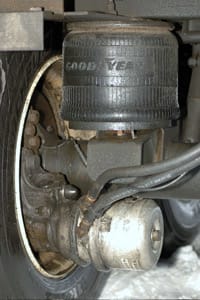
The caliper is nearly impossible to see without removing the wheel, leaving CVSA inspectors at a loss on how to determine brake functionality.
Imagine having a brand new truck sidelined during a roadside inspection because the inspector didn't understand what he was looking at
. That happened more than once as the first of the next-generation air disc brakes hit the street.
Some inspectors, confronted for the first time with this emerging technology, had no idea how to inspect the systems for roadworthiness or functionality, or how to measure brake stroke, lining thickness, rotor wear, or anything else.
Collin Mooney, director of enforcement programs at the Commercial Vehicle Safety Alliance, says new style air disc brake systems posed problems for vehicle inspectors when they first hit the streets. They have very little in common with the older disc brake systems, and almost nothing in common with drum brake systems. Consequently, traditional inspection procedures and out-of-service criteria were inapplicable to air disc systems.
"The pushrods and the adjustment mechanisms, for example, are sealed and isolated from view, so we couldn't perform even a basic stroke measurement on the new systems," he says. "We knew we had to get working with industry to develop an inspection procedure we could perform at roadside."
Development of a standard inspection procedure began unofficially in December 2006 during CVSA's Brake Safety Symposium, when Lt. Charles Hanafin, the training coordinator for commercial vehicle enforcement with the Massachusetts State Police, called on brake manufactures to provide guidance on roadside brake inspections.
"We need to be able to tell if the brake is in satisfactory condition to be operating on our highways," Hanafin said. "We know drivers don't do proper brake inspections, so there has to be some way of determining if these things are working properly."
It took representatives from Bendix, Haldex, and Meritor Wabco, and the CVSA Vehicle Committee and Passenger Carrying Committee more than two years to develop inspection procedures and out-of-service criteria for air disc systems.
These committees have agreed on the procedures and the out-of-service criteria for air disc brakes, and the CVSA documents have been revised and included in the 2009 North American Standard Out-of-Service Criteria guidebook, published in April, according to Meritor Wabco's Paul Johnston.
Defining the problem
Without removing wheels, it's very difficult to inspect braking surfaces and disc pads, or to observe brake actuation. It's also impossible to measure pushrod stroke.
"You can't measure brake stroke because the mechanism is internal," explains Ron Plantan, principal engineer of Bendix's wheel-end group. "So, rather than rely on measurements to prove the brake is working properly, the brake manufacturers persuaded CVSA to rely on visual indications that it wasn't."
At a two-day workshop held in January 2008, brake suppliers demonstrated various techniques CVSA inspectors could use to verify proper brake function.
"We showed them, for example, that if the actuator isn't working properly, or the caliper is bound up or seized, the pad wouldn't make contact with the rotor, and eventually it would rust over," says Randy Petresh, vice president of technical and customer support for Haldex Commercial Vehicle Systems. "They eventually agreed that those sorts of things would be reliable indicators of brake function."
But Petresh was rather surprised at the amount effort it took to get CVSA to see that point.
"They were obsessed with stroke measurement, but that wasn't even on the table," he said. "You can't do it. And 'brake adjustment' just isn't an issue with disc brakes."
On a drum brake, braking force decreases as brake stroke increases. With disc brakes, pushrod travel shortens as the rotor gets hot and expands. Brake performance actually improves as brakes get hotter.
Compounding the challenge is the fact that currently there are more than five models of airdisc brakes available from three manufacturers. They have many common components, but each manufacturer's system is unique enough that a single, universal set of measurements and methods wouldn't apply to all air disc makes and models.
"They wanted measurements that were conclusive, leaving no room for the inspector to interpret the measurement," says Jim Szudy, engineering manager for vehicle systems at Bendix. "In the end, they settled on the presumption of function, barring any physical defects."
In essence, if the brake appears to be working while at rest, then logically it could only work better as it gets hot. That, of course, is precisely 180 degrees from the CVSA's thinking on drum brakes, and that's why it took some persuading to bring the inspectors around.
Next steps
There's still one hurdle to overcome - a method of measuring pad wear without removing the wheel. CVSA would like such a tool, and brake manufacturers have agreed to put some effort into developing something. The hope is the design will work on drum brakes as well, Plantan says.
"That will require some degree of universality in pad thickness, etc., and presently there are differences across the brands, and even among brakes of the same brand," Plantain explains. "Some of brakes in service today would have to change. There are probably six or seven variations across three manufacturers."
Bendix, Haldex, and Meritor Wabco reps will sit down with CVSA again this fall to try ironing this out. They'll probably come up with a solution, but CVSA wants the final say. So, while 85 percent of the work is done, a few sticking points remain.
"We remain working with these CVSA committees to refine an inspection tool for the benefit of the inspectors to remove some of the 'looks like' judgment calls," notes Johnston. "This is not on the critical path, but we all agree a common tool for any air disc brake would be a benefit for the industry."
From the September 2009 issue of Heavy Duty Trucking.
More Maintenance

Color Match Smarter: Tools That Restore & Perform
For fleet managers and collision repair professionals keeping heavy-duty trucks on the road, getting the color right the first time isn't just about appearance — it's about efficiency, turnaround time, and bottom-line results. Discover how today's digital color tools are transforming the repair process from guesswork to precision.
Read More →
Wrong Repair Prompts Recall of Freightliner, Western Star 4x2 Trucks
DTNA is recalling more than 2,400 trucks that received an incompatible software fix instead of the hardware repair required to address brake valve corrosion.
Read More →
Truck Drivers Need More Than Another Alert
Fleets have more visibility into truck health, safety events, and driver activity than ever. The next challenge is turning all that information into useful guidance for the person who has to decide what to do next.
Read More →
The Maintenance Checks Trucking Fleets Should Prioritize Before Fall Freight Picks Up
Making it through August isn’t the same as being ready for the next several months of operation. Find out what systems may have suffered from summer heat and need to be checked out before fall.
Read More →
What Three Fleets Are Doing Differently When Buying Truck Parts in 2026
With freight improving but costs still climbing, fleet maintenance executives explain how they're balancing price, quality, and supplier relationships.
Read More →
Paccar Recalls 2027 Trucks Built This Summer for Possible Electrical Problem
The nearly 6,000 Kenworth and Peterbilt trucks in the recall could potentially lose engine power, among other things.
Read More →
Will API PC-12 Oil Change Trucking Fleet Maintenance?
The new API PC-12 heavy-duty engine oil category reflects the changing demands of modern diesel engines. But fleets like Foodliner are looking to getting their own data before making decisions on adopting the new oils and questions such as extending oil drain intervals.
Read More →
Brake Safety Week to Focus on Drums and Rotors
Commercial vehicle inspectors are focusing on truck brakes during CVSA's Brake Safety Week, August 23-29.
Read More →Possible Battery-Cable Fires Prompt Recall of 15,000+ International MV and HV Trucks
On the recalled vehicles, manufacturing variations can cause the battery interconnect cable to contact the auxiliary stud and hold down the bracket.
Read More →
Rush, MCT Team Up to Grow Refrigeration Service Network
The joint venture will operate MCT's network of Carrier Transicold dealerships and mobile service locations, with the companies promising greater service capacity and uptime for refrigerated fleets.
Read More →