




Aerodynamic Devices Can Translate Into Fast Fuel Savings
Falling acquisition prices, proven performance and fast ROI times on aerodynamic add-ons can translate into fast fuel savings for even cash-strapped fleets. Learn more in this feature from June's special fuel issue.

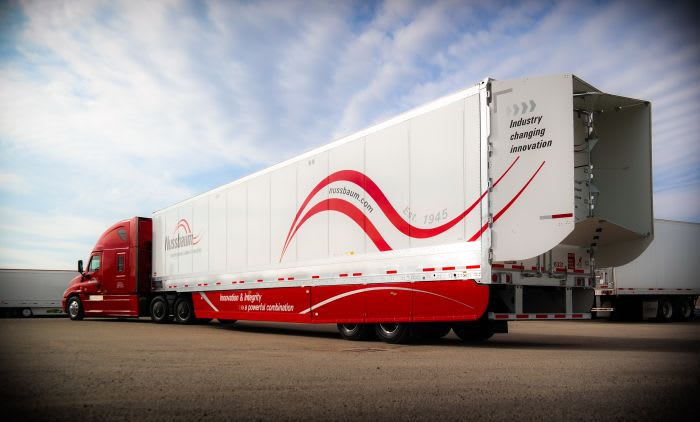
This trailer owned by Illinois-based Nussbaum Transportation has both an aerodynamic “boat tail” from Stemco TrailerTails and extra-long trailer side fairings it developed with Wabash. Photo: Nussbaum Transportation
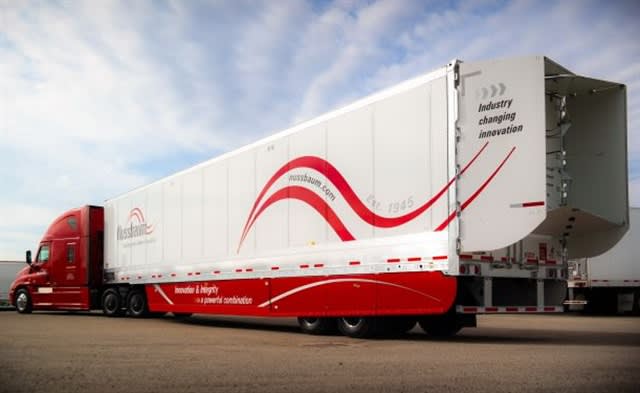
This trailer owned by Illinois-based Nussbaum Transportation has both an aerodynamic “boat tail” from Stemco TrailerTails and extra-long trailer side fairings it developed with Wabash. Photo: Nussbaum Transportation
Adding aerodynamic devices to smooth airflow over the vehicle at highway speeds is a (relatively) cheap and easy way for fleets to improve fuel economy in long-haul tractor-trailer applications. But calculating fuel savings and return on investment for aerodynamics can be notoriously tricky. Moreover, not every aerodynamic device on the market today is appropriate for all applications. Luckily, several recent, high-profile studies have made it easier for fleet managers to identify the best devices for their applications and to determine both fuel savings and a realistic ROI timeline.
A particularly valuable information packet was recently released by SmartWay Canada, and it takes an extremely deep dive into the science of tractor-trailer aerodynamics. But on an elemental level, the principles of clean vehicle design can be readily understood by anyone who’s ever stuck their hand outside the window of a car moving at highway speeds: Air is a mass that creates resistance to the objects moving through it. Surfaces with sleek, rounded edges move through this air mass more efficiently. Engines moving vehicles through the air mass don’t have to work as hard — and therefore burn less fuel.
There is also a secondary component to vehicle aerodynamics beyond the ability to simply slip through the air mass efficiently. And that is the science of dealing with low-pressure pockets in the vehicle profile as air passes over it. Again, the science dealing with this problem can be complex. But the overall concept is easy to grasp: Nature abhors a vacuum. If an area on a vehicle is generating a lower-pressure pocket, air moving past it will naturally try to fill that void to equalize overall pressure. This creates “drag” and turbulence in the air flowing past the vehicle, which, once again, makes it more difficult for the vehicle to move forward efficiently and forces the engine to burn more fuel to do so. Two key drag-producing areas on modern tractor-trailers are the fifth wheel (trailer) gap and the area immediately behind a box van trailer.
Fleets can spec aerodynamic devices to address both of these efficiency issues. And the SmartWay Canada guide, as well as a more in-depth research paper published by National Research Center Canada’s Aerodynamics Laboratory, have invaluable advice for doing so effectively. It should be noted that the fuel-saving calculations presented here are based on the assumption that a vehicle is traveling approximately 100,000 miles a year at highway speeds the majority of the time on tractor-trailers with a 36-inch trailer gap. Here are some highlights to consider as you’re spec’ing aerodynamic devices for your fleet.
Fighting flow around the fifth wheel
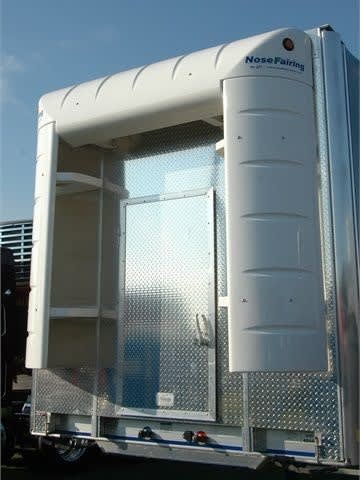
According to the SmartWay Canada study, trailer nose fairings, like these OptiFlow Front Fairings from Wabco, are the most effective way to reduce low pressure in the fifth wheel area and can yield fuel savings of around 422 gallons a year.Photo: Wabco
The gap between the back of the tractor and the front of the trailer is one of the worst low-pressure areas on a tractor-trailer. Given the articulation demands required of a fifth wheel, and the room for trailer clearance required to meet those demands, it remains one of the most difficult areas to address aerodynamically.
According to the SmartWay Canada study, fleets looking at increasing aerodynamic efficiency around the trailer gap would do well to begin by reducing the distance between the cab and trailer as much as practical. If it is assumed that a 48-inch gap width is the current standard, reducing the gap to 24 inches can provide a savings of around 422 gallons of fuel per year. However, that close of a trailer gap isn’t feasible for most fleets. The report found that a new, standard 36-inch trailer gap would be “feasible” to meet current industry requirements and would save a fleet around 810 gallons of diesel per year.
The report found that of the devices currently available to improve trailer-gap aerodynamics, the most effective is the trailer fairing. Surface-pressure data carried out by SmartWay researchers found that these devices reduce airflow through the gap in a way that guides the flow smoothly from the tractor to the trailer, “thus avoiding stagnating flow in the gap and minimizing any influence downstream due to adverse changes in the trailer surface.”
Taken as a whole, SmartWay researchers concluded that the largest savings possible based on the gap devices tested is approximately 422 gallons per year.
Yaw angles and side skirts
According to SmartWay, the most effective aerodynamic devices in use on tractor-trailers today are trailer side fairings. Standard side fairings, which are typically 26 feet in length and extend from just behind a trailer landing gear back to its axle, generally save approximately 766 gallons of fuel per year. A relatively new, extended side fairing that extends past the trailer wheels delivers even greater efficiency, SmartWay found, saving approximately 871 gallons of fuel per year in highway operations. Split side skirts, which can be spec’d to accommodate storage areas or control boxes, do not provide a continuous structure to manage air flow past lower trailer sections, but are still surprisingly effective: SmartWay found they typically save around 740 gallons of fuel a year.
SmartWay researchers concluded that standard, short, and split side skirts all provide nearly identical drag reduction trends and magnitudes, resulting in more than 10% drag reduction compared to tractor-trailers without these devices.
Importantly, they noted that regardless of which system is used, side skirts demonstrate a large drag reduction at low yaw angles (order of 0.05), and show the greatest benefits at yaw angles exceeding 4 degrees. According to the report, “The similarity of these results, despite some differences in skirt length, skirt-tire gap width, and solidity of the skirt, indicates that the location and shape of the leading edge of the skirt is a likely dominant contribution to the performance of side-skirts. This implies that as long as the flow is redirected along the sides of the trailer, instead of underneath, the drag reduction is significant. It is likely that the leading edge contributes most to the flow split between what enters the underbody region and what is redirected around the trailer bogie. Extending the skirts over the trailer wheels provides an additional reduction in drag, as identified by the increased performance of the extended side skirts over the standard side skirts.”
The success of side fairings has led to the introduction of a number of other devices to sculpt air around trailers. Most of these target the underside of the trailer, which is a low air-pressure area to begin with — a problem compounded by the drag-inducing tandem axles toward the rear of the trailer.
To counter these problems, fleets can now spec a variety of devices for trailer undersides ranging from removable landing gear, to bogie fairings, to various devices designed to smooth out the underside area of a trailer completely.
Bogie fairings are essentially a wind-deflection structure that sit in front of the trailer axle and divert air around it. SmartWay found these systems can save up to 184 gallons of fuel a year. A belly box structure, which can serve as a dual storage-aerodynamic device by keeping air from hitting crossmembers and other drag-inducing components underneath a trailer, was found to save around 475 gallons of fuel per year.
Boat tails bring up the rear
The low-pressure area at the rear of a 53-foot trailer has long been recognized as a problem area in tractor-trailer aerodynamics, complicated by the fact that access doors are also located in this area. “Boat tail” structures that taper the final air flow past a trailer to reduce the low-pressure area in its wake are the most popular solution for fleets today. These systems usually consist of a set of panels that extend aft of the trailer. To allow access to the cargo door, these panels have some sort of extension and retraction system that allow them to fold or flip out of the way as needed.
Of the boat tail systems it surveyed, SmartWay found that long, four-panel boat-tails provide the greatest increase in base pressure, with the three-panel and shorter four-panel boat-tails providing a smaller difference.
“Despite the larger increase in base pressure for the long four-panel boat-tail, pressurization inside the boat-tail cavity that acts on the inside surfaces of the inward-facing panels provides an added component of drag,” researchers note. “This is likely a contributing factor toward the small difference in drag reduction between the short and long boat tails. Little difference is observed for the drag reduction and the pressure distributions between the long three-panel and the tapered three-panel boat-tails, indicating that the size of the side panels do not have a major influence on the boat-tail performance.”
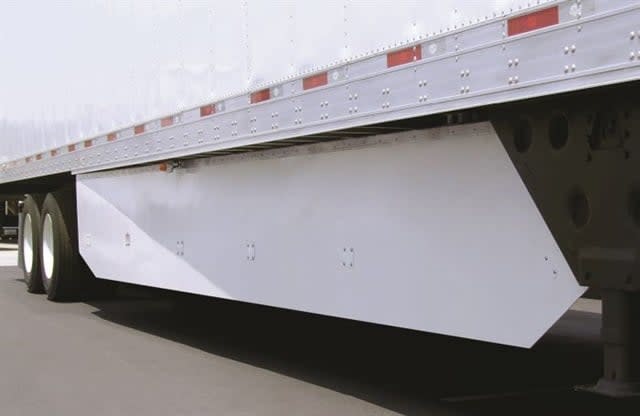
Trailer side skirts remain the most popularly spec’d aerodynamic device today and are remarkably effective regardless of the size or configuration used.Photo: Jim Park
Performance-wise, SmartWay Canada found little variation in boat tail devices, regardless of which style or size of device was used. Long, four-panel boat tails, for example, were found to save approximately 500 gallons of fuel a year, while three-panel, tapered devices delivered the worst performance, but still saved around 422 gallons per year.
A never-ending puzzle
Mike Roeth, executive director of the North American Council for Freight Efficiency, notes that although his organization gives aerodynamic devices consistently high confidence ratings in terms of their ability to deliver fuel savings for fleets, he cautions that getting the “formula” right can be challenging.
“As each device is added, the performance of other devices will be impacted,” Roeth cautions. “The airflow over each device changes the operating conditions for the other devices. The performance of a combination of devices will not simply be the additive total of each device operating alone.”
That said, however, NACFE has found that the greatest aerodynamic drag reduction comes from using devices in three main areas: gap, underbody, and rear. “Addressing the aerodynamics of all three points of drag should give the greatest fuel savings for the vast majority of fleets.”
Using similar formulas to SmartWay Canada, Roeth says NACFE was able to determine that ROI for the three most popular aerodynamic systems occurs surprisingly quickly — around 55,000 miles in many cases. Making that easier, Roeth says, is that the cost of trailer side skirts have decreased substantially over the past three to five years, “due to far more market entrants driving cost competition and much higher deployment volumes reducing cost per unit.” Based on interviews with fleets, NACFE estimates that costs for side skirts have dropped roughly 70% compared to cost estimates compiled as part of the 2010 National Academy of Sciences study that investigated fuel efficiency technologies for commercial vehicles.
Taken as a whole, the findings seem clear: Even limited use of tractor-trailer aerodynamic devices yield significant fuel savings for fleets. And fast ROI times mean even cash-strapped fleets can start with one device, then add others until a full, fuel-saving package is in place.
More Fuel Smarts

How Volvo Updated Its D13 for EPA 2027 [Watch]
Volvo’s updated D13 promises lower emissions without sacrificing performance or fuel economy. Take a closer look at what changed inside the engine in this HDT Spotlight video.
Read More →
Diesel Price Spike Shortens Payback for Natural Gas Trucks, Report Says
Energy Vision estimates fleets could recover the higher purchase price of an RNG-fueled Class 8 tractor in 1.3 to 2.8 years under current fuel-price scenarios.
Read More →
Calstart Becomes Catalyst Mobility, Reflecting Broader Focus
Calstart is now Catalyst Mobility, reflecting the nonprofit’s growing national role in clean transportation, including zero-emission trucks, infrastructure and incentive programs.
Read More →

Record Diesel Prices Squeeze Trucking Fleets
Average U.S. diesel prices have climbed to nearly $6 a gallon, surpassing the 2022 record as tight refinery capacity and Middle East disruptions keep fuel costs elevated.
Read More →
How Fuel Delivery Shapes Engine Performance
Fuel delivery depends on more than what happens at the injector. For fleet, maintenance and technical professionals, looking at the full path from pump to injector can provide useful context for understanding engine performance.
Read More →
East Coast Port Launches $45M Electric Truck Push
The Port Authority of New York and New Jersey announced millions in incentives for zero-emission drayage trucks, yard tractors, and new charging hubs near the port.
Read More →
California Bill Could Shed Light on Electric Truck Prices
Why do battery-electric Class 8 trucks remain so expensive? A California bill headed to Gov. Gavin Newsom would give fleets and state agencies more visibility into what manufacturers charge.
Read More →
Detroit Opens Orders for EPA 2027 Engines
Detroit isn’t starting from scratch to meet EPA 2027 diesel emissions standards. Its Gen 6 DD13 and DD15 engines keep much of today’s platform while updating the fuel and aftertreatment systems.
Read More →
Zero-Emission Truck Corridor Planned for West Coast
California, Oregon, Washington, British Columbia and Baja California are coordinating plans for truck charging and hydrogen fueling from Canada to Mexico.
Read More →
A Closer Look at Kenworth’s Electric T880E Vocational Truck [Video]
Learn more about Kenworth's T880E battery-electric vocational truck at the Paccar Technical Center, including its range, applications, upfitting considerations, and PTO options, in this HDT Spotlight video.
Read More →