For White Holdings Trucking, getting a handle on its trailer operations was critical for getting better asset utilization and recouping financial losses from units stuck in detention.
Photo: White Holdings Trucking
3 min to read
“I only have one trailer I can’t account for today,” says Brandon Pangle of White Holdings Trucking. “And a few months ago, I’d be trying to track down at least four or five trailers on any given day.”
It’s a familiar refrain for fleet managers; tracking down trailers, then determining if they’ve been unloaded, how long they’ve been waiting to be unloaded, and if they’re available for a load. For Pangle, director of technology and compliance for White Holdings Trucking, it was a problem his fleet needed help with.
Fleet Snapshot
Who: White Holdings Trucking
Where: Duncan, South Carolina
Operations: Regional-haul LTL
Fleet: 28 tractors, 100 trailers
Fun Fact: White Holdings, a minority-owned business, has grown from five tractors in 2015 to almost 30.
Challenge: Making trailer tracking more effective
White Holdings is a small, South Carolina-based regional-haul fleet servicing customers in the Southeastern coast states, making runs to Atlanta; Greensboro, North Carolina, and other nearby metropolitan areas. The problem the carrier was facing with its trailer fleet was an all-too-common one, Pangle says. “Trailers get picked up and taken off by other fleets all the time,” he explains. “Or they sit on our customers’ yards for days waiting to get unloaded. And we never knew where our trailers were, how long they’d been somewhere, or if they were empty and could be taken out by a driver during a drop-and-hook swap.”
Today, Pangle says about 75% of White Holdings’ trailers have some sort of tracking device on them. Still, he wanted more information about his assets to get full utilization from them.
The answer came from Spireon, a vehicle intelligence company that provides a daily intelligence report on all of his trailers. This enables him to get drivers to empty trailers or, just as important, to charge customers for detention.
Spireon’s managed trailer service for fleets acts as a personal trailer management consultant, according to the company. The service assumes responsibility for a range of data-related administrative tasks, reports, and analyses that can help improve business operations.
Although reports such as daily yard checks, high dwell locations, trailer utilization, and detention were already available through FleetLocate — White Holding’s tracking system — Spireon’s trailer management service helps turn the numbers on the reports into actions.
“Using Spireon, we can see where our trailers are, how long they’ve been there, and begin charging detention if they’ve been idle for longer than five days,” Pangle says. “We’d been missing out on a lot of money for detention charges because we weren’t sure where trailers were or how long they’d been there. But now, with Spireon reports, we now have a handle on things, and we’re seeing cost benefits now for all aspects of trailer use — from acquisition costs to improved utilization to helping our customers get more proactive about unloading trailers and getting them back into service faster.”
Pangle’s day begins with an action report with the latest information about the fleet’s trailer assets. The service is customizable, and Pangle has added his own “bells and whistles” to it, ensuring he’s getting the data he needs in a format he can act on quickly — including a dedicated column exclusively to track detention times.
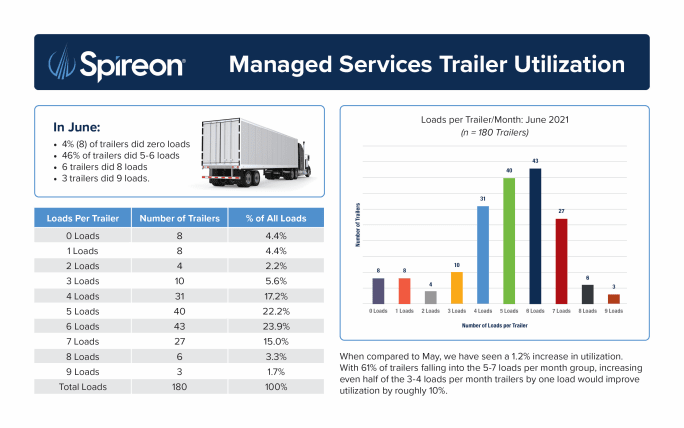
Graphic: Spireon
“Once I have that report, I can send it out to our team, who can then refer to it during the course of the day when they need a trailer, without having to log into a computer or work the phones or simply ask around to see if it’s present in a location and available for use.”
Spireon officials say its management services can increase fleet trailer management ROI by as much as 200% in some cases. And Pangle says White Holdings’ operations and bottom line are already benefiting from the system. “We feel like finally we’re starting to get a handle on our trailer operations.”
This article first appeared in the October 2021 issue of Heavy Duty Trucking.
Volvo’s updated D13 promises lower emissions without sacrificing performance or fuel economy. Take a closer look at what changed inside the engine in this HDT Spotlight video.
The Michelin X Multi Energy D2 is a regional haul drive tire engineered to help fleets improve fuel efficiency, durability and traction in demanding stop-and-go operations.
ZF is expanding its North American commercial-vehicle presence with new transmission applications, electrification, trailer technology and autonomous-driving systems.
Could Tesla’s camera-only autonomous driving technology work on an 80,000-pound Semi? In this commentary, HDT's Deborah Lockridge takes a look at Tesla, Cybercab, and how autonomous trucks see the road.
The U.S. Department of Transportation issued a new automated-vehicle strategy that outlines plans for driverless-truck regulations, cross-state freight corridors, and federal safety standards.
The Port Authority of New York and New Jersey announced millions in incentives for zero-emission drayage trucks, yard tractors, and new charging hubs near the port.
The National Highway Traffic Safety Administration says it lacks authority to regulate medium- and heavy-duty truck engines separately from complete vehicles, but the existing standards have not yet been eliminated.
Detroit isn’t starting from scratch to meet EPA 2027 diesel emissions standards. Its Gen 6 DD13 and DD15 engines keep much of today’s platform while updating the fuel and aftertreatment systems.