





Dig Deeper: What Fleets Need to Know About Hazmat Regulations
A TSA Hazmat Endorsement Security Check in 5 Steps
Getting a hazmat endorsement on a commercial driver’s license takes more than just completing entry-level driver training and passing a knowledge test.
May 11, 2023
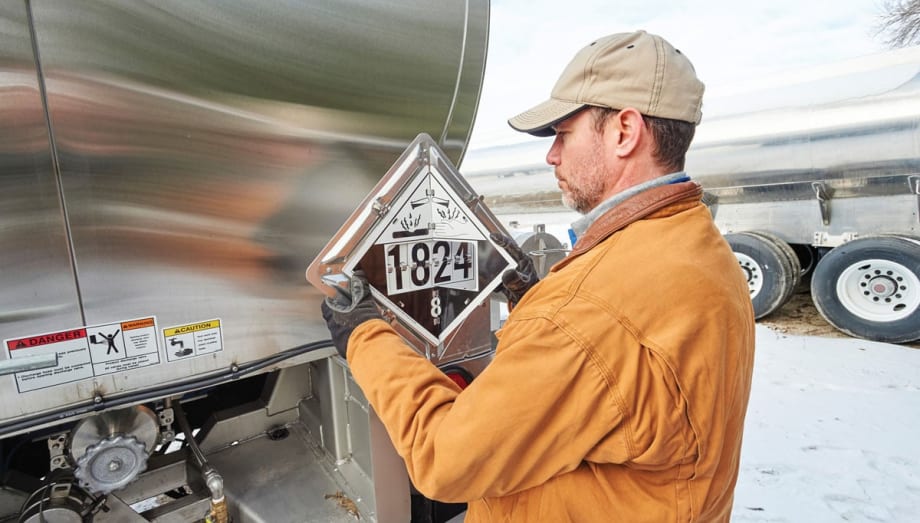
If a hazardous material is required to be placarded, then the hazmat endorsement is also required.
Photo: J.J. Keller
3 min to read
Getting a hazmat endorsement on a commercial driver’s license takes more than just completing entry-level driver training and passing a knowledge test. Drivers seeking a hazmat endorsement also are subject to a federal background check.
State driver’s licensing agencies cannot issue, renew, upgrade to, or transfer an HME until the Transportation Security Administration determines that the individual does not pose a security risk. TSA draws its conclusions through a security threat assessment.
It can take up to 60 days for TSA to complete the required background check. You can help minimize the wait time by understanding the steps in the assessment process.
1. Confirm the Need for a Hazmat Endorsement
For the hazmat endorsement requirements, consult the Federal Motor Carrier Safety regulations, as commercial driver’s licenses are a federal requirement. Section 383.5 defines hazardous materials as “any material that has been designated as hazardous under 49 U.S.C. 5103 and is required to be placarded under subpart F of 49 CFR part 172 or any quantity of a material listed as a select agent or toxin in 42 CFR part 73.”
The key phrase in this definition is “required to be placarded.” If a hazardous material is required to be placarded, then the hazmat endorsement is also required.
There are two situations that often need clarification when it comes to the hazmat endorsement:
Transporting Class 9 materials. Class 9 materials do not require placards for domestic transportation. As a result, a hazmat endorsement is not required if the driver is transporting only Class 9 materials. Placards aren’t required; therefore, the hazmat endorsement is not required. Even if Class 9 placards are displayed, the hazmat endorsement is still not required.
Transporting diesel fuel in non-bulk packaging. Whether diesel is regulated largely depends on the type of packaging. Generally, combustible liquids such as diesel are not subject to the hazardous materials regulations when in non-bulk packaging. Therefore, when diesel is transported in non-bulk packaging (119 gallons or less capacity), placards are not required, and the hazmat endorsement is also not required.
2. Complete an Application
The security threat assessment application is submitted in one of two ways based on the state licensing agency of the driver.
A handful of states require drivers to visit the Department of Motor Vehicles for application and fingerprinting information. These states include:
Florida
Kentucky
Maryland
New York
Pennsylvania
Texas
Virginia
Wisconsin
Check with these states for additional details.
All other drivers are required to complete an application either at an enrollment center or through TSA’s website. Drivers are instructed to schedule an appointment either online or by calling (855) 347-8371. The application centers accept walk-in appointments, but those with appointments take priority.
3. Visit an Enrollment Center
When drivers visit an enrollment center, they must be prepared to:
Provide approved documents to prove identification and citizenship.
Submit fingerprints.
Pay an application fee.
Once the application is submitted, drivers can check their status online.
4. Wait on TSA’s assessment
TSA investigates the following when determining eligibility:
The driver’s citizenship or immigration status
Mental capacity (as determined by a court, board, commission, etc.)
Terrorist watchlists, Interpol, and other government databases
Drivers may also be ineligible due to incomplete or false application information.
If TSA finds potentially disqualifying information, it will send the driver a letter with instructions on how to proceed.
5. Follow up With the State
When a driver passes the investigation, TSA notifies the state (not the driver). The state verifies the driver’s eligibility when it issues a CDL with a hazmat endorseement. Each driver should check with his or her state licensing agency on how it handles the HME issuance process and status once TSA provides the results.
Kathy Close is a subject matter expert at J.J. Keller & Associates. Her areas of expertise include transportation security, DOT drug and alcohol testing, and driver qualification. This article was authored under the guidance and editorial standards of HDT’s editors to provide useful information to our readers.
Subscribe to Our Newsletter
More Safety & Compliance

FMCSA Pauses Biennial-Update Enforcement Amid Motus Transition
Carriers whose updates were due on or after June 1 have more time, while FMCSA works to stabilize its new registration system and warns of phishing sites impersonating its new carrier registration system, Motus.
Read More →
ZF Expands Commercial Vehicle Push in North America
ZF is expanding its North American commercial-vehicle presence with new transmission applications, electrification, trailer technology and autonomous-driving systems.
Read More →
Truck Drivers Need More Than Another Alert
Fleets have more visibility into truck health, safety events, and driver activity than ever. The next challenge is turning all that information into useful guidance for the person who has to decide what to do next.
Read More →
Tesla Wants a Self-Driving Semi. Are Cameras Enough?
Could Tesla’s camera-only autonomous driving technology work on an 80,000-pound Semi? In this commentary, HDT's Deborah Lockridge takes a look at Tesla, Cybercab, and how autonomous trucks see the road.
Read More →
What DOT’s Automated Vehicle Strategy Means for Trucking
The U.S. Department of Transportation issued a new automated-vehicle strategy that outlines plans for driverless-truck regulations, cross-state freight corridors, and federal safety standards.
Read More →
NYC Expands Speed, Pedestrian Safety Tech Across Fleet
New York City is expanding intelligent speed assistance and pedestrian-alert systems across its municipal fleet, moving the technologies from pilot programs into vehicle procurement and retrofit requirements.
Read More →
FMCSA Removes 110 Truck Driver Training Schools from Certified ELDT List
Federal regulators also are targeting more than 160 additional training providers and launching a nationwide audit of third-party CDL skills testers as part of a broader crackdown on trucking fraud.
Read More →
Beyond DOT Compliance: What Makes a Trucking Fleet Truly Safe?
A trucking fleet can follow every rule and still make unsafe decisions. The real test comes when safety conflicts with freight, productivity, or cost.
Read More →
Hours of Service Pilot Programs: FMCSA Readies for 2027 Rollout
Two pilot programs could eventually reshape hours-of-service rules, giving truck drivers options to pause their 14-hour clock or use longer split sleeper rest periods.
Read More →
New Guide Offers Pet Safety Tips for Truck Drivers
Hundreds of thousands of pets travel in truck cabs. A new safety guide from Volvo Trucks and the Center for Pet Safety offers practical advice for truck drivers who bring dogs and cats along for the ride.
Read More →