





Related: California Aims to Regulate Sustainability Into Freight System
A Look at the California-Compliant Trailer
There’s a California-compliant trailer in your future, whether you want it or not. But what’s not to want?
January 27, 2016
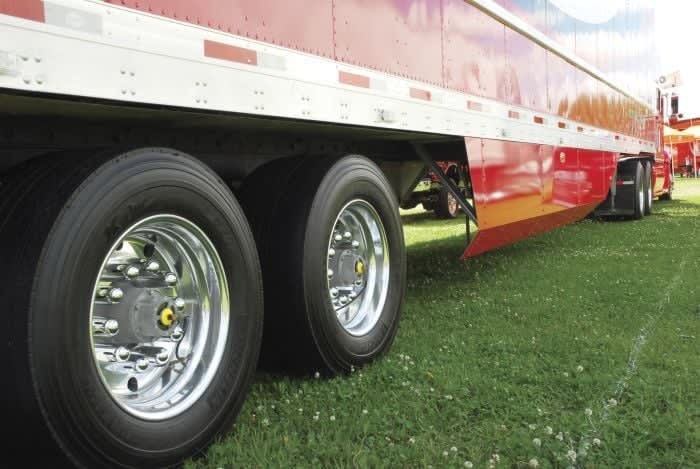
It doesn’t take much to meet CARB’s 2010 requirements for trailer aero, but even this can be too much for some fleets.
4 min to read
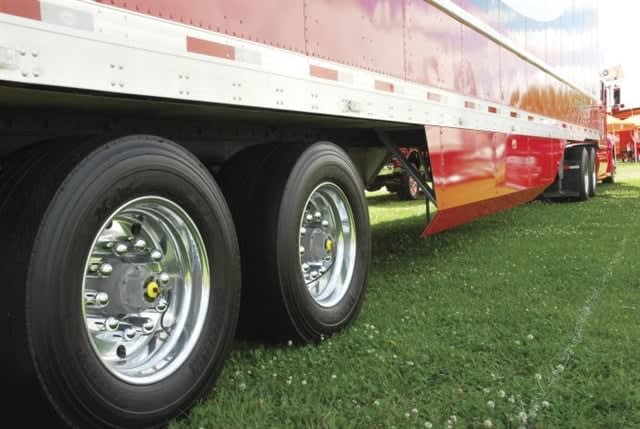
It doesn’t take much to meet CARB’s 2010 requirements for trailer aero, but even this can be too much for some fleets.
The California-compliant trailer has proven to be a fairly benign creature. There was some gnashing of teeth back in 2009 when the California Air Resources Board announced that most 53-foot box trailers domiciled and operating there would have to meet a set of requirements intended to minimize the amount of fuel needed to pull the things. The hue and cry soon died down as fleets realized that the regulation would actually save them money.
Joe Rajkovacz, director of governmental affairs and communications for the Western States Trucking Association, says his group took a wait-and-see approach before condemning the rule outright.
“We looked at it and felt that it was largely unnecessary, but that compliance with the rule would produce cost savings,” he says. “Sure enough, most of the complaints died down soon enough.”
Under the rule, all 53-foot box-type trailers (dry or refrigerated) must be equipped with Environmental Protection Agency SmartWay-approved side skirts or tail fairings that improve fuel economy from 4% to 5%, in addition to low-rolling-resistance tires (either standard or wide-base singles).
A host of exemptions have been rolling in since the rule was implemented that allow different compliance dates for fleets of different sizes engaged in local and regional operations as opposed to strictly longhaul operations.
Regulated trailers must also be pulled exclusively by SmartWay-certified tractors.
“The challenge for many fleets, particularly the smaller ones, is that it’s difficult to determine which, if any, exemptions might apply or which category a fleet fits into if they engage in more than one type of trucking,” Rajkovacz says. “There’s a lot of misunderstanding that’s resulting in citations that fleet owners didn’t see coming.”
Many of the exemptions have reached the end of the sunset period, but a few still remain, such as the requirement that all model year 2010 and older trailers have installed SmartWay verified low-rolling-resistance tires.
It now appears to be a virtual certainty that some form of trailer regulation will be coming to the national stage with Phase 2 of federal greenhouse gas reduction/fuel economy rules that are currently in the comment period.
Going nationwide
If the proposal made public by the EPA and the National Highway Traffic Safety Administration in June 2015 remains substantially unchanged following the comment period, fleets all over the country will be required to spec trailers equipped to improve the fuel economy of the trucks pulling them. Proposed technologies include aerodynamic devices, low-rolling resistance tires, automatic tire inflation systems and lightweight components.
The proposal also contains language that applies to non-box trailers, which might not require aerodynamic devices but would probably need low-rolling-resistance tires and automatic tire inflation systems.
Many of the same problems that beset California carriers will likely resurface in the nationwide application, such as:
Mixed fleets with a high concentration of regional or local work may not see adequate payback because the trailers do not spend a high enough percentage of time operating at highway speeds;
Areas with lower speed limits (like California’s 55-mph limit for trucks) reduce the effectiveness and the return on investment on the aerodynamic devices;
Fleets with high trailer-to-tractor ratios will need to equip all their applicable trailers with the required aero and rolling-resistance-reducing fitments, regardless of their annual mileage; and
The owner of the trailer may not be the operator of the trailer, so leasing companies may not have the operational incentives to equip their fleet appropriately, while their customers may balk at any increase in the capital cost.
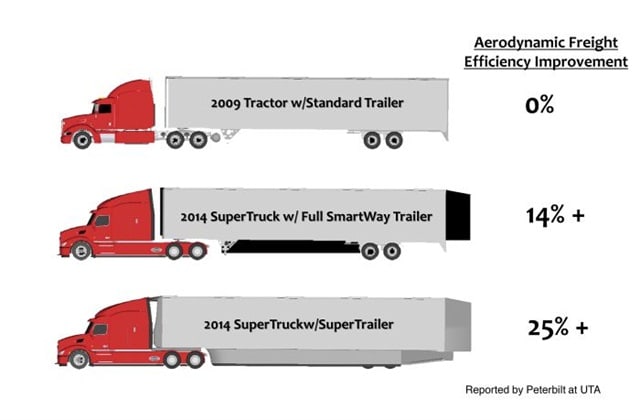
Changes we have seen up to now are additive and evolutionary. Wait until the revolutionary improvements come our way.
Looking ahead
The way we view today’s aerodynamic challenges will change profoundly over the next few years. Rick Mihelic, a retired manager of vehicle performance and engineering analysis with a major OEM, says there are a finite number of options for treating trailers that will stand up to fleet concerns and operational realities.
“The effectiveness of a trailer side fairing is limited by its dimensions,” he says. “We could design taller and longer skirts, for example, but we would come up against concerns about ground strikes or access to the trailer bogies for brake cooling or routine maintenance.”
As we saw with two of the completed EPA SuperTruck projects, full-length and full-height skirts played roles in the trailers’ improvements in aero performance.
Mihelic says fleets will come around to these type of fairings at about the same time the aero research specialists start looking seriously at some very advanced aero solutions, such as geometric shaping, vortex generators, longitudinal grooves or riblets, base vents and more.
Also coming to a trailer near you will be very advanced methods of improving airflow around trailers. The impact of such devices may not even be noticeable today, but once trailer aerodynamics are optimized, or become as good as they can practically be, the problems of friction, air-flow separation control and wake management will be in full development.
And then there’s the question of making changes to the fundamental shape of the trailer, through larger front corner radii, fast-back or teardrop body styles and more. Those doors will open soon enough.
And it all started with CARB’s 2009 requirements that trailers be fitted with skirts, boat tails and low-rolling-resistance tires.
Subscribe to Our Newsletter
More Fuel Smarts

Wex Adds Cardless Fuel Payments for Over-the-Road Customers
A new fuel card feature for Wex customers offers convenience and security.
Read More →
New California Law Could Shed Light on Electric Truck Prices
Why do battery-electric Class 8 trucks remain so expensive? A California bill signed by Gov. Gavin Newsom would give fleets and state agencies more visibility into what manufacturers charge.
Read More →
How Volvo Updated Its D13 for EPA 2027 [Watch]
Volvo’s updated D13 promises lower emissions without sacrificing performance or fuel economy. Take a closer look at what changed inside the engine in this HDT Spotlight video.
Read More →

Diesel Price Spike Shortens Payback for Natural Gas Trucks, Report Says
Energy Vision estimates fleets could recover the higher purchase price of an RNG-fueled Class 8 tractor in 1.3 to 2.8 years under current fuel-price scenarios.
Read More →
Calstart Becomes Catalyst Mobility, Reflecting Broader Focus
Calstart is now Catalyst Mobility, reflecting the nonprofit’s growing national role in clean transportation, including zero-emission trucks, infrastructure and incentive programs.
Read More →
Record Diesel Prices Squeeze Trucking Fleets
Average U.S. diesel prices have climbed to nearly $6 a gallon, surpassing the 2022 record as tight refinery capacity and Middle East disruptions keep fuel costs elevated.
Read More →
Sponsored•September 9, 2026
How Fuel Delivery Shapes Engine Performance
Fuel delivery depends on more than what happens at the injector. For fleet, maintenance and technical professionals, looking at the full path from pump to injector can provide useful context for understanding engine performance.
Read More →
East Coast Port Launches $45M Electric Truck Push
The Port Authority of New York and New Jersey announced millions in incentives for zero-emission drayage trucks, yard tractors, and new charging hubs near the port.
Read More →
Detroit Opens Orders for EPA 2027 Engines
Detroit isn’t starting from scratch to meet EPA 2027 diesel emissions standards. Its Gen 6 DD13 and DD15 engines keep much of today’s platform while updating the fuel and aftertreatment systems.
Read More →
Zero-Emission Truck Corridor Planned for West Coast
California, Oregon, Washington, British Columbia and Baja California are coordinating plans for truck charging and hydrogen fueling from Canada to Mexico.
Read More →