




6 Steps to Longer Steer Tire Mileage
Extending the life of your heavy duty truck's valuable and expensive steer tires needn’t be labor-intensive or time-consuming.

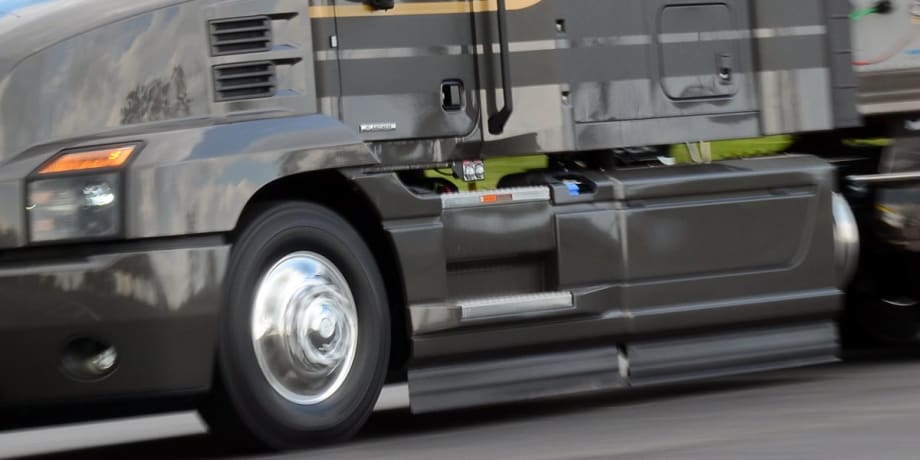
Why throw away $500 by mounting tires incorrectly or on a truck with mechanical problems? Look after your steer tires, and they will look after you.
Photo: Jim Park
Steer tires will cost you more money than any other tires on the truck, but their total lifecycle costs can be among the lowest — but only if you look after them from cradle to grave.
Starting with selecting the proper tire for the application and following up with frequent pressure checks, observing the tire for the first possible signs of irregular wear, and treating the casings like gold will keep those assets performing for miles and miles.
Here are six things to think about that may result in a longer, happier relationship with your steer tires.
1. Pick the Right Tire and the Right Pressure
Steer tires come in two load ranges, G and H. Typical load-range G tires have a weight limit of just under 6,200 pounds when inflated to 110 psi (this varies only slightly by brand). That imposes a steer-axle weight limit of 12,400 pounds if the tires are properly inflated.
Many fleets have a 100-psi-fits-all tire-inflation policy. According to the load and inflation tables, that would give you about 5,800 pounds per tire or 11,600 pounds for the axle. Many trucks today exceed that weight bobtail.
To accommodate the weight of today’s aero trucks with their big engines and aftertreatment systems, the weight rating of the steer axles at many OEMs is up to 13,200 or even 14,600 pounds. To get there, you’ll need a load-range H tire inflated to 120 psi.
In mixed fleets running trucks with both 12,000- and 13,200-pound axles, it would be easy to overlook the heavier axle rating — even more so if your maintenance service provider is in the habit of pulling any old steer tire off the rack and throwing it on the truck.
A sure-fire way to ruin a steer tire is to overload it or run it under-inflated, which are the same thing from the tire’s point of view. Tires do not respond well to under-inflation, so have your tire people do a survey of your trucks’ steer-axle weight ratings and compare it to the type of tire in use (load-range G or H) and then check the cold inflation pressure.
If you’re one of those fleets that chew through steer tires, this might be one of the reasons why.
2. Make Sure They’re Pulling in the Same Direction
If there’s a problem with the truck’s geometry, it will be revealed on the tread face of your steer tires. They are but two lonely sentinels guarding against 16 other tires that may have different agendas. All the tussling for directional control will take its toll in tread wear. Fortunately, astute observers can detect the problem with the stroke of a hand across the tread face.
Misalignment and/or bad steering geometry exiles thousands of steer tires to trailer positions every year, yet the problem is simple to detect and remedy. Running the palm of your hand across the tread face will reveal irregularities you may not yet be able to see. If you catch the problem early enough, you can probably save the tire.
Two technicians with a tape measure can roughly determine drive-axle parallelism and the distance from the center of the steer axle hub to the center of the drive axle hub. Any deviation in these measurements from the left side to the right side indicates there’s an alignment issue. That’s when the more drastic remedy of having the tractor professionally aligned should be considered.
A tape measure won’t reveal steering geometry issues such as improper toe or caster settings, but it’s still a reasonable triage procedure. It’s fast, easy, and cheap, and it can reveal problems that could cost you thousands. Annual alignments are almost always worth the perceived cost and inconvenience.
3. Be Finicky About Mounting and Installation
When you have a couple of hundred pounds of metal and rubber rotating at 500 rpm, any irregularities in balance or concentricity will be immediately obvious — at least to the rotating mass, if not to the driver. Getting the tire concentrically mounted on the rim can be a finicky process that few technicians take the time to get right. It can be verified by measuring the distance of the GG ring on the tire to the edge of wheel.
Any inconsistencies of more than 2 mm should be corrected before proceeding.
If the tire isn’t concentrically mounted, it will have an egg-shaped rotation, which will cause vibration and increased tread wear. This can be verified with a run-out gauge or a suitable substitute placed close to the tire. The gap between them and the tread face should be the same throughout 360 degrees of rotation.
A radial run-out condition can also result from the tolerances between the hub pilots and/or studs and the wheel. When first mounted on the hub, the wheel could be hanging on the studs or pilots, which can produce a non-concentric rotation. Stud spacers can help, or the wheel may just be worn out and ready to be turned into beer cans.
Lateral runout also can contribute to irregular wear. It appears as side-to-side movement of the rotating assembly. For a tire or wheel, its effect is to lead a vehicle alternately left and right as it rolls along, creating the perception of a shimmy or wobble. This, too, can be checked with a run-out gauge.
This is also why the mounting faces between the inside of the wheel and the hub must be cleaned of rust, flaking paint, and other debris before mounting the wheel.
Loose or improperly adjusted wheel bearings can also contribute to radial runout. The most obvious symptom here is excessive wear along the inside shoulder of the tire.
4. Pay Attention to Wheel Balance
Tire people will tell you that high-quality tires need not be balanced. However, when you mount that high-quality tire on a rotating assembly that includes an aluminum or steel wheel and a brake drum or rotor, there’s no guarantee the entire assemblage of parts that form the rotating mass will be perfectly balanced.
Installers can take care to align the yellow dot on the tire with the valve stem for balance. That helps, but only in a small way.
Accessories such as balancing rings or internal balancing compounds have shown good results at stabilizing the balance of the entire wheel-end assembly after installation. Anything that helps improve the balance and concentricity of the wheel-end assembly isn’t going to hurt tire life.
5. Monitor your Scrap Tires
No tire should ever be given up for scrap without first being thoroughly examined. As it comes off the truck, the technician should note the end-of-life mileage, unit number, and wheel position, as well as the reason for removing it: flat, damage, irregular wear, run-out, etc.
A tire with serious feather wear, for example, may be telling you that you have chassis or steering system alignment problem. Simply removing the tire without identifying the truck and the wheel position it came from guarantees the next tire installed there will experience the same problem.
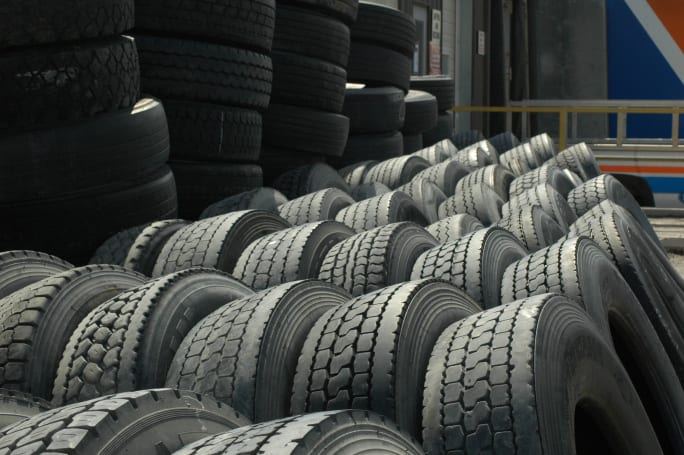
Scrap tire analysis will reveal why the tire came off the truck. If it’s damaged, it’s more likely a problem with the truck than the tire. Never scrap a tire without noting truck number, wheel position and the type of damage. It may save the next tire you install at that position.
Photo: Jim Park
The industry’s increasing reliance on data won’t help much more here. Everything you need to know about what killed your tire is right before your eyes.
6. Preserve your Casings
A quality truck tire casing can go on to be retreaded two or three times, so don’t chance ruining the casing by trying to squeeze every last 32nd of tread out of the tire. Most puncture flats occur below 8/32 or 9/32 tread depth, when the tread gets thin enough to let something through to the inner liner. Pulling tires before they get down to the DOT minimum improves their chances of surviving to fight another day.
Steer tires don’t wear themselves out. The wear that appears on the tire is almost always the result of some external force acting on the tire. To prevent or reduce that wear, you have to determine the problem. Diagnosing steer tire wear is mixture of art and science.
Note: The Technology & Maintenance Council of the American Trucking Associations publishes the Radial Tire Conditions Analysis Guide. It’s a comprehensive review of tread wear and tire removal conditions. The manual also includes probable causes for the conditions shown. It’s available for purchase through their website.
This article first appeared in the October 2021 issue of Heavy Duty Trucking.
More Equipment

How Volvo Updated Its D13 for EPA 2027 [Watch]
Volvo’s updated D13 promises lower emissions without sacrificing performance or fuel economy. Take a closer look at what changed inside the engine in this HDT Spotlight video.
Read More →
Michelin Tire Improves Efficiency and Durability for Regional Fleets
The Michelin X Multi Energy D2 is a regional haul drive tire engineered to help fleets improve fuel efficiency, durability and traction in demanding stop-and-go operations.
Read More →
ZF Expands Commercial Vehicle Push in North America
ZF is expanding its North American commercial-vehicle presence with new transmission applications, electrification, trailer technology and autonomous-driving systems.
Read More →
Tesla Wants a Self-Driving Semi. Are Cameras Enough?
Could Tesla’s camera-only autonomous driving technology work on an 80,000-pound Semi? In this commentary, HDT's Deborah Lockridge takes a look at Tesla, Cybercab, and how autonomous trucks see the road.
Read More →
Kodiak: Driverless Long-Haul Truck Launch on Track for 2026
Kodiak AI says its driverless long-haul safety case is 93% complete and it remains on track to begin commercial operations by year-end 2026.
Read More →
What DOT’s Automated Vehicle Strategy Means for Trucking
The U.S. Department of Transportation issued a new automated-vehicle strategy that outlines plans for driverless-truck regulations, cross-state freight corridors, and federal safety standards.
Read More →
East Coast Port Launches $45M Electric Truck Push
The Port Authority of New York and New Jersey announced millions in incentives for zero-emission drayage trucks, yard tractors, and new charging hubs near the port.
Read More →
PlusAI Going Public to Fund Autonomous Truck Launch
A SPAC deal could provide PlusAI with up to $300 million as it works toward a 2027 commercial launch of factory-built autonomous trucks.
Read More →
NHTSA Moves to Rewrite Truck Fuel-Economy Rules
The National Highway Traffic Safety Administration says it lacks authority to regulate medium- and heavy-duty truck engines separately from complete vehicles, but the existing standards have not yet been eliminated.
Read More →
Detroit Opens Orders for EPA 2027 Engines
Detroit isn’t starting from scratch to meet EPA 2027 diesel emissions standards. Its Gen 6 DD13 and DD15 engines keep much of today’s platform while updating the fuel and aftertreatment systems.
Read More →