




5 Secret Weapons for the Tire Shop
Maintenance experts share essential tools that ease the workload and keep the shop running smoothly.

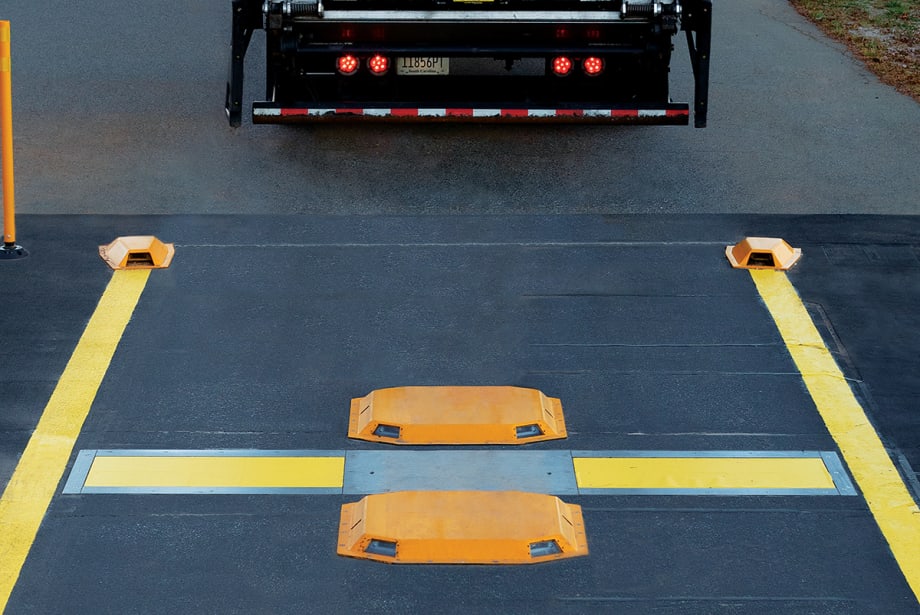
WheelRight’s tire pressure management system checks tire pressure and tread depth and checks for tire damage using in-ground pressure sensors and high-definition cameras.
Photo: Snider Fleet Services
Tools have been evolving ever since the first primates discovered a rock could crack nuts. Humans moved from a sharpened piece of stone to a metal hand-ax to a chainsaw.
So it is with tools for the tire shop. From simple tire irons and pressure gauges, we now have mount/dismount machines that automate the process. We have calibrated inflation systems that can fill eight tires at a time. There are even drive-through inspection bays that check inflation pressure, measure tread depth, and inspect for damage using cameras, sensors and machine learning.
With all that technology at our fingertips, which of all the tools in your tire crib is the most indispensable? We posed that question to a handful of maintenance execs and got some interesting answers.
1. Bead Seaters
“A good bead-seater tool is one that we couldn’t live without,” says Homer Hogg, director of technical service at TravelCenters of America. “When this tool is in good working condition, it dramatically improves productivity and safety along with helping to ensure the beads are properly seated on the rim.”
The brand TA uses, the Bead Bazooka from Gaither Tools, uses a proprietary trigger release mechanism called a RAR (Rapid Air Release) valve. The company says the device can release air much faster than other bead seaters, so it’s smaller than competitive products while delivering good bead-seating performance. There are several models available, depending on the application.
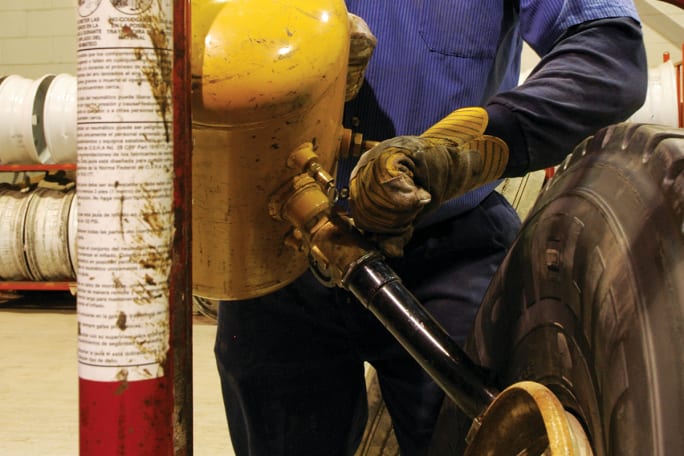
Bead-seating tools provide a localized blast of air that causes the tire casing to expand, quickly seating the tire bead against the rim flange.
Photo: Jim Park
There are a many other bead-seater devices on the market, and they are used by most tire shops these days. They aren’t terribly expensive, but that doesn’t stop some people from cutting corners. Just check out some videos of homemade bead seaters on YouTube. Many are made from barbecue propane tanks with makeshift valves and lots of DIY welding. A homemade bead seater might be safer than using starting fluid, but just barely.
2. Torque Wrenches
While not high on the list of sexiest tools, torque wrenches are a must-have in the tire shop. They are required for wheel-bearing adjustment and of course for tightening wheel fasteners. There’s a fine line between too tight and not tight enough. It’s not good enough to simply reef down on the nuts with an extension bar. Applying too much torque can stretch the studs, which will inevitably lead to the nut backing off and the loss of clamping force. In this case, too much torque can be worse than insufficient torque, because overtightening creates a false sense of security.
“I know it sounds cliché, but the most valuable tool in our shop is a properly maintained and calibrated torque wrench,” says Jeff Katz, fleet manager, Dayton Freight Lines in Toledo, Ohio. “Our primary tire torque wrenches are ‘break-over’ type, like the Norbar 4R model. These are very useful in a noisy environment where the ‘click’ from a typical torque wrench might not be heard.”
Calibrated is the operative word here. Any long-handled wrench can get you close, but some precision is required for wheel fasteners. Torque wrenches should be calibrated regularly.
For fleets with deeper pockets, electronic torque wrenches provide precise torque measurement and an electronic record of the tightening event.
3. Regulated and Calibrated Shop Air
Another must-have shop tool is a master gauge and service gauge checking station. These can be fabricated easily enough or purchased pre-assembled from most tire supply and equipment companies.
“This is not a big expense, nor does it take a lot of time to check service gauges,” says Peggy Fisher, president of cloud-based tire pressure monitoring and tire management service TireStamp. “However, checking their accuracy on a regular basis will ensure the quality of the service work technicians perform remains high.”
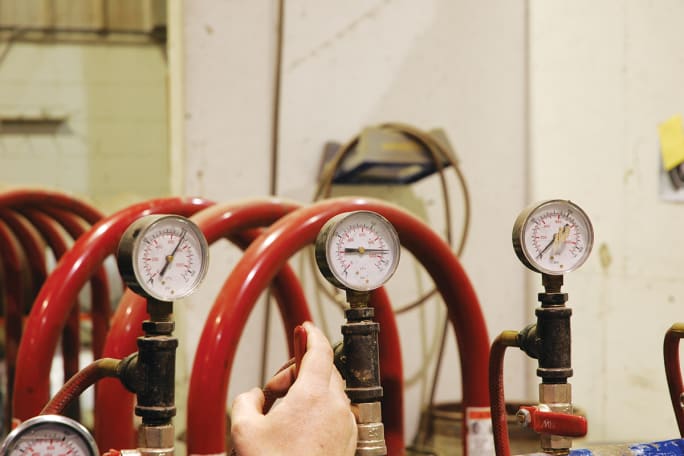
Calibrated spider air lines allow the inflation of multiple tire simultaneously to the same pressure, reducing irregular wear resulting from mismatched pressures in dual wheels.
Photo: Jim Park
Since proper inflation is vital to the health of tires, having tools that ensure it is correct is necessary, says Fisher. “When gauges are found to be off by 5 psi or more, they should either be recalibrated or replaced.”
Fisher is also a big fan of the “spider” style of drop air-line, attached to a regulator that has four airlines on it with clip-on chucks. It can inflate four tires at a time on one side of a vehicle. These are also offered in mobile hand carts that can be set up outside the shop doors. They are commercially available from companies such as Ken-Tool.
“One on each side of a trailer bay should be used so that the technician can hook them up to all eight tires on a trailer and walk away to check the lights, brakes, etc., while the tires are being topped off,” she says. “This guarantees that all the tires are inflated to the same pressure, which eliminates irregular wear caused by different pressures in dual tires.”
4. Tire Irons
Doug Lloyd, director of maintenance at Averitt Express, told HDT that while the company’s larger tire shops use dismount/mount machine and wheel/tire balancers, the smaller shops still use tire irons, specifically the Golden tire tool.
The Golden tools are designed with ergonomics in mind, minimizing possible strain injuries and making the dismount and mount task safe and easy without risk to the tires. Company literature claims tubeless tires can be demounted in as little as eight seconds and remounted in less than 20 seconds.
Danny Schnautz, operations manager at Clark Freight Lines of Pasadena, Texas, says basic tire tools such as an inflation cage and a good set of tire irons are his most valued tools. “You can’t do a proper repair without them, and their basic design has not changed in years,” he says. “Finding a set with just the right feel and curve is very valuable to the tire technician, as he will be using them all day long. Ask the techs what tool they like to use and buy them what they want.”
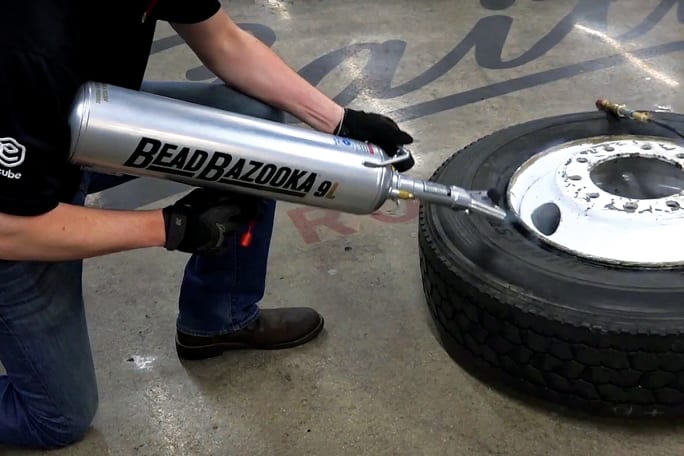
The Bead Bazooka’s trigger release mechanism allows operators to maintain a safe distance and provides an instant release of compressed air.
Photo: Snider Fleet Services
5. Drive-Thru Tire Triage
Taking tire maintenance to the next level and beyond, Mike Palmer, vice president of fleet services at Estes Express Lines, thinks he might have found the Holy Grail of tire tools, WheelRight’s Tire Management System.
It’s an in-ground installation that checks tire pressure and tread depth, checks for tire damage, and most importantly to Palmer, doesn’t require RFID chips, branding or any add-on tracking devices.
Using an array of in-ground pressure sensors and high-definition cameras and strobes that photograph all the tires on the truck from several different angles, the collected data is run through a machine-learning algorithm that produces a report in a matter of seconds.
The truck drives over the installation at 10-15 mph and gets a red light or a green light immediately afterward. Green is good to go. Red means there’s an issue, and in Palmer’s case, drivers are instructed to head to the tire bay, where the report is already in the technician’s hands as the driver pulls up to the door.
“The system doesn’t track individual tires, instead it records wheel position by unit number or license plate,” says Palmer. “We have installed the system on inbound lanes, so we know as soon as a truck arrives on the yard if it has a tire problem that requires attention.”
WheelRight is based in the United Kingdom and sold and serviced here by Snider Fleet Solutions. Snider VP of Sales Keith Allen says the ROI on such a system works for almost any fleet with 100 trucks or more.
More Maintenance

Color Match Smarter: Tools That Restore & Perform
For fleet managers and collision repair professionals keeping heavy-duty trucks on the road, getting the color right the first time isn't just about appearance — it's about efficiency, turnaround time, and bottom-line results. Discover how today's digital color tools are transforming the repair process from guesswork to precision.
Read More →
Wrong Repair Prompts Recall of Freightliner, Western Star 4x2 Trucks
DTNA is recalling more than 2,400 trucks that received an incompatible software fix instead of the hardware repair required to address brake valve corrosion.
Read More →
Truck Drivers Need More Than Another Alert
Fleets have more visibility into truck health, safety events, and driver activity than ever. The next challenge is turning all that information into useful guidance for the person who has to decide what to do next.
Read More →
The Maintenance Checks Trucking Fleets Should Prioritize Before Fall Freight Picks Up
Making it through August isn’t the same as being ready for the next several months of operation. Find out what systems may have suffered from summer heat and need to be checked out before fall.
Read More →
What Three Fleets Are Doing Differently When Buying Truck Parts in 2026
With freight improving but costs still climbing, fleet maintenance executives explain how they're balancing price, quality, and supplier relationships.
Read More →
Paccar Recalls 2027 Trucks Built This Summer for Possible Electrical Problem
The nearly 6,000 Kenworth and Peterbilt trucks in the recall could potentially lose engine power, among other things.
Read More →
Will API PC-12 Oil Change Trucking Fleet Maintenance?
The new API PC-12 heavy-duty engine oil category reflects the changing demands of modern diesel engines. But fleets like Foodliner are looking to getting their own data before making decisions on adopting the new oils and questions such as extending oil drain intervals.
Read More →
Brake Safety Week to Focus on Drums and Rotors
Commercial vehicle inspectors are focusing on truck brakes during CVSA's Brake Safety Week, August 23-29.
Read More →Possible Battery-Cable Fires Prompt Recall of 15,000+ International MV and HV Trucks
On the recalled vehicles, manufacturing variations can cause the battery interconnect cable to contact the auxiliary stud and hold down the bracket.
Read More →
Rush, MCT Team Up to Grow Refrigeration Service Network
The joint venture will operate MCT's network of Carrier Transicold dealerships and mobile service locations, with the companies promising greater service capacity and uptime for refrigerated fleets.
Read More →