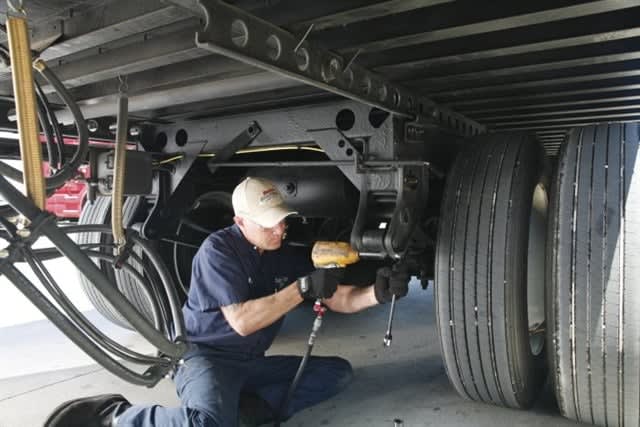
All bolts must be properly tightened and periodically checked for proper torque. Telltale signs of loose fasteners include shiny areas and weeping rust around them. Photo: Reyco Granning
6 min to read
All bolts must be properly tightened and periodically checked for proper torque. Telltale signs of loose fasteners include shiny areas and weeping rust around them. Photo: Reyco Granning
Managers spend a lot of time tending to engines, fuel use, brakes and tire wear, as they should. But too often they and their technicians ignore suspensions, a major truck and trailer component that’s subject to considerable wear and tear. We contacted several suspension makers and asked them which suspensions are most often overlooked.
Ad Loading...
1. Improper parts replacement
“I see more issues with people who didn’t replace stuff correctly: bushings, repairs, whatever, it’s done wrong and they can’t understand why it didn’t perform as expected,” says Bill Simmons, retired field service and warranty manager and now a consultant, with 51 years at Reyco Granning. “They didn’t re-torque the fasteners correctly, didn’t clean the area before putting in the parts. Ninety percent of the time they didn’t install them correctly, and they didn’t read the instructions.”
Suspension manufacturers offer maintenance and replacement instructions on their websites, he notes.
Ad Loading...
In addition, normal wear items are commonly overlooked, Simmons says. Nylon washers or beam spacers insulate hangers from trailing beams on most brands of air-ride suspensions. On steel-spring suspensions, there are wear pads between hangers and springs themselves. All these wear out, and a steel-to-steel situation develops. If these insulators, as he calls them, are not part of regular maintenance, they lead to the more expensive replacement of the arms, springs and whatever else has been worn.
2. Improper torqueing of fasteners
Improper torque is very common, on both trucks and trailers, says Skip Martens, corporate technical training manager, who’s been with Hendrickson for 46 years. “[Technicians] just don’t do it. [Maintenance managers] don’t put it in the preventive maintenance schedule. And if you don’t write it down, they don’t go in and do it.
“Once something gets loose, it begins wearing out the flat interface between the fastener and the component. Once it starts, it just gets worse. In one case I saw with a vocational truck, they were torqueing fasteners every morning on a mixer truck, just so the truck could go out and haul concrete that day. It’s scary.”
U-bolts that secure axles to suspensions are often found to be less than secure. As a brand-new truck is driven or towed from the factory to a dealer or customer, the U-bolts are among the things that “settle in” and the U-bolts relax slightly, Martens says. Dealer mechanics should catch this but often don’t — something discussed during a Fleet Talk session at the recent fall meeting of the Technology & Maintenance Council of the American Trucking Associations. So checking torque on U-bolts should be part of the pre-delivery inspection done by fleet technicians.
“Do a visual inspection,” Martens adds. Two signs of a fastener being loose are polishing around the fastener and bright orange weeping rust around the connection.
Ad Loading...
3. Movement in places where it’s not supposed to occur
“A mechanical suspension moves — rubber bushings, rockers, springs — and it has a finite life,” says Russ Brazeal, vice president of engineering at Hutchens Industries, where he’s been for 43 years. “Movement is in the bolted areas, radius rod connectors, adjustments in the rods themselves, U-bolts — none of those is supposed to move. When they do, things wear out. [Maintenance personnel] ought to re-torque the fasteners just out of habit. Visual movement comes after the fact and you need to prevent that.”
People don’t tighten and re-torque the bolts like they should, Brazeal says. They’re often hard to get to, some of the torque loads are pretty high (350 to 540 foot-pounds and more), and it’s a dirty job. Access to some of the nuts can be tricky, depending on which way the bolts are put in – facing the wheels or the inside of the suspension. Rubber wears out and sometimes the vehicle has to be jacked up to take weight off the suspension to see properly.
Several years ago Hutchens replaced standard bolts with huckbolts to secure the equalizer, or rocker, between axles, and in this application they’ve held up well.
4. Axle alignment
“One of the most important and commonly neglected maintenance items is checking and re-aligning your axles, says Jason Heath, product manager, Powered Vehicle Systems, with SAF-Holland. This should be done two times per year, he says, noting that periodic preventive maintenance of your suspension will lower your tire and fuel expense.
“In addition, axles properly aligned allow a driver to focus on driving rather than correcting the steering wheel. This is a factor that can impact safety as well as employee satisfaction,” Heath says. “Ill-handling vehicles are a reason for a driver to quickly start looking for employment at another company.”
Ad Loading...
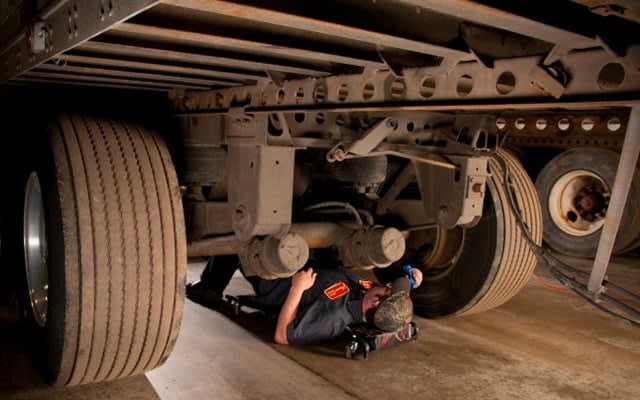
Technicians sometimes shy away from suspension inspections and maintenance because parts are hard to see and get at, high torque values take muscle to apply, and it’s a dirty job. Photo: SAF-Holland
Handling U-Bolts
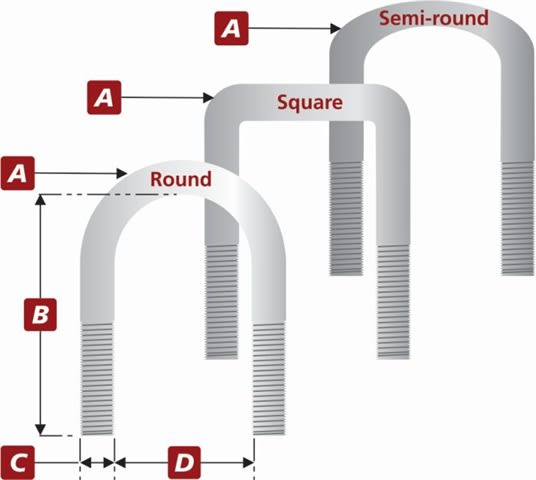
U-bolts secure axles to suspensions and are thus critical to function and safety. They need to be properly torqued, of course. And if replaced, the correct parts must be used. Hendrickson says these specifications are required to obtain the correct U-bolt:
A U-bolt’s shape must match the contour of the axle or axle carrier, and be strong enough for the application. Graphics: Hendrickson
Type of bend (round, semi-round, square, etc.)
Length of legs (from inside highest point to end of thread)
Thread size and pitch (fine thread UNF, coarse thread UNC)
Width (inside legs)
Grade (usually SAE Grade 5 or 8)
Rolled threads vs. cut threads
A rolled thread provides better thread structure than a cut thread. Rolled threads also have a better surface quality, allowing applied torque to go directly to clamping force.
Match all fasteners
Always match the grade of the fasteners and U-bolts. If using a Grade 8 U-bolt, attach a Grade C locknut. Using a lower grade locknut will not tighten to a sufficient clamp force to maintain the proper clamp loads and can fail pwwrematurely. Always use hardened steel or high-tensile flat washers. A mild steel washer can compress when tightened and subject the bolt to vibration and fatigue, and allow the joint to loosen. If using flange fasteners, where a washer is not needed, remember they require a different torque value than a washer and locknut.
Flange fasteners vs. locknuts and washers, as well as fasteners with different coatings, have different torque values. Due to the larger-diameter bearing surface, flange headed bolts require a higher tightening torque because more torque is lost by friction.
Ad Loading...
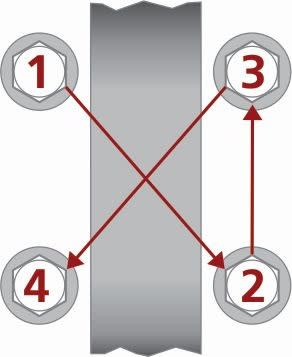
U-bolt nuts should be tightened in this sequence and at the proper torque, often in increments. Shaded column is the axle.
Use the right tool
Ensure that a calibrated torque tool is used and that a torque value is specified. Be aware that certain automatic tightening tools can result in variations in torque value and preload of bolts. Avoid this by using a calibrated torque tool for the final tightening torque.
Understand that…
Maintaining proper torque at all times is key for suspension performance, durability and safety.
Over tightening U-bolts can be just as damaging as under tightening.
Under tightened U-bolts can cause damage to mating components.
To achieve a uniform U-bolt tension, the locknuts should be tightened in a crisscross pattern in 50-pound increments. A good tightening sequence ensures that an even preload distribution is achieved in the joint.
Fleets report higher lubricant costs as Middle East disruptions tighten supplies of ingredients used in synthetic engine oils and some driveline lubricants.
New CL-4 and FB-4 formulations will begin arriving in early 2027, with improved protection against oil breakdown, wear and deposits, according to Shell.
The repair invoice is the first number you see — and often one of the smallest. Here’s what else an out-of-service order can cost a fleet, and how planning can reduce the damage.
Continental says its new Generation 5 steer and drive tires for regional operations offer longer tread life, with estimated mileage gains of 22% and 19%, respectively.
The technician shortage isn't going away, and no single fix can close the gap on its own. Trent Broberg makes the case that AI's real job in the shop is protecting the billable hours and job satisfaction of the techs you already have, not asking them to work faster.
For fleet managers and collision repair professionals keeping heavy-duty trucks on the road, getting the color right the first time isn't just about appearance — it's about efficiency, turnaround time, and bottom-line results. Discover how today's digital color tools are transforming the repair process from guesswork to precision.
DTNA is recalling more than 2,400 trucks that received an incompatible software fix instead of the hardware repair required to address brake valve corrosion.