




$350,000 on Hand Sanitizer: How Werner is Responding to the COVID-19 Pandemic
How one of the country's largest transportation and logistics companies is responding to the challenges of COVID-19 pandemic, from free telemedicine and distributing personal protective equipment, to a voluntary pay cut for senior management. An interview with Derek Leathers of Werner Enterprises.

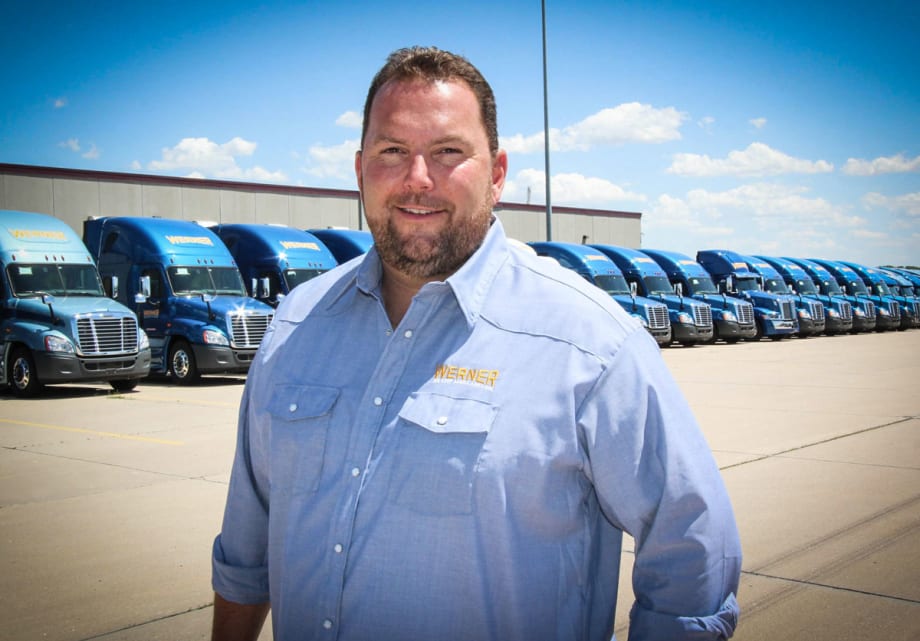
Derek Leathers, president and CEO of Werner Enterprises, says drivers have been emailing him photos of bills of lading because they're proud of the work they're doing delivering needed COVID-19 supplies.
Photo: Werner Enterprises
Derek Leathers’ first indication of the potential disruption of what would become the COVID-19 pandemic came on a personal level. His daughter was studying abroad in Spain, which saw its first resident test positive for the virus on Feb. 26.
“That was a few weeks ahead of when we started seeing a major appearance of the virus in the U.S.,” says Leathers, who is president and CEO of Nebraska-based Werner Enterprises. “So I was kind of working through that on more of a personal level – and then it didn’t take long to realize that as this comes toward our shores it could be very disruptive.”
So in late February or early March, he says, Werner, one of the nation’s largest transportation and logistics companies, had its first meetings to talk about contingency planning for what was then being referred to as the coronavirus.
Unlike a lot of companies, Werner actually had a pandemic plan in place from the H1N1 flu pandemic in 2009. “So you start with what you know and what you've done previously, and then adapt based on this particular virus being much more contagious and obviously much more aggressive,” Leathers says. In addition, Werner benefited from its experience in emergency response. “We actually have an entire vertical of our company called emergency and surge event management. So we have a lot of tornado, natural disaster and other type of emergency response experience. The difference in this one is that it's much more widespread.”
In developing its plans and response to the pandemic, Leathers says, “I think one of the most important things is to develop, what’s your compass or your true North going to be through the crisis.”
Leathers asks his team to “imagine that their mom is in every truck."
Werner’s goal, he says, was to make decisions based on data and logic, but above all on compassion. “I've found it to be helpful, because there's very difficult decisions you have to make on very short timelines. And if you kind of keep that ‘above all, compassion’ in context and you really live those words, it makes some of those decisions easier.”
Leathers says he asks his team to “imagine that their mom is in every truck and, and really try to take that visual to heart when you're making tough decisions, whether it be on sanitation equipment or our response to any drivers that needed time off or in a few rare cases we have had some positive tests. What’s our empathy look like in that situation, and what’s our financial support, our physical and emotional support… what's that whole process look like?”
Taking Care of Drivers
Early on, Werner established a COVID-19 hub on its intranet and set up an email and phone hotline to its COVID-19 task force so someone would be on the other end of the line walking drivers through any concerns. The company waived the copay on telehealth so drivers or other employees could access it at no cost.
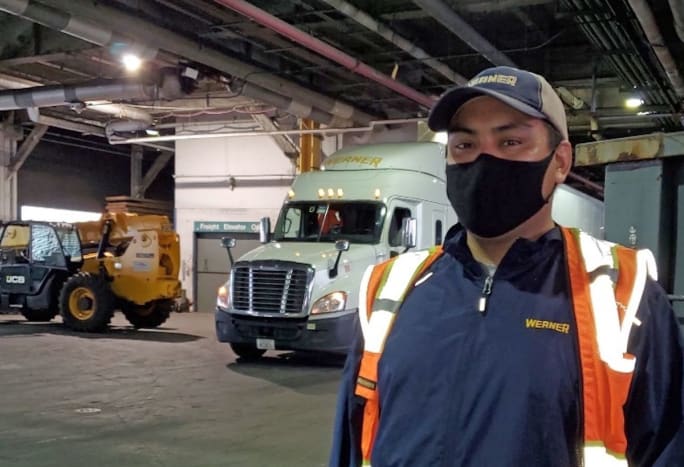
A professional driver for Werner Enterprises delivers goods to those working on COVID-19 relief efforts.
Photo: Werner Enterprises
But if a driver gets sick on the road with possible COVID-19 symptoms, Leathers acknowledges, “the logistics are hard. It is not easy if you have a situation where a driver was to test positive. You can't go buy a plane ticket to get them home. You can't rent a car to get them home. It’s difficult to find accommodations to put them up in. And so you really have to have kind of a thoughtful response plan. And it is literally case by case, because every one of those situations will be so different.”
Communication has been a big focus, as well. Leathers has been doing videos at least twice a week, some of which are internal, some of which are posted on social media, to help keep drivers and their families informed. “The point was constant communication to the fleet so that they were aware of what was happening.”
One of the biggest messages, he says, has been the importance of social distancing. “Just keeping your distance from those around you is critical. So we do that with electronic reminders, video reminders, heartfelt stories that they can watch, to just try to keep it in front of mind all the time.”
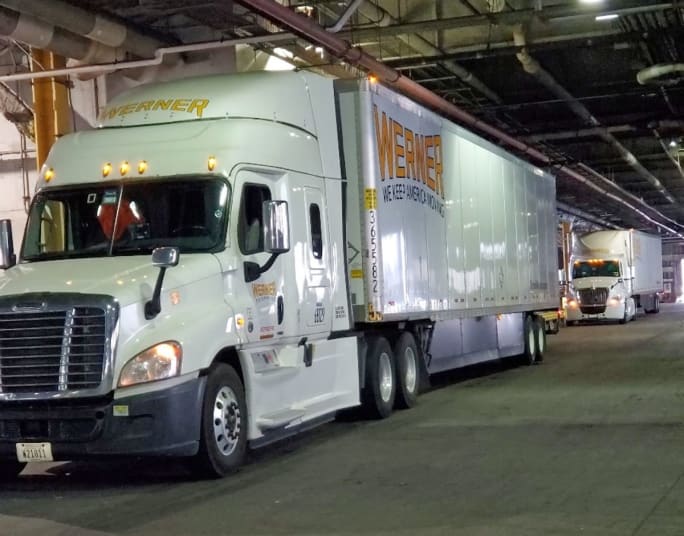
Werner’s fleets deliver bottled water to Atlanta to support United Way as they fight COVID-19.
Photo: Werner Enterprises
Drivers are also reminded about ongoing cleaning and sanitation of high touchpoints in the cab, not just steering wheels and door handles, but also trailer doors and gladhands, and about being very careful during the fueling process. While truck stops have stepped up to help keep fuel islands clean and sanitized, “at the end of the day you've got to own it individually and make sure you don't assume else has done their work,” Leathers says.
One of the challenges has been making sure drivers have what they need to protect themselves. Necessities such as hand sanitizer “were extremely hard to come by even early on,” he says. “We probably overbought and over distributed early, but it turned out to be every ounce was needed. We've already now replenished in three waves since then.”
Werner since has been able to get more sanitizer in bulk packaging, as it has worked with a couple of local distilleries that have switched to producing hand sanitizer.
Masks are another challenge. When we spoke in mid-April, Leathers said, the company was in the process of distributing 40,000 masks to associates. In the early days, before the CDC recommended everyone wear masks, the company focused its efforts on mask distribution to drivers in areas that were hotspots for virus transmission.
Other Employees
Drivers, of course, are not the only employees affected by the pandemic. Werner currently has about 60% of its associates around the country working from home. It started with those who were high-risk or had high-risk family members, or small children or elderly family members to take care of. As the weeks have progressed, the number of people telecommuting has increased. Those still in the office – which includes Leathers, who says he had been throughout the crisis as an example – are operating with greater social distancing than the CDC-recommended minimum of 6 feet.
Shop technicians, on the other hand, can’t work from home. Werner has assigned mechanics to specific bays, which has slowed down productivity in the shop, and sanitizes equipment before they work on it. If a driver leaves the company, the truck goes into a 72-hour quarantine before being sanitized and reassigned.
It appears that all of these measures are paying off. As of our interview, Leathers said, only 11 company employees had tested positive for COVID-19 – out of nearly 14,000.
COVID-19 Impacts Werner Business
As supply chains have been scrambled by stay-at-home orders, closures of manufacturing plants, cancellations of events, etc., “our network has been turned upside down over the last four weeks,” Leathers says.
In normal times, he explains, “truckers rely on balance and planning above all else. You have to have a balanced network, you have to have proper optimization, and you have to have proper planning.”
The COVID-19 crisis has meant that Werner has seen volume from some customers drop by 50-90%. “Fortunately for us, we have a larger population of customers whose volumes were actually up during the initial surge of relief supplies, medical equipment and consumer staples.” One problem, however, is while there’s a lot of freight going into hotspot areas, there’s very little freight coming out of them.
In addition, as that initial surge has slacked, “Freight is slowing, there is no question.
“There's only so much toilet paper or paper towels a person can actually buy and store. And as that has tapered off, there isn't some obvious replacement for that freight when you have the majority of the economy shut down right now. So volumes are tapering off, I suspect they will taper further. I think the second quarter will be very, very challenging.”
Werner has been taking measures to operate as lean as it can, including the executive officers and senior vice presidents voluntarily reducing their base salaries – Executive Chairman Clarence L. Werner will reduce his annual base salary for the rest of 2020 by $250,000, and Leathers will reduce his base salary by 25%. The remaining executive officers have elected reductions of 15% each, and the senior vice presidents 10% each.
“We have done a pretty good job of eliminating any and all expenses that are not directly related to serving our customers safely and on time and protecting our drivers and associates throughout the process,” Leathers says. “I think we've spent over $350,000 on sanitizer already, so certain costs are going to be up.”
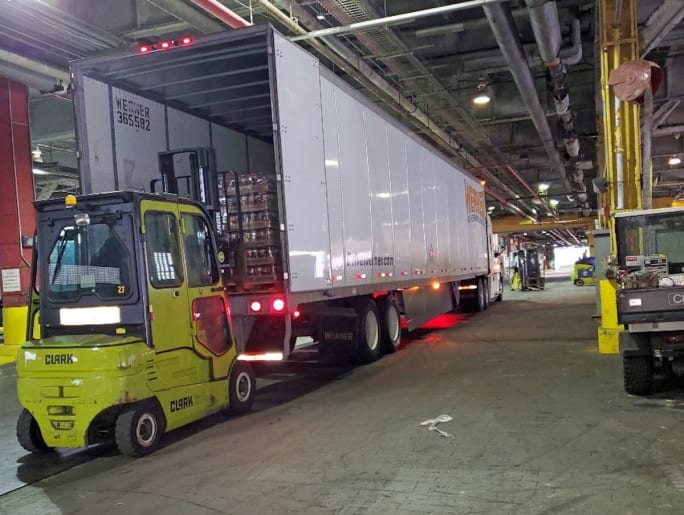
Werner’s dedicated fleets deliver three trailers full of Powerade to service members, first responders and volunteers of the USO in New York City, who are helping fight COVID-19.
Photo: Werner Enterprises
Werner is also supporting drivers with two weeks’ pay if they are impacted by the virus. It has pledged $1 million to a COVID relief fund “to do what's right by people that may be more impacted than others” to be able to go above and beyond that two weeks for some drivers.
“We are going to do everything we can to hold this organization together, because on the other end of this, when we get the economy back, when things start to grow, customers are going to expect to be able to ship, and we want to be ready and prepared to do that.”
How Will COVID-19 Change Things?
Looking forward, Leathers says, there are some learnings to be had from this crisis.
“I think companies across the country have woke up to the reality that there probably are more work-from-home options than we ever realized. And that technology has come a long way. I think the opportunity to provide more workplace flexibility will likely increase as a result of this,” not just in trucking, but across many industries.
“I think the most important learning in my view is that the country's woke up to the reality that the American truck driver matters,” Leathers says. “It is awesome to see the amount of gratitude and thanks and respect being shown to the American truck driver right now through this pandemic.”
More Fleet Management

Color Match Smarter: Tools That Restore & Perform
For fleet managers and collision repair professionals keeping heavy-duty trucks on the road, getting the color right the first time isn't just about appearance — it's about efficiency, turnaround time, and bottom-line results. Discover how today's digital color tools are transforming the repair process from guesswork to precision.
Read More →
FMCSA Pauses Biennial-Update Enforcement Amid Motus Transition
Carriers whose updates were due on or after June 1 have more time, while FMCSA works to stabilize its new registration system and warns of phishing sites impersonating its new carrier registration system, Motus.
Read More →
2026 Blueprint for Countering Smarter Supply Chain Theft
Cargo theft is no longer just the cost of doing business. It's a multi-billion-dollar criminal enterprise exploiting vulnerabilities across your fleet, drivers, and supply chain.
Read More →


How Telematics Improves Visibility, Control, and Performance in Refrigerated Fleets
Explore how telematics help refrigerated fleets improve visibility, uptime, efficiency, compliance, and cargo protection across connected cold chain operations.
Read More →
What the U.S.-Canada Trade War Means for Trucking
Escalating U.S.-Canada tariffs could disrupt cross-border freight, reduce truck volumes, raise costs, and create new uncertainty for carriers on both sides of the border.
Read More →
What Are Trucking’s Top Concerns for 2026?
The American Transportation Research Institute wants to know what's worrying trucking fleet managers, drivers, and other stakeholders in its annual Industry Issues survey.
Read More →
American Trucking Associations Looks for a New Leader
ATA President and CEO Chris Spear abruptly left his job at the association on August 21, at a pivotal time for the trucking industry.
Read More →
Public Wi-Fi Cybersecurity Risks: How Truck Drivers and Fleets Can Protect Their Data
Public Wi-Fi can expose truck drivers and fleets to credential theft, malware, and other cyber threats. Here’s how to reduce the risk on the road.
Read More →
For Nicky Cupp, Fleet Innovation Starts With Frustration
HDT Truck Fleet Innovator Nicky Cupp turns everyday pain points at Fraley & Schilling into opportunities for better technology and smarter processes.
Read More →
Adam Buttgenbach’s Approach to Electric Trucks: Start With Where They Fit
HDT Truck Fleet Innovator Adam Buttgenbach helped PepsiCo build one of North America’s largest EV fleets by focusing on where electric trucks make operational sense.
Read More →