




Related: ATA, TMC Announce First-Ever National Technician Appreciation Week
3 Ways Fleets Can Solve a Technician Shortage
Frustrated with the quality of technician talent your local school is churning out? Maybe you need to get more involved with the school to help solve the problem, rather than blaming the training providers and its graduates.
by James Menzies, Today’s Trucking
September 18, 2020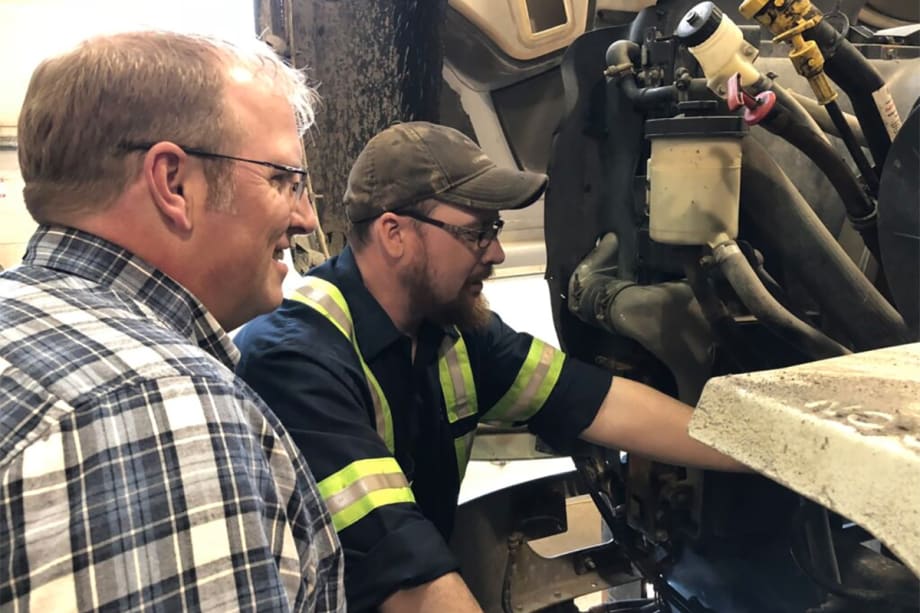
Photo: James Menzies
6 min to read
Frustrated with the quality of technician talent your local school is churning out? Maybe you need to get more involved with the school to help solve the problem, rather than blaming the training providers and its graduates.
That was a message during a panel discussion at the Technology & Maintenance Council’s fall meetings, on Supporting education to help resolve your technician shortage. Panelists included: Brad Kuykendall, CEO of Western Technical College; George Arrants, vice-president of the ASE Education Foundation; Kenneth Calhoun, fleet optimization manager, Altec; and Eric Benge, senior manager of fleet maintenance with Walmart’s supply chain division.
They all urged technician employers to become more engaged with their local training institutions to help guide them on industry requirements and ultimately to turn out better-prepared technicians.
Supporting Your Local Vocational Schools
“If you’re not involved with your local school, you are part of the problem,” Arrants blasted. “Our needs are constantly changing. We need to manage expectations and the only way to do that is to be involved. It’s not somebody else’s problem – it’s everybody’s.”
One way companies can support schools is by providing access to equipment – but there’s a risk in doing so. Calhoun recalls donating a piece of equipment to a local school, only to find it still being used 22 years later.
“Lo and behold it was still in active inventory,” he said of the discovery during a site visit. “I’m not sure what value comes from working with technology from the previous century.”
To prevent this, Calhoun suggested equipment be loaned – not donated – with an accompanying agreement that lays out the length of the loan, and when it will be reviewed for a possible year-long extension. This keeps schools from continuing to train on obsolete, outdated equipment.
But Kuykendall said equipment loans or donations are extremely valuable for training institutions.
“Equipment costs with the increase in technology have increased substantially,” he pointed out. “It makes it extremely difficult for some schools to provide updated training. Some are training on equipment from the 90s we just aren’t seeing anymore.”
He urges fleets to donate damaged vehicles, and says schools can also partner with OEMs to secure access to equipment.
“Working with an OEM can be a wonderful partner,” he said. “The educational institution gets access to some of that training equipment, the fleet manager or dealership is getting better qualified graduates, and students are winning because they have better training equipment to work on.”
Calhoun said equipment can be rotated through a school if fleets are aware in advance of what skills will be taught and when. When loaning equipment, take advantage of the opportunity to visit the school and engage with the students, he suggested.
Get Involved with Your School's Program Advisory Committee
Get involved with your local school’s Program Advisory Committee (PAC), urged Calhoun.
“If you want to see change, you need to be a part of that change,” he said. The PAC should be led by someone from industry – not the training institution – and it’s up to them to guide the school on what employers need from graduates.
Calhoun said copious notes should be taken during PAC meetings, and minutes presented at the beginning of each meeting. Schools need to act on PAC recommendations, or be held accountable.
“It ensures your input is valued and being taken into consideration and used to improve the programs,” Calhoun said.
Arrants said PAC chairmen should be people of importance in the community, such as trucking company owners.
“Don’t pick just anyone from industry to be a PAC leader,” he said. “Find someone who has importance in the community.”
For PAC leaders, Arrants said to “determine what you expect to get out of that meeting and create the agenda backwards.”
Calhoun suggested ending PAC meetings with a tour of the shop. And he added one of the PAC’s objectives should be to push educators outside their comfort zones.
“My mission in life is to geofence their comfort zone and not ever let them back in it,” he said. “You can’t leave educators to figure this out on their own. You have to be the voice that drives that change.”
Arrants suggested inviting former students into PAC meetings, so they can provide feedback to help improve the program.
From the school side of the equation, Kuykendall said decision makers from campus should be involved, to show their commitment to the program.
Supporting Future Heavy-Duty Truck Technicians in High School
In addition to supporting the training providers, trucking employers should also engage students – even before they reach the post-secondary education level.
“If you wait until they reach community college, they may never get there,” said Arrants. “You need to be looking at your local high school.”
High schools may not have a diesel program, but many offer automotive shop classes, and Arrants said studies have shown 18% of those students in automotive programs want to work on trucks and heavy equipment.
“Let’s not overlook the diamond in the rough – the automotive programs in your community,” he said.
Kuykendall noted many students struggle to obtain funding to pursue their post-secondary education, and urged industry to support them with financial aid or tuition reimbursement.
“It really impacts many of the students who could turn into be superstar technicians,” Kykendall said of the cost of post-secondary education. Sometimes, he added, the school will match scholarships offered by employers. Helping to pay for an aspiring technician’s education will instill loyalty if they are hired upon graduating.
Calhoun said if industry doesn’t invest in its future talent, it will be impossible to attract the right talent.
“People in our industry complain, if they could only find employees who can pass a drug screen and show up on time. Can we set the bar any lower than that? We should recruit for character and teach for skills,” he said. Investing in future talent is less expensive than the cost of bad hires, he added.
Manage New Technician Expectations In Your Fleet Shop
Walmart’s Benge said it’s important to engage students and manage their expectations. Too often employers expect a star technician to show up on day one, while new hires expect to be tearing down engines and transmissions right from the start.
“After a few PMIs, wheel seal replacements and brake jobs, they are off chasing another dream and ultimately, we both lose,” he said.
For Benge, his reaction to this problem was initially to blame the new hires and the training providers. But then, when discussing the issues with peers in industry associations, he came to realize the employers have to tackle the issue themselves.
“The turning point for me was engagement in our local trucking association and truck training committees,” he said.
Benge also emphasized the importance of internship programs. At Walmart, the current program is in its fourth year.
“A solid internship program can move you closer to the front of the line and give the student an opportunity to learn more about your organization and opportunities prior to making a long-term commitment,” he said.
Kuykendall said internship programs are a great opportunity for shops to “try before you buy.”
“You want to make sure not only is that individual competent in their technical field, but also a good cultural fit,” he added. “You can have a phenomenal technician in the shop but if they don’t fit into your culture there’s going to be a lot of butting of heads and aggravation on both sides.”
James Menzies is the editor of Today's Trucking, where this article originally appeared. This content was used with permission from Newcom Media as part of a cooperative editorial agreement.
Subscribe to Our Newsletter
More Maintenance

Sponsored•September 16, 2026
Color Match Smarter: Tools That Restore & Perform
For fleet managers and collision repair professionals keeping heavy-duty trucks on the road, getting the color right the first time isn't just about appearance — it's about efficiency, turnaround time, and bottom-line results. Discover how today's digital color tools are transforming the repair process from guesswork to precision.
Read More →
Wrong Repair Prompts Recall of Freightliner, Western Star 4x2 Trucks
DTNA is recalling more than 2,400 trucks that received an incompatible software fix instead of the hardware repair required to address brake valve corrosion.
Read More →
Truck Drivers Need More Than Another Alert
Fleets have more visibility into truck health, safety events, and driver activity than ever. The next challenge is turning all that information into useful guidance for the person who has to decide what to do next.
Read More →
The Maintenance Checks Trucking Fleets Should Prioritize Before Fall Freight Picks Up
Making it through August isn’t the same as being ready for the next several months of operation. Find out what systems may have suffered from summer heat and need to be checked out before fall.
Read More →
What Three Fleets Are Doing Differently When Buying Truck Parts in 2026
With freight improving but costs still climbing, fleet maintenance executives explain how they're balancing price, quality, and supplier relationships.
Read More →
Paccar Recalls 2027 Trucks Built This Summer for Possible Electrical Problem
The nearly 6,000 Kenworth and Peterbilt trucks in the recall could potentially lose engine power, among other things.
Read More →
Will API PC-12 Oil Change Trucking Fleet Maintenance?
The new API PC-12 heavy-duty engine oil category reflects the changing demands of modern diesel engines. But fleets like Foodliner are looking to getting their own data before making decisions on adopting the new oils and questions such as extending oil drain intervals.
Read More →
Brake Safety Week to Focus on Drums and Rotors
Commercial vehicle inspectors are focusing on truck brakes during CVSA's Brake Safety Week, August 23-29.
Read More →Possible Battery-Cable Fires Prompt Recall of 15,000+ International MV and HV Trucks
On the recalled vehicles, manufacturing variations can cause the battery interconnect cable to contact the auxiliary stud and hold down the bracket.
Read More →
Rush, MCT Team Up to Grow Refrigeration Service Network
The joint venture will operate MCT's network of Carrier Transicold dealerships and mobile service locations, with the companies promising greater service capacity and uptime for refrigerated fleets.
Read More →