2021 HDT Fact Book: Safety, Regulatory Issues Top of Mind for Fleets
Safety issues are more important to trucking fleets than ever, affecting nearly every aspect of the business. Don't miss this original data from HDT's annual fleet safety survey published in HDT's 2021 Fact Book.
Heavy Duty Trucking’s annual Fact Book issue is designed to provide a snapshot of the current state of the industry, where it’s been, and where it’s going. These numbers can help you in planning and benchmarking your fleet, and in telling trucking’s story to others.
Graphic: HDT
3 min to read
Safety issues are more important to trucking fleets than ever, affecting nearly every aspect of the business, from federal safety compliance scores and the driver shortage to insurance costs and the risk of a “nuclear verdict.”
Ad Loading...
That’s why, new to the Fact Book this year, we launched what we intend to be an annual fleet safety survey conducted by Heavy Duty Trucking and sister media brand Work Truck.
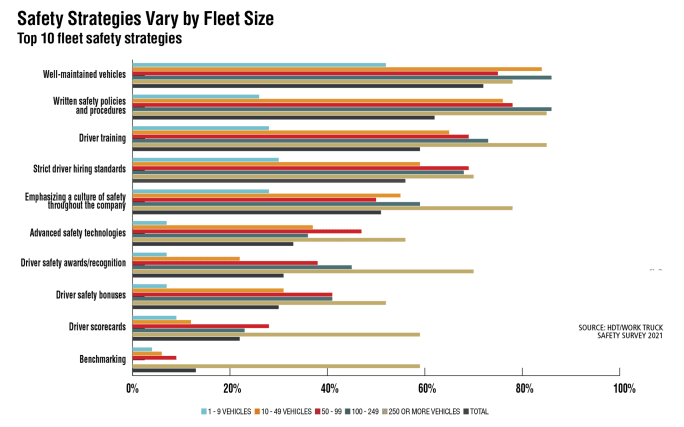
Not surprisingly, the results showed that the smallest fleets approach safety quite differently from the largest fleets. For instance, when asked about fleet safety strategies, fleets with fewer than 10 vehicles used these strategies considerably less than respondents as a whole. Larger fleets were more likely to cite driver training, advanced safety technologies, and driver safety awards/recognition than respondents as a whole.
Ad Loading...
Larger fleets in the HDT/Work Truck 2021 safety survey were more likely to pursue driver training and emphasizing a culture of safety as safety strategies than respondents as a whole.
Source: HDT/Work Truck Safety Survey 2021
Only about half of respondents said they emphasize a culture of safety throughout the company as a safety strategy, and that was much more common among fleets of 250 or more vehicles at 78%. Of the smallest fleets, only 28% checked off the safety culture option.
2020, of course, was anything but a typical year for fleets, and safety issues were no exception.
Lytx reports that compared to 2019, data from its video-based safety and analytics system indicated that truck fleet drivers had an increased number of posted speed violations, incomplete stops at stop signs, and failures to stop at stop signs. Areas that improved from the previous year included late response, following distance, red lights, unsafe lane changes, and drowsy driving.
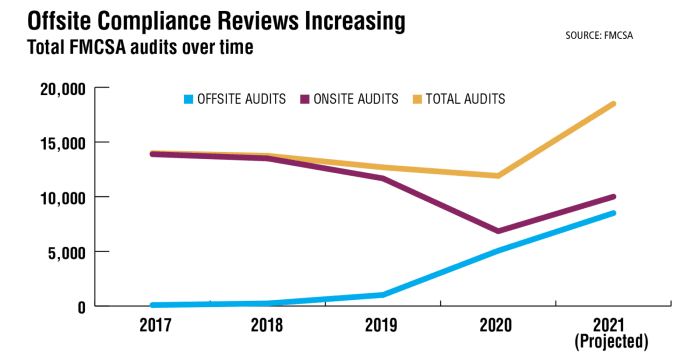
The Federal Motor Carrier Safety Administration ramped up its use of offsite audits during the pandemic, and that trend is expected to continue. Not only do they consume fewer resources, but they also allow the FMCSA to expand its enforcement reach — a goal the agency has been striving to achieve for years.
2020 also was the first year the electronic logging device mandate was fully in effect, and we saw the FMCSA change hours-of-service rules to make them more flexible. How are those playing out in the violation statistics?
Ad Loading...
“If you look at substantive hours of service violations (ie, driving beyond the allowable hours), we actually have seen a pretty decent decline in those violations since the ELD mandate, as compared with false log violations, which have risen — which is what you would expect,” says Brandon Wiseman, owner and president of Trucksafe Consulting. In 2020, he said, 14-hour violations dropped to 9,700 from 36,600 in 2017 and 30-minute rest break violations dropped from 51,000 to 10,000.
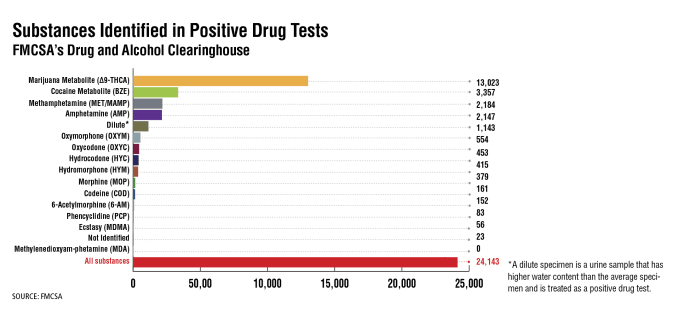
Last year was the first year for the FMCSA’s Drug and Alcohol Clearinghouse, which took effect Jan. 6. As of June 1 this year, there had been more than 80,420 test results reported to the clearinghouse, with drug tests accounting for 82% of total violations reported. Marijuana was by far the most common drug detected.
However, that clearinghouse does not include hair testing, which proponents say identifies many more drug users than urine-testing. Fleets that use hair testing last year found drivers testing positive for marijuana less than for cocaine and opioids.
Between the time the Drug & Alcohol Clearinghouse opened Jan. 6, 2020, and the end of May, 2021 (most recent report available), drivers tested positive more than 80,000 times, with marijuana by far the most common substance identified. (More than one substance can appear in a positive drug test.) 73,609 drivers had at least one violation, and more than 60,000 were in prohibited status as of June 1. More than 45,000 had not started the return-to-duty process, while 13,310 had completed it and were no longer in prohibited status.
Source: FMCSA
“Urine tests miss cocaine and opioid use because the timeframe for detection is small, compared to marijuana,” explains Lane Kidd, spokesman for the Trucking Alliance, which advocates for hair testing and other safety measures. “Hair testing catches the lifestyle users, who cannot refrain a few days before testing and avoid getting caught. If hair testing failures were accepted into the clearinghouse, the results would show cocaine and opioids leading in the drug test results and the seriousness of the drug abuse problem we have among too many truck drivers.”
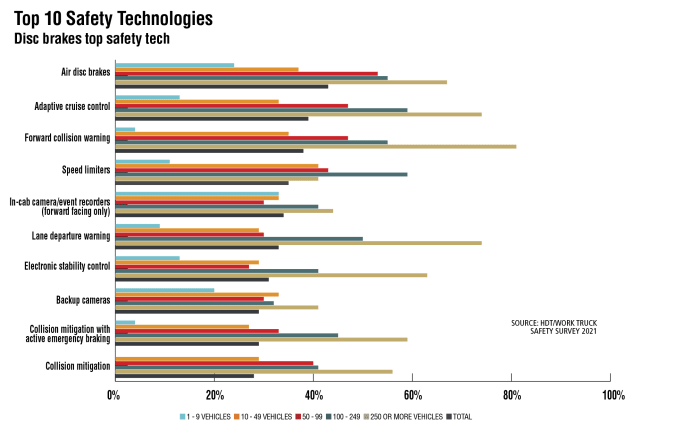
Forward-facing-only cameras have been more popular than those that face both forward and into the cab to monitor driver behavior, with 34% compared to 25% of fleets adopting.
Source: HDT/Work Truck Safety Survey 2021
Cameras are the most common safety technology fleets plan to adopt in the next year. For the largest fleets, however, 250-plus, distracted driving prevention/detection technology tops the list with 23%, far higher than the 9% overall.
Source: HDT/Work Truck Safety Survey 2021
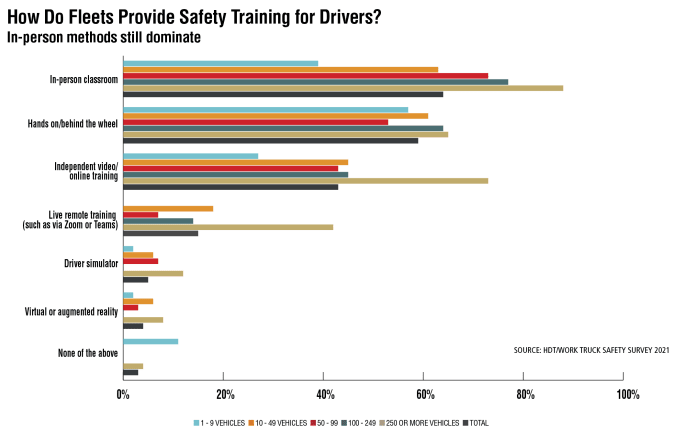
Nearly two-thirds of fleet professionals surveyed do in-person classroom-based driver safety training. Larger fleets are far more likely to do in-person classroom training, as well as more likely to use technology-based training solutions such as independent video/online training, live remote training, driver simulators, and virtual or augmented reality.
Source: HDT/Work Truck Safety Survey 2021
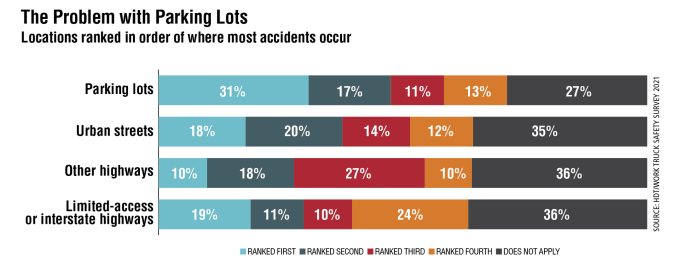
Parking lots appear to be more of a challenge for fleet respondents than other locations, with nearly half ranking it first or second when asked where the most accidents occur.
Source: HDT/Work Truck Safety Survey 2021
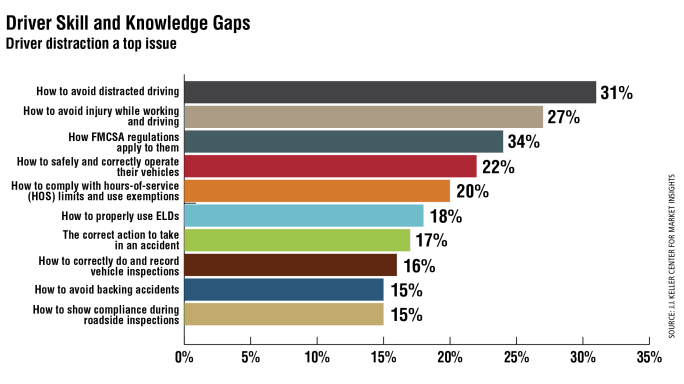
The number one driver knowledge/skill gap identified by fleet managers in a J.J. Keller survey was how to avoid distracted driving, which is also a top carrier issue identified in the American Transportation Research Institute's 2020 Critical Issues in the Trucking Industry report. Some “secondary” skills desired by fleet managers include driving in mountains and inclement weather, how to maintain a healthy lifestyle on the road, and how to know when they are too tired or sick to drive.
Source: J.J. Keller Center for Market Insights
FMCSA had already conducted close to 3,500 offsite reviews as of the end of May 2021, compared to approximately 4,000 onsite reviews during the same period. At this pace, the agency’s investigators are on track to perform nearly 8,500 offsite audits by the end of the year, a 68% increase year-over-year and a nearly 2,500% increase from 2017, according to Trucksafe Consulting.
Source: FMCSA
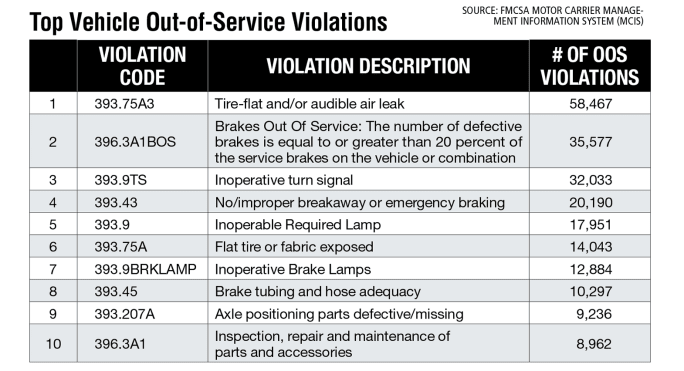
Looking at FMCSA’s top out-of-service equipment violations for fiscal year 2021 to date (as of mid-July), “Inoperative Brake Lamps” appeared in the top 10 list this year but not last year, perhaps because of CVSA’s Roadcheck focusing on lighting. Load securement, which was no. 8 last year, dropped out of the top 10 this year, with “Leaking/spilling/blowing/falling cargo” appearing at number 11.
Source: FMCSA Motor Carrier Management Information System (MCIS)
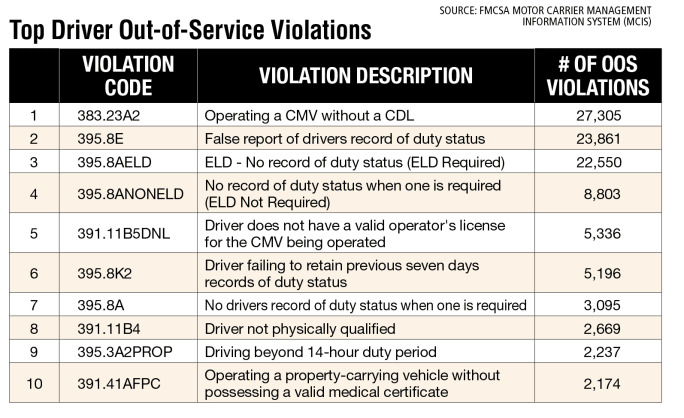
The most common driver out-of-service violations for fiscal year 2021 to date (as of mid-July) were similar to a year ago, with the top four OOS violations remaining the same. However, “Driver does not have a valid operator's license for the CMV being operated” moved up from number 7 to number 5, trading places with “No drivers record of duty status when one is required.” And appearing on this year’s top 10 but not last year was “Driving beyond 14-hour duty period.” Coming in at number 11 this year was “Driver on duty and in possession of a narcotic drug / amphetamine.”
Source: FMCSA Motor Carrier Management Information System (MCIS)
Trucking is an increasingly data-driven industry. Numbers matter. There’s no end to the available software and analytics available to fleets today to help them analyze and improve their operations.
But sometimes you want to look at statistics and data to help give you the big picture, and this is what Heavy Duty Trucking’s annual Fact Book issue is all about. It’s designed to provide a snapshot of the current state of the industry, where it’s been, and where it’s going. These numbers can help you in planning and benchmarking your fleet, and in telling trucking’s story to others. And it can serve as a reference guide throughout the year.
This is the seventh year for the HDT Fact Book. Check out the other published sections of the Fact Book:
Delaware and Maryland are the latest states to add requirements and fines for snow and ice removal on commercial trucks. But a flying-ice accident could cost a fleet more than a citation.
ATA's new roadmap calls for independent ELD certification, better fraud detection and closer oversight of providers. Here's how the proposed system would work.
Nearly 4,900 Freightliner, Western Star, and Kenworth trucks are being recalled because a missing snap ring could allow the driveline to separate from the truck.
FMCSA just removed a record number of electronic logging devices from its registry. ATA says it's time to rethink how ELDs get approved in the first place.
The annual 72-hour truck inspection blitz will take place May 11–13 across North America. Here's what fleets can expect and what inspectors found during the 2026 event.
Can trucking’s standard seven-way connector handle more cameras and trailer data? Grote’s Adam Slade shows HDT how the company is using new technology with its 4See trailer system, not only to add a new backup camera but also to expand other capabilities — without adding another connection.
PrePass Intelligence helps fleets measure bypass savings, flag potential toll overcharges, and spot suspicious transactions by combining data from separate systems.