




Tips for Cleaning and Sanitizing Truck Cabs
The best protection against COVID-19 is to assume it's everywhere and to take proper precautions, like washing your hands and cleaning surfaces – including in a truck cab.

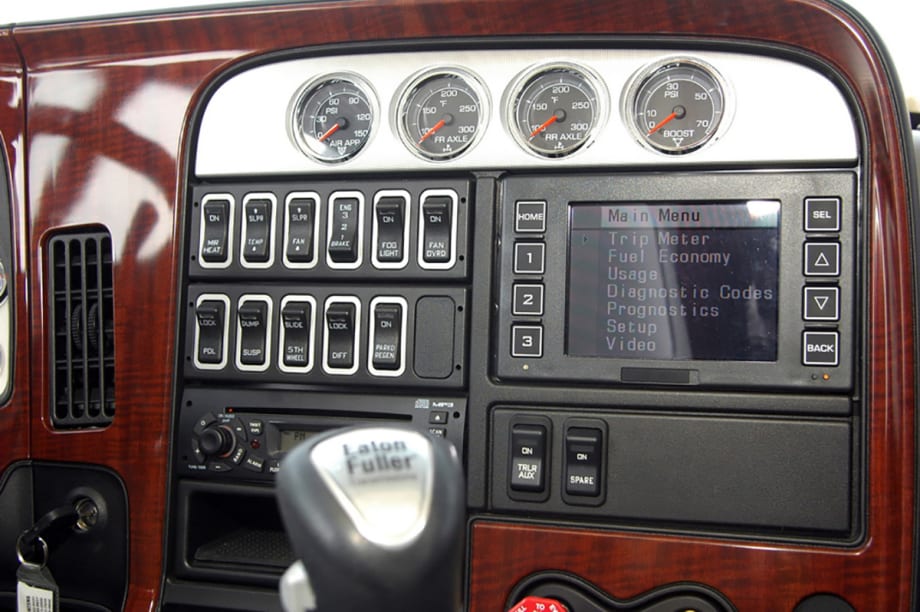
Areas frequently touched by drivers while they work should be cleaned and sanitized when a new driver starts work or a technician services the truck.
Photo: Jim Park
[UPDATED] How often did your mother remind to wash your hands after using the washroom and before sitting down to a meal? If you're like many people, those words now echo like a distant early warning siren, as handwashing has become the first line of defense against the novel coronavirus behind the COVID-19 pandemic, along with taking care in what you touch and sanitizing surfaces from kitchen counters to truck cabs.
"I guess I have changed some of my habits; I'm standing farther away from people, washing my hands more often, and being careful what I touch and how I open doors," said driver Gary Ebelhar, who was en route from Seattle to Los Angeles when we spoke on March 31. "But I'm not doing it all the time. It hasn't become a habit for me yet. It's not the normal I or anyone else is used too."
No, it's not normal, or routine behavior, yet. Nor is refraining from touching your face or rubbing your eyes when tired. Yet refraining from such contact is a recommended way of reducing the possibility of infection from the novel coronavirus. Reducing is the operative word here. There's no guarantee of prevention.
According to the Centers for Disease Control and Prevention, the virus is thought to spread mainly from person-to-person when they are in close contact with one another (within about 6 feet), through respiratory droplets produced when an infected person coughs or sneezes. CDC says these droplets can land in the mouths or noses of people who are nearby or possibly be inhaled into the lungs.
It may also be possible to get COVID-19 by touching a surface or object that has the virus on it and then touching your own mouth, nose, or possibly eyes. Current evidence suggests that the virus may remain viable for hours or even days on different surfaces. Depending on the source of the information, the virus can survive on porous surfaces like paper or cardboard for up to 24 hours, and on harder, less porous surfaces such as plastic, glass, or steel for 48 to 72 hours. Since there's no way to be sure when, if ever, a surface has seen the virus, your best assumption is that the virus is present, and therefore, you should wash your hands (or use an alcohol-based sanitizer if handwashing isn't possible) as soon as you can after touching something such as a door knob, an ATM keypad, or an ELD screen in a slip-seat truck.
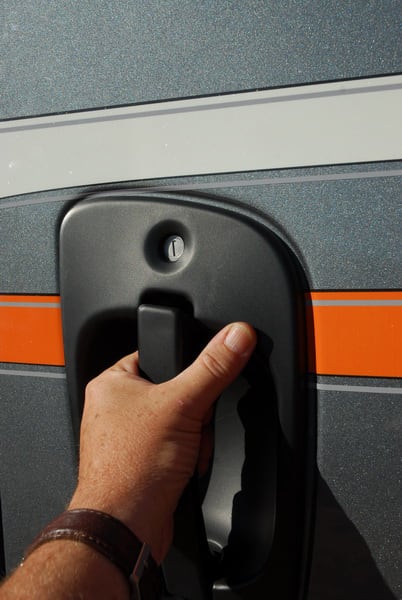
Alcohol or bleach solutions are best for rubbing out the virus on contact, but hot soapy works almost as well.
Photo: Jim Park
In fact, just about every surface inside the cab, even the door handles and glad-hands, could be a source of transmission. Even though CDC says physical contact with surfaces is not considered the primary line of transmission, it won't hurt to be cautious and wash up frequently.
How to Keep the Cab Clean
If you're a driver, before starting a driving shift, wipe down all the surfaces you're likely to touch with an appropriate cleaning product or hot soapy water. It may take an extra 10 minutes, but you'll make that up with the lack of traffic clogging the highways. Surfaces include the steering wheel, gear shift or selector, all driver switches and controls, door handles (interior and exterior), and glass. Don't forget to wipe down surfaces in the sleeper too. If you're a solo driver on a steady truck or your own truck, take the same precautions, although you may not need to be quite as vigorous.
Bedding and linens should be laundered regularly. CDC recommends using hot water and advises against shaking dirty laundry so as to avoid dispersing the virus through the air. Launder the laundry bag as well, or dispose of any garbage bags used to store dirty laundry.
For electronics such as tablets, touch screens, keyboards, etc., remove any visible contamination following the manufacturer’s instructions. Consider use of wipeable covers for electronics. If no manufacturer guidance is available, consider the use of alcohol-based wipes or sprays containing at least 70% alcohol to disinfect touch screens. To prevent damage, do not spray liquids directly on to the device and do not immerse them in cleaning solutions.
For Technicians
CDC says it is not known how long the air inside a room (in this case, the cab of a truck) occupied by someone with confirmed COVID-19 remains potentially infectious. Even if the driver has not had any symptoms, it has been reported that some people may be infected and contagious without showing symptoms. Leaving windows open prior to driving or servicing the truck might be advisable. At the very least, technicians should wear protective gloves or thoroughly wipe down surfaces that they are likely to touch while performing service on the truck, especially door handles, steering wheels, gear shifts, etc. And of course, they need to thoroughly wash their hands after the job is completed.
"They should be paying attention to the high touch points in the shop, such as telephones, touch screens, keyboards, and the like," says Joe Puff, vice president of truck technology and maintenance at NationaLease. "It's the same with trucks; the grab handles, steering wheels, and places that drivers touch all the time need to be properly wiped down as precaution. It's doesn't take much, and that little bit of effort can save lot of grief."
Recommended Cleaning Products
The Environmental Protection Agency has published a list of disinfectants that meets its criteria for use against SARS-CoV-2, the novel coronavirus that causes the disease COVID-19. It's a long list that includes dozens of commercial and industrial cleaning products as well as household products. These are disinfectants, as opposed to simple cleaning products. As disinfectants, there is some virus-killing capability, while common cleaning products may just transfer the virus from the surface to the rag or wipe. In either case, wipes and rags should be properly disposed of or laundered after use.
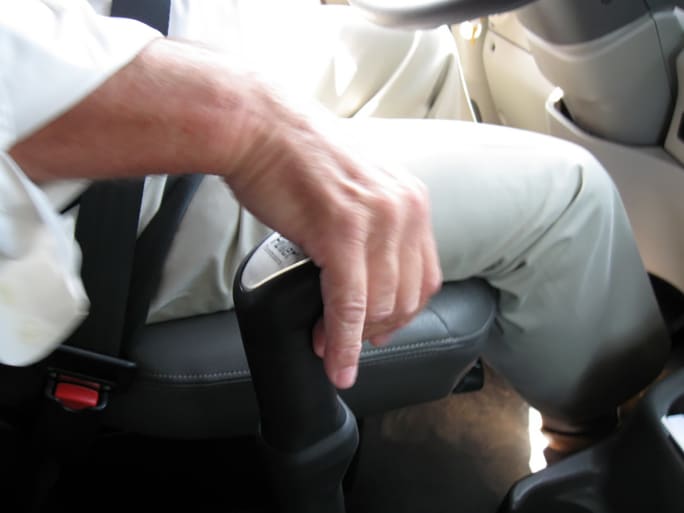
Gearshifts or selectors need to be wiped down frequently. Experts suggest spending at least a minute scrubbing the surface.
Photo: Jim Park
Many of the recommended products contain sodium hypochlorite, which is the main ingredient in laundry bleach. If the products listed on the EPA site are not readily available, a mixture of 5 tablespoons (1/3 cup) bleach per gallon of water or 4 teaspoons bleach per quart of water makes an effective substitute. It may not smell as nice as some of the store-bought product, but it will do the job. Never mix household bleach with ammonia or any other cleanser.
Consumer products usually come ready to use, but some commercial products may have to be diluted as per the manufacturer's instructions and allow proper ventilation during and after application. CDC recommends ensuring a contact time of at least one minute.
Bleach May Not be Best in a Truck Cab
One truck OEM issued a service bulletin late in March outlining recommended cleaning procedures that cautioned against using bleach in any form (wipes, ready-to-use spray, solution from concentrate). Although these documents normally are confidential to dealers, HDT obtained a copy after it was distributed to fleets in an unusual move. The bulletin also advised against using white spirit/paint thinner as a sanitizer. “[Both] will also cause damage to most surfaces,” it noted.
Instead, it recommends the following products for general cleaning and disinfecting, suggesting the surface should remain visibly wet for the duration of the contact time:
Ethanol wipes: 5 minutes
Lysol disinfecting wipes: 10 minutes
Lysol disinfectant spray: 10 minutes
DS1 Signet Neutral Disinfectant: 10 minutes
According to the OEM, soft surfaces such as cloth, vinyl, leather, and nonwoven materials must be cleaned with ethanol only. It says ammonia-based cleaning solutions such as Lysol brand non-bleach disinfectant wipes or ready-to-use spray, and hydrogen peroxide, must not be used to sanitize soft trims. Isopropyl alcohol must never be used on leather seats or leather steering wheels, use ethanol only.
For hard surfaces, the OEM recommends ethanol for the following cab areas:
Painted/surface treated plastics: e.g. deco trims, chromed accents, controls like knobs and buttons
Mold-in-color plastic surfaces: e.g. A/B pillars, non-leather steering wheels, plastic grab handles
Ammonia-based cleaning solutions such as Lysol brand non-bleach disinfectant wipes or ready to use cleaning spray, and/or ethanol may be used only on painted or enameled metal surfaces, such as exterior door handles, or on unpainted metal surfaces, such as exterior metal grab handles.
Additionally, the OEM named DS1 Signet Neutral Disinfectant as an alternative for washable hard, non-porous surfaces, such as:
glass surfaces
laminated surfaces
metal
stainless steel
plastic
chrome
enameled surfaces
Formica
vinyl (hard plastic ONLY – DS1 is NOT to be used on vinyl-covered upholstery: seats, walls, IP or DP parts, mattresses/cushions)
Public Spaces
Assume public surfaces could be contaminated. You should wipe down what surfaces you can, but that obviously impractical in many situations. Also, limit the time you spend in closed spaces in the company of others, and stay at least six feet apart at all times.
The bottom line is, take precautions and wash your hands thoroughly after touching any object of which you're unsure, and do not touch your face, put your fingers or anything else near your mouth, nose or eyes. And if you have to cough or sneeze, cover your mouth with a handkerchief or an arm or hand, and wash up afterward.
Hand sanitizer is not as effective as proper handwashing, but is recommended when you can't get to a sink. CDC says these should be alcohol-based products with concentrations of at least 60-70%. Products with lesser concentrations are not as effective, CDC notes.
Commercial sanitizer has been hard to obtain. There are loads of recipes online for making your own alcohol-based sanitizer, but many experts advise against it. They say it turns out too diluted, in which case it would be of little value. It could also be too strong, which could lead to injuries. In addition, the Commercial Vehicle Safety Alliance has reported some instances where homemade hand sanitizer could be perceived to run afoul of regulations regarding hazardous materials or alcohol in the cab.
Stay safe and help flatten the curve.
Editor's note: This story was updated April 8, 2020, to add information from a truck maker advising against the use of bleach to clean truck cabs.
More Safety & Compliance
A Camera Isn't a Safety Program. Here's What Brokers Are Screening for Now
Footage alone may not be enough to pass broker vetting processes. Here's what counts as a defensible safety program now.
Read More →
Marijuana and Trucking’s Drug-Testing Dilemma
Marijuana is getting stronger, laws are changing, and drug tests still can’t reliably establish impairment. What does that mean for truck drivers and the fleets that employ them?
Read More →
PrePass, Kodiak Connect Driverless Trucks to Roadside Enforcement
The system will allow enforcement agencies to verify Enhanced Inspection information and decide whether Kodiak’s autonomous trucks can bypass roadside screening sites.
Read More →

From One Generation to the Next: How Mentorship Builds Safer Truck Drivers
After three decades in trucking, Harold Perry shares what he's learned about driver safety, mentorship, and helping the next generation build confidence behind the wheel.
Read More →
FMCSA Pauses Biennial-Update Enforcement Amid Motus Transition
Carriers whose updates were due on or after June 1 have more time, while FMCSA works to stabilize its new registration system and warns of phishing sites impersonating its new carrier registration system, Motus.
Read More →
ZF Expands Commercial Vehicle Push in North America
ZF is expanding its North American commercial-vehicle presence with new transmission applications, electrification, trailer technology and autonomous-driving systems.
Read More →
Truck Drivers Need More Than Another Alert
Fleets have more visibility into truck health, safety events, and driver activity than ever. The next challenge is turning all that information into useful guidance for the person who has to decide what to do next.
Read More →
Tesla Wants a Self-Driving Semi. Are Cameras Enough?
Could Tesla’s camera-only autonomous driving technology work on an 80,000-pound Semi? In this commentary, HDT's Deborah Lockridge takes a look at Tesla, Cybercab, and how autonomous trucks see the road.
Read More →
What DOT’s Automated Vehicle Strategy Means for Trucking
The U.S. Department of Transportation issued a new automated-vehicle strategy that outlines plans for driverless-truck regulations, cross-state freight corridors, and federal safety standards.
Read More →
NYC Expands Speed, Pedestrian Safety Tech Across Fleet
New York City is expanding intelligent speed assistance and pedestrian-alert systems across its municipal fleet, moving the technologies from pilot programs into vehicle procurement and retrofit requirements.
Read More →