




TuSimple Expands UPS Autonomous Routes
TuSimple has expanded autonomous truck service for current customer UPS to 20 trips per week and has added an additional route between Phoenix, Arizona, and El Paso, Texas.

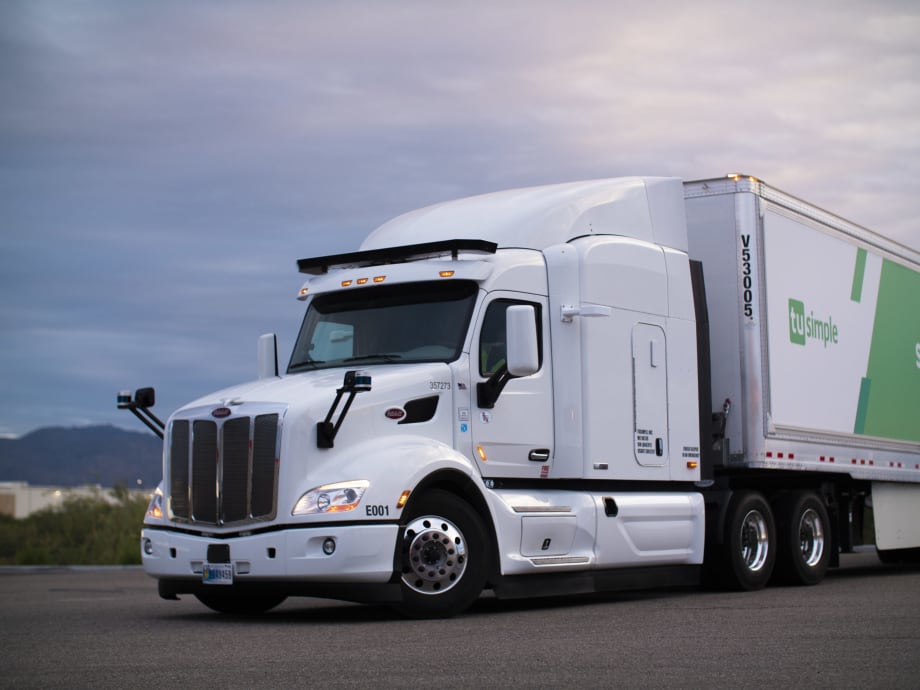
TuSimple has confirmed that its autonomous trucks are continuing to log a 10% fuel economy increase compared to conventional, human-driven tractor-trailers.
Photo: TuSimple
TuSimple, a global autonomous-driving technology company, has expanded autonomous truck service for current customer UPS to 20 trips per week. The company also added a route between Phoenix, Arizona, and El Paso, Texas. The company said 10 runs per week are on the new route; the other 10 runs are on an established route between Phoenix and Tucson, Arizona.
Autonomous trucks are achieving 10% fuel savings during operations for UPS when compared to traditional truck operation with human drivers, TuSimple said. Last December, TuSimple announced research results from the University of California, San Diego, that showed its autonomous driving technology significantly reduces the fuel consumption of heavy-duty trucks.
“We partnered with TuSimple to explore autonomous technology for our Global Smart Logistics Network, which aims to improve network efficiencies, safety, and customer service,” said UPS Chief Strategy and Transformation Officer Scott Price. “TuSimple has been instrumental to this initiative, so it was a logical next step for us to expand the test to additional routes within our North American Freight Forwarding lanes.”
UPS Ventures made a first-of-its-kind strategic investment in autonomous ground transportation when it invested in TuSimple in August of last year after a successful ongoing pilot program that started in March of 2019. The addition of a new route and an expanded number of runs is a vote of confidence for TuSimple, the copmany said, as it works to expand its autonomous capabilities and demonstrate the first driverless operation in 2021.
“UPS has been a valued partner of ours since we officially started working together early last year,” said Chuck Price, chief product officer, TuSimple. “This deep relationship shows the company’s commitment to innovation and exemplifies why UPS is considered a trailblazer when it comes to exploring and implementing cutting-edge technology.”
TuSimple is aiming to transform the $800 billion U.S. trucking industry by improving safety, increasing efficiency, reducing operating costs and carbon emissions. The company has 18 contracted customers and makes approximately 20 autonomous trips per day. Company officials have promised a true "depot-to-depot" driverless truck.
More Fuel Smarts

How Volvo Updated Its D13 for EPA 2027 [Watch]
Volvo’s updated D13 promises lower emissions without sacrificing performance or fuel economy. Take a closer look at what changed inside the engine in this HDT Spotlight video.
Read More →
Diesel Price Spike Shortens Payback for Natural Gas Trucks, Report Says
Energy Vision estimates fleets could recover the higher purchase price of an RNG-fueled Class 8 tractor in 1.3 to 2.8 years under current fuel-price scenarios.
Read More →
Calstart Becomes Catalyst Mobility, Reflecting Broader Focus
Calstart is now Catalyst Mobility, reflecting the nonprofit’s growing national role in clean transportation, including zero-emission trucks, infrastructure and incentive programs.
Read More →

Record Diesel Prices Squeeze Trucking Fleets
Average U.S. diesel prices have climbed to nearly $6 a gallon, surpassing the 2022 record as tight refinery capacity and Middle East disruptions keep fuel costs elevated.
Read More →
How Fuel Delivery Shapes Engine Performance
Fuel delivery depends on more than what happens at the injector. For fleet, maintenance and technical professionals, looking at the full path from pump to injector can provide useful context for understanding engine performance.
Read More →
East Coast Port Launches $45M Electric Truck Push
The Port Authority of New York and New Jersey announced millions in incentives for zero-emission drayage trucks, yard tractors, and new charging hubs near the port.
Read More →
California Bill Could Shed Light on Electric Truck Prices
Why do battery-electric Class 8 trucks remain so expensive? A California bill headed to Gov. Gavin Newsom would give fleets and state agencies more visibility into what manufacturers charge.
Read More →
Detroit Opens Orders for EPA 2027 Engines
Detroit isn’t starting from scratch to meet EPA 2027 diesel emissions standards. Its Gen 6 DD13 and DD15 engines keep much of today’s platform while updating the fuel and aftertreatment systems.
Read More →
Zero-Emission Truck Corridor Planned for West Coast
California, Oregon, Washington, British Columbia and Baja California are coordinating plans for truck charging and hydrogen fueling from Canada to Mexico.
Read More →
A Closer Look at Kenworth’s Electric T880E Vocational Truck [Video]
Learn more about Kenworth's T880E battery-electric vocational truck at the Paccar Technical Center, including its range, applications, upfitting considerations, and PTO options, in this HDT Spotlight video.
Read More →