




Scania Hails Positioning Accuracy Breakthrough for Autonomous Vehicles
Scania says new positioning technology leveraging the capabilities of the Galileo global navigation satellite system has achieved accuracy down to centimeter-scale levels for autonomous vehicles, allowing tricky maneuvers like merging.

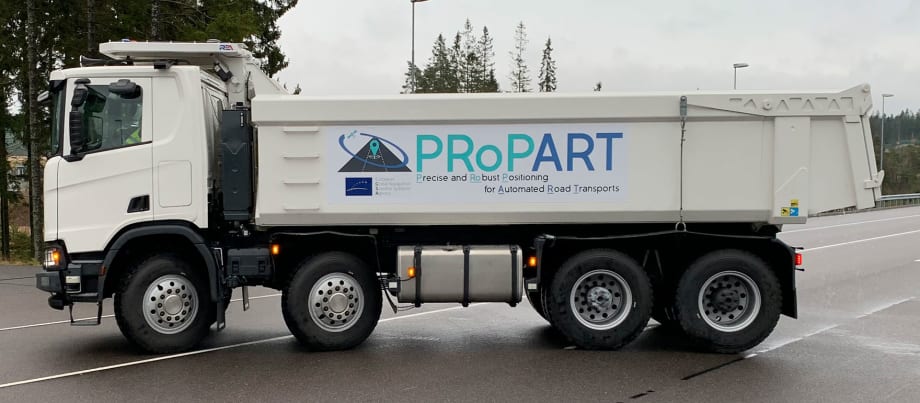
Scania said new technology tested in Europe has lead to a breakthrough in safely merging trucks under autonomous control.
Photo: Scania
Autonomous vehicles and advanced driver assistance systems need robust and precise positioning to enable reliable operations. This is especially important in the early transitional phase of the technology, when other vehicles on the road will not be automated.
Swedish truck maker Scania said that working with technology partners in Europe, it has achieved a breakthrough in enhanced positioning accuracy for autonomous vehicles, using the Galileo global navigation satellite system in combination with other positioning and sensor technologies.
This solution was developed as part of Europe’s Propart project – The Precise and Robust Positioning for Automated Road Transports research effort – which involves Scania and six partners.
The Propart technology project combines Real Time Kinematic positioning software from Waysure (Sweden) with satellite measurements from Fraunhofer IIS (Germany). The satellite positioning was augmented with an ultra-wideband ranging solution from Spanish research institution Ceit-IK4.
The company said it believes this technology could eventually become a key enabler for autonomous trucks in the future.
Centimeter-Level Positioning
The project’s vehicle positioning solution was recently demonstrated in a recreated motorway situation at the AstaZero test area in Sweden, with a connected autonomous truck and two unconnected manned cars.
The self-driving truck was supplied by Scania, with Hungary-based vehicle-to-everything communications company Commsignia providing the short-range communication technology. Baselabs from Germany provided sensor data fusion of onboard and roadside sensors and developed a situational assessment for the automated lane change maneuver. The project has received funding from the European GNSS Agency under the European Union’s Horizon 2020 innovation program.
As part of the test, a Scania self-driving truck executed a safe and efficient lane change in traffic. The maneuver was managed by the new system, relying on centimeter-level positioning combined with collaborative perception sensor data.
Scania said the project demonstrated that it was possible to pinpoint the position with 10-centimeter accuracy. The truck could execute the maneuver due to the precise positioning and an accurate representation of the whole surrounding environment. This was achieved by fusing data from the truck’s camera and front and side radars combined with radars mounted on roadside units.
Infrastructure-to-Vehicle Communications
“In addition to positioning, we’ve also added infrastructure-to-vehicle communications,” said Stefan Nord, project coordinator with Rise, a Swedish Research Institute, which coordinated the demonstration.
Ordinarily, Nord added, autonomous vehicles rely on their own sensors to interpret and process data on the surrounding environment. “If vehicles share information, you can extend their horizon and benefit from data from another vehicle to also look around the corner and thereby gather more data as a basis for manoeuvring decisions,” he said.
“In the project, we focused on achieving a positioning error below 20 centimeters in combination with an ambitious target integrity risk – that is, the probability of the position error exceeding this error limit," explained Fredrik Hoxell, development engineer for Scania Intelligent Transport Systems. “However, for deployment in real-life traffic situations, which tend to be much more dynamic and unstructured, there are of course many more vehicle and system characteristics and possible sources of errors that need to be handled.”
Hoxell noted that Scania is presently investigating several different positioning solutions. “Reliable and high-integrity navigation is absolutely essential when operating autonomous vehicles in uncontrolled environments. These trials offer one possible facet of the overall challenge related to navigation support on the journey towards safe and sustainable autonomous transport,” he said.
The merging demo is featured in this video from Propart partner The Fraunhofer Institute for Integrated Circuits.
More Safety & Compliance

Hours of Service Pilot Programs: FMCSA Readies for 2027 Rollout
Two pilot programs could eventually reshape hours-of-service rules, giving truck drivers options to pause their 14-hour clock or use longer split sleeper rest periods.
Read More →
New Guide Offers Pet Safety Tips for Truck Drivers
Hundreds of thousands of pets travel in truck cabs. A new safety guide from Volvo Trucks and the Center for Pet Safety offers practical advice for truck drivers who bring dogs and cats along for the ride.
Read More →
Medical Cards, English Proficiency Reshape Roadcheck Violations
Medical-card violations jumped to the top of the driver out-of-service list during CVSA’s 2026 International Roadcheck, while English-language proficiency violations appeared among the leading violations for the first time.
Read More →
How Lance Evans Turns Enforcement Experience Into Better Fleet Safety
HDT Truck Fleet Innovator Lance Evans brings lessons from law enforcement to K&B Transportation’s approach to safety technology, data, driver coaching, and compliance.
Read More →
New FMCSA Chief Safety Officer Has Trucking Industry and Law Enforcement Experience
Steve Dowling joins FMCSA after serving as senior director of safety at Covenant Logistics and in leadership roles in commercial motor vehicle industry organizations.
Read More →
Driver Trust Can Make or Break the Success of Fleet Safety Technology
New Teletrac Navman research suggests that onboarding, transparency about driver data, and positive feedback can play a significant role in how commercial drivers respond to safety and coaching technology.
Read More →
FMCSA: Stop Using These 15 Electronic Logging Devices
Fleets and drivers must replace the revoked ELDs with ones on the FMCSA's registered device list of electronic logging devices.
Read More →
How HDT’s 2026 Truck Fleet Innovators Are Rethinking Fleet Operations
Meet five trucking leaders who are challenging assumptions, solving operational problems, and putting innovative ideas to work.
Read More →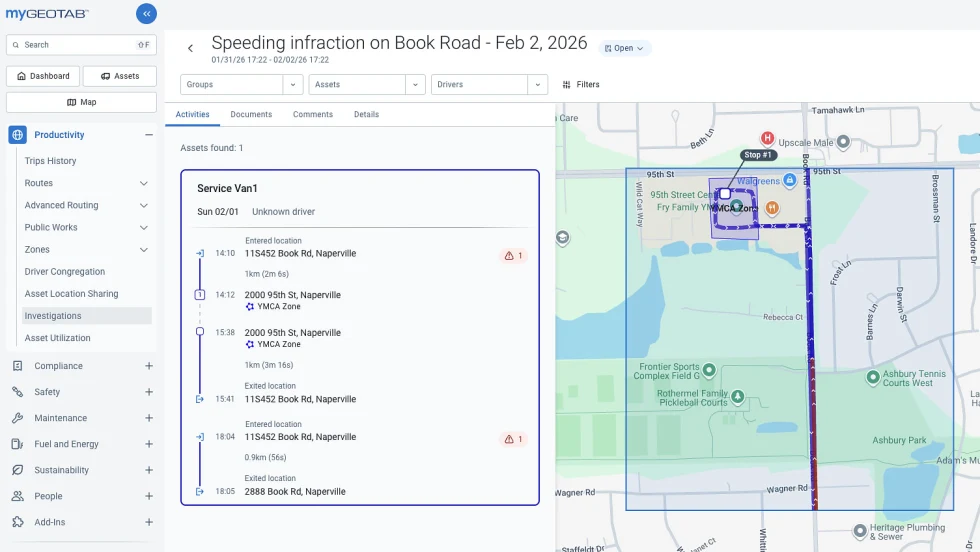
Geotab Launches Tool to Speed Fleet Incident Investigations
Geotab Investigations brings telematics data, video, photos, reports and other evidence into one case file to help fleets determine what happened and resolve incidents faster.
Read More →
FMCSA Moves to Codify English Language Requirements for Commercial Drivers
By changing regulations on English-language proficiency requirements for commercial drivers, rather than relying on a guidance memo, the FMCSA said future administrations won't be able to walk back the Trump administration's stricter enforcement with just a memo.
Read More →