





Related: Uber Freight Facility Insights Reinforce Need for Speed
Uber Freight: Facility Ratings Making a Difference
See what Uber Freight found out in its second Facility Ratings Report about how shippers can improve the experience at their facilities for truck drivers.
January 30, 2020
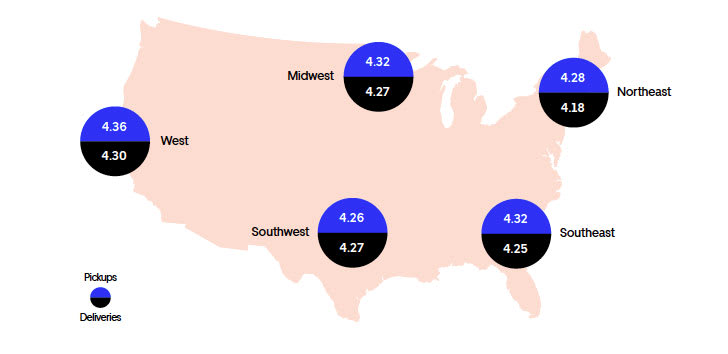
The West rated highest for both pickups and deliveries. The Southwest ranked lowest for pickups, while the Northeast ranked lowest for deliveries.
Image: Uber
3 min to read
Since Uber Freight released its facility ratings app feature last year, it has collected more than 500,000 ratings and over 115,000 reviews, and the company said the data is helping shippers address delays and other problems at shipping and receiving facilities that make driver experiences there unpleasant.
In its second Facility Insights Report, issued in January, it reported that drivers left the highest ratings when picking up and delivering on Sunday mornings. With an average rating of 4.46, pickups rated highest from midnight to 4 a.m. Deliveries had the highest average rating from 4 to 8 a.m., at 4.39.
Late afternoon and evenings were the worst time for ratings. From 4 p.m. to midnight on weekdays, the average facility rating for pickups was 4.22. For deliveries during this time window, the average rating was 3.99.
By far, wait time is the biggest factor in a facility’s rating, according to the report.
Weekday mornings showed the highest average wait times for pickups but some of the lowest for deliveries. Pickup wait times on weekdays from midnight to 8 a.m. ranged from 189 to 269 minutes. From 4 a.m. to noon, average delivery wait times ranged from 68 to 89 minutes.
Beyond Wait Time
However, Uber said, two additional themes emerged: treating drivers well and providing the right amenities. “Exhibiting respect and help during pickups and deliveries is an important consideration for driver and carrier favorability,” it advises shippers. “Clear communications and a bit of friendliness can go a long way.”
As far as amenities, restroom availability – especially for female – tops the list. Other niceties, such as vending machines and overnight parking, are also highly valued.
“We see shippers fostering stronger working relationships with carriers through shorter wait times and better facility amenities,” Uber said in a blog post about the latest report. “This, in turn, leads to carriers giving higher ratings, which leads to faster bookings, more return carriers, and lower accessorial costs.”
For instance, Uber Freight recently partnered with electronics giant LG to identify and improve lagging operations at one of its busiest facilities. Using facility ratings data from the Uber Freight platform, LG was able to cut wait times by over an hour, resulting in an average rating increase from 3.7 to 4.3, according to Uber.
New Facility Ratings Features
To continue improving the facility experience, Uber said it is rolling out some new app features:
Wait times: Estimated wait times for facilities included directly in facility detail pages so drivers have all the information they need to schedule and book loads with confidence.
Maps: More detailed information on entrance locations at facilities to make the load drop-off experience more streamlined.
Quick reviews: Additional feedback options to diversify and streamline facility ratings and reviews, leading to more accurate information for drivers and more robust data for shippers.
More Drivers

Hours of Service Pilot Programs: FMCSA Readies for 2027 Rollout
Two pilot programs could eventually reshape hours-of-service rules, giving truck drivers options to pause their 14-hour clock or use longer split sleeper rest periods.
Read More →
Medical Cards, English Proficiency Reshape Roadcheck Violations
Medical-card violations jumped to the top of the driver out-of-service list during CVSA’s 2026 International Roadcheck, while English-language proficiency violations appeared among the leading violations for the first time.
Read More →
Driver Trust Can Make or Break the Success of Fleet Safety Technology
New Teletrac Navman research suggests that onboarding, transparency about driver data, and positive feedback can play a significant role in how commercial drivers respond to safety and coaching technology.
Read More →
EEOC Sues KLLM Over Alleged Sex Discrimination in Driver Training
KLLM is facing a federal sex-discrimination lawsuit over policies the EEOC alleges put female truck driver trainees at a disadvantage.
Read More →
FMCSA Moves to Codify English Language Requirements for Commercial Drivers
By changing regulations on English-language proficiency requirements for commercial drivers, rather than relying on a guidance memo, the FMCSA said future administrations won't be able to walk back the Trump administration's stricter enforcement with just a memo.
Read More →
Drivers Put Western Star Trucks to the Test at Star Nation Experience
Watch to get an inside look at the Western Star trucks, technology, and community behind the Star Nation Experience 2026!
Read More →
Trump Administration Looks to Put More Veterans Behind the Wheel
The Freedom Haulers program pulls together existing and expanded programs at several federal agencies to recruit veterans to drive commercial heavy-duty trucks and cut the red tape for them to get a CDL, training, and employment.
Read More →
Putting Mack’s Command Steer to the Test
A test drive of Mack’s Command Steer active steering system evaluates how it can make truck driving easier and less tiring.
Read More →
Competition Heating Up for Truck Drivers
New report reveals rising driver hiring costs, the return of sign-on bonuses, growing AI advantages, and the operational factors shaping driver retention.
Read More →
How Fraley & Schilling Improved Logbook Compliance by Over 50%
Fraley & Schilling needed a way to close a compliance workflow gap in its ELD system without adding more work from driver training, reminders, and back-office follow-ups. It found the answer in a custom driver app.
Read More →