





From the 2015 archives: TransPower's Totally Electric Class 8 Tractor [Video]
Q&A: Meritor's T.J. Reed on TransPower and the Future of Electric Trucks
Meritor's T.J. Reed, global vice president of electrification, talks to HDT about the company's recent acquisition of TransPower and the state of electric commercial vehicles.
January 23, 2020
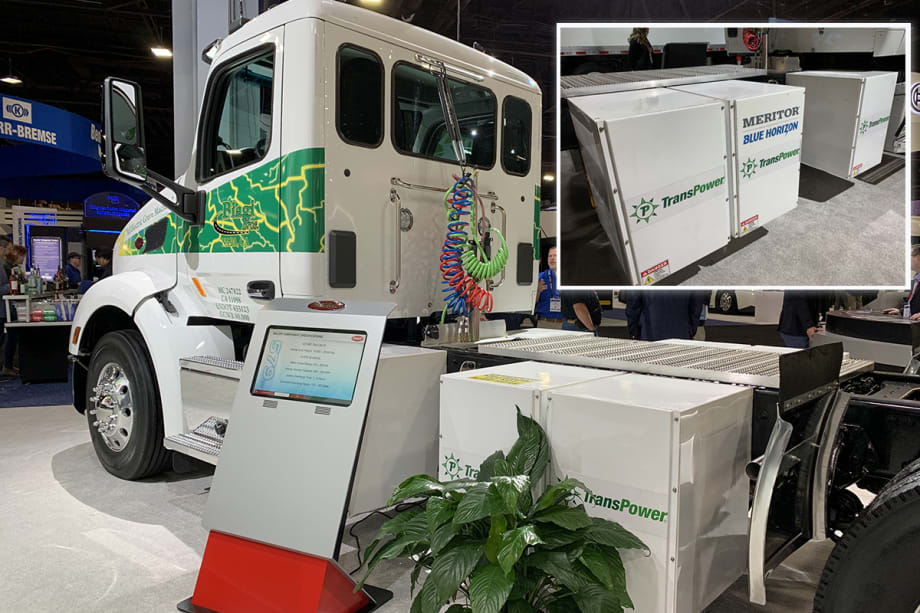
The TransPower/Blue Horizon technology was showcased on this Peterbilt electric truck at the North American Commercial Vehicle Show last fall.
Photo: Deborah Lockridge
6 min to read
Meritor has been making a big push the past couple of years in electric truck powertrain technology research and development with its dedicated Blue Horizon brand of components and vehicle control systems. The legacy automotive and truck component supplier kicked off 2020 by completing its acquisition of TransPower, a developer of advanced vehicle electrification systems, advancing Meritor's long-term plans to develop a full suite of electric truck, bus, and van components and drivetrains centered on electrification.
In this HDT interview, T.J. Reed, global vice president of electrification, talks about what the TransPower acquisition will mean for Meritor in both the short- and long-haul, and how he sees the current timeline for electric trucks playing out as 2020 gains steam.
HDT: We should start with your latest news – Meritor’s acquisition of TransPower. Why did you choose to go ahead and complete that merger now as the new year was beginning?
Reed: We don’t see electrification as a “party trick.” This is a global trend with viable technologies that can benefit commercial vehicle fleets everywhere. We’ve had this viewpoint for some time now, and early on as electrification gained traction, we began seeking dedicated partners we could work with to develop the new drivetrains that eventually became the core of our Blue Horizon product line.
HDT: So this relationship goes back several years?
Reed: Yes. We started working with TransPower in 2017. If you go back to 2016, nobody was really talking much about battery-electric trucks – certainly not in terms of detailed plans for developing this technology. But they were. And we kind of looked at our capabilities at the time and what we needed to do to accelerate our research and development on those fronts, and we started looking at companies that we could integrate our technologies with but that also have expertise in vehicle controls and capabilities in the commercial vehicle space. TransPower had all those attributes, as well as a proven capability to obtain and leverage grant dollars to prove this technology could work on commercial vehicles. So we felt like this was a natural fit virtually from the beginning.
HDT: And over time, that relationship has grown stronger as the technology has matured?
Reed: Yes. We’ve been working with them for the past two years on our Blue Horizon e-axles. They are the full vehicle integrator on this technology – able to take conventional vehicle chassis and put a fully electric drivetrain in. So there were many opportunities for us to collaborate as things progressed. And over the past two years, those mutual interests and goals accelerated to the point where were investing in them and acquiring shares. And, eventually, we saw this a good time to buy their remaining shares and bring them fully into our family of companies.
HDT: So, I guess you guys are “bullish” on electrification for electric trucks?
Reed (laughing): I see what you did there! Yes. We are very bullish on electric trucks for commercial vehicles, to use your term. We’re looking at the market now and expect to see adoption in three phases. And we think our customers are seeing things in a similar way: We are through the early stages of prototypes and proof of concept trucks and technology. We’re now moving into low-volume production and real-world evaluation trials that will prove out the concept in real world operations. And after that will come what we call series production.
HDT: So we’re not going to see full-on production and deployment this year?
Reed: There’s a lot of interest in the technology, and we’re just now starting to see demand ramp up. So the first customers seem to be taking trucks into service. And, for the most part, we see them trying two, three or four trucks out. And, of course, our immediate customers are the OEMs that are providing these trucks to the fleets. So they’re interested in all new sort of technologies as they come available. We want to be in position to serve them. But we also want to work with the fleets to learn more about the pull-through from their end of things with the technology.
HDT: What applications seem most promising to you for electric trucks right now?
Reed: I think we’re still looking at medium-duty applications for the most part. Refuse will be big. So will last-mile operations. That certainly seems to be where the bulk of the early adopters are coming from. So the initial trucks with a daily range of 100 miles and the ability to fully charge overnight seems to be the right starting formula.
HDT: What about long-haul electric trucks?
Reed: Long- and line-haul applications are different. But there’s work being done on those fronts. You see it now with grant money flowing to Paccar and the early builds they’ve done. Navistar and, certainly, Freightliner, are already putting equipment in the hands of real customers. As far as our planning goes, we’re developing a modular, flexible, platform. So our goal will be able to mix and match components and systems and technologies as the range expectations and capabilities scale up. But we want to focus on full vehicle validation right now.
HDT: What about the driver aspect of electrification?
Reed: We don’t see drivers as necessarily opposed to electric trucks. But if they’re familiar with diesel trucks, then they want the performance of an electric truck to be as good – if not better – than what they’re used to. And those are goals that are readily within our capabilities now. We can do things with shift calibrations and fine-tune our electric motors in ways that give us positive feedback from drivers who test out our technologies.
HDT: I have a gut feeling that – fuel costs aside – it may well be maintenance costs that make the early ROI arguments for electric trucks. Do you think that’s a valid prediction?
Reed: Well, if you do the math, it stands to reason. There are many fewer parts compared to a diesel truck, of course. But there are still of lot things we don’t understand. We need better data on how the systems perform in different climates and temperature extremes, for example. And we need to understand how the trucks’ drive cycles work much better. But, you know, we have a long, rear-view look back on diesel trucks. We understand them and how they perform as commercial vehicles very well now. And we’ll eventually get to that point with electric trucks as well.
HDT: Do you have any trucks with your technology out in the field now?
Reed: Yes. We have several Kalmar electric yard tractors out working now. Their T2E model started production last year. We’ve also got a grant funded to develop Peterbilt 220 EV medium-duty trucks for PepsiCo, as well as a Model 579EV that’s being developed for drayage operations as well as for some California municipalities. And we’re working with some pretty big names on these projects. So we expect to have news on these projects later on.
HDT: Meanwhile, it does seem like interest in this technology is starting to build.
Reed: I will tell you the interest is definitely there. I get inquiries – sometimes two or three – every week on this technology and when it will be available and what it will cost.
Subscribe to Our Newsletter
More Fuel Smarts

Record Diesel Prices Squeeze Trucking Fleets
Average U.S. diesel prices have climbed to nearly $6 a gallon, surpassing the 2022 record as tight refinery capacity and Middle East disruptions keep fuel costs elevated.
Read More →
Sponsored•September 9, 2026
How Fuel Delivery Shapes Engine Performance
Fuel delivery depends on more than what happens at the injector. For fleet, maintenance and technical professionals, looking at the full path from pump to injector can provide useful context for understanding engine performance.
Read More →
East Coast Port Launches $45M Electric Truck Push
The Port Authority of New York and New Jersey announced millions in incentives for zero-emission drayage trucks, yard tractors, and new charging hubs near the port.
Read More →

California Bill Could Shed Light on Electric Truck Prices
Why do battery-electric Class 8 trucks remain so expensive? A California bill headed to Gov. Gavin Newsom would give fleets and state agencies more visibility into what manufacturers charge.
Read More →
Detroit Opens Orders for EPA 2027 Engines
Detroit isn’t starting from scratch to meet EPA 2027 diesel emissions standards. Its Gen 6 DD13 and DD15 engines keep much of today’s platform while updating the fuel and aftertreatment systems.
Read More →
Zero-Emission Truck Corridor Planned for West Coast
California, Oregon, Washington, British Columbia and Baja California are coordinating plans for truck charging and hydrogen fueling from Canada to Mexico.
Read More →
A Closer Look at Kenworth’s Electric T880E Vocational Truck [Video]
Learn more about Kenworth's T880E battery-electric vocational truck at the Paccar Technical Center, including its range, applications, upfitting considerations, and PTO options, in this HDT Spotlight video.
Read More →
Kenworth T880E Brings EV Power to Vocational Trucks
A closer look at the Kenworth T880E’s range, charging, powertrain and upfit options — and where fleets are showing the most interest.
Read More →
Jennie Abarca Is Proving Electric Trucks Can Do the Job
HDT Truck Fleet Innovator Jennie Abarca is building confidence in fleet electrification one load at a time while openly sharing the challenges she encounters along the way as a small-fleet owner.
Read More →
Cummins Adjusts 2027 Engine Rollout After EPA Proposal
The engine maker will gradually introduce its new Model Year 2027 diesel engines while continuing to offer current models during the transition, citing the EPA's proposed emissions rule changes.
Read More →